

OpenAI Slashes GPT-5.6 Luna Prices by 80% to Beat Anthropic
OpenAI slashes GPT-5.6 Luna prices by 80% and Terra by 20%, adds 2.5x faster Sol mode just three weeks after launch

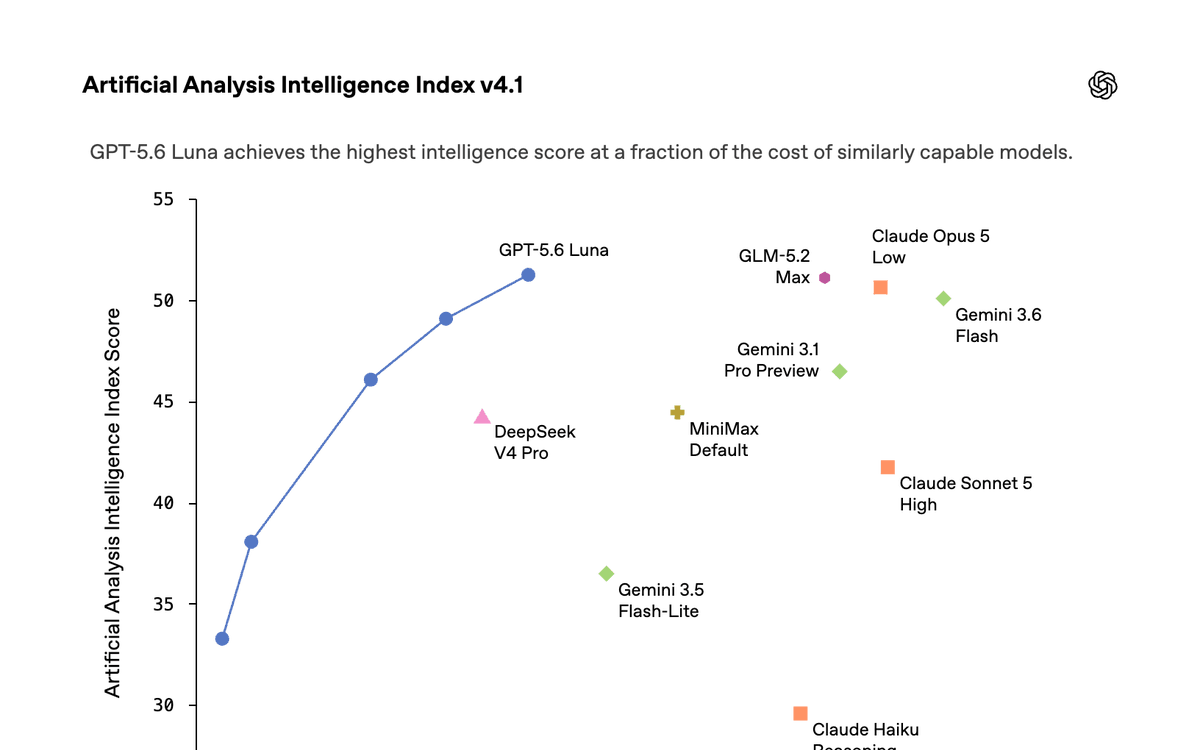
- Luna drops 80%: GPT-5.6 Luna now costs $0.20/$1.20 per million tokens (was $1/$6), effective immediately.
- Terra drops 20%: GPT-5.6 Terra falls to $2/$12 per million tokens; Sol price unchanged at $5/$30.
- Fast mode for Sol: New API option delivers 2.5x speed at 2x standard price, with no intelligence change.
- Auto-review upgrade: Codex CLI and ChatGPT Auto-review upgrade from GPT-5.4 to GPT-5.6 Luna, cutting cost ~10x.
- Competitive pressure: Cuts arrive just 3 weeks after GPT-5.6 GA launch, driven by efficiency gains and rivalry with Anthropic and DeepSeek.
- Agentic focus: Lower Luna/Terra prices directly reduce unit economics for high-volume agentic workflows in Codex and ChatGPT Work.
OpenAI just made its newest model family significantly cheaper, and it did so faster than almost anyone expected. Just three weeks after the general availability of GPT-5.6, the company is cutting prices for two of the family's three tiers, passing along efficiency gains it credits largely to GPT-5.6 Sol itself.
The numbers that matter
The cuts are not incremental. GPT-5.6 Luna, the fastest and lowest-cost tier, drops by roughly 80% -- it now costs $0.20 per million input tokens and $1.20 per million output tokens. That is a dramatic fall from its launch price of $1/$6. Terra, the mid-range tier, gets a 20% reduction, landing at $2 per million input tokens and $12 per million output tokens. The most powerful version, GPT-5.6 Sol, won't see a price cut.
Here is how the updated pricing stacks up against launch prices and the competition:
| Model | Input (old) | Input (new) | Output (old) | Output (new) |
|---|---|---|---|---|
| GPT-5.6 Luna | $1.00/M | $0.20/M | $6.00/M | $1.20/M |
| GPT-5.6 Terra | $2.50/M | $2.00/M | $15.00/M | $12.00/M |
| GPT-5.6 Sol | $5.00/M | $5.00/M | $30.00/M | $30.00/M |
A new gear for Sol
Sol is not getting cheaper, but it is getting faster. OpenAI is introducing a Fast mode for GPT-5.6 Sol in the API, which delivers up to 2.5x the speed of standard processing at 2x the standard price. The company says there is no change in intelligence -- you are paying for throughput, not a smarter model. For latency-sensitive pipelines, that trade-off will be worth it for some teams.
What this means for agentic workflows
The price cuts ripple into OpenAI's product layer in a meaningful way. OpenAI is upgrading the Auto-review feature in both the ChatGPT app and Codex CLI from GPT-5.4 to GPT-5.6 Luna. Combined with Luna's new price, the company says Auto-review will cost about 10x less than before. For teams running agentic coding workflows, that is a real change in unit economics.
GPT-5.6 is a model family made up of three tiers -- Sol (flagship), Terra (balanced), and Luna (fast and cheap) -- all sharing a 1 million token context window, 128k max output, and a February 2026 knowledge cutoff. The naming (sun, earth, moon) maps neatly to size, and OpenAI has confirmed the three tiers are distilled from the same base training run.
Why now, not later
OpenAI is in a heated battle with Anthropic and others for who can provide the best models -- but lately customers seem much more interested in price. Price cuts typically come months after a model launch. The fact that these are arriving just three weeks in signals that OpenAI is under real competitive pressure and has the efficiency headroom to act quickly.
Anthropic has been repeatedly extending its Fable 5 free trial period to retain users, and the competition has clearly shifted from pure performance metrics to pricing strategy and workflow lock-in. GPT-5.6 Sol still sits above Claude Opus 4.8 on output cost, while GPT-5.6 Luna is cheaper than Claude Sonnet 5's current $2.00 intro input rate. DeepSeek still undercuts everyone at the flagship tier on pure token price. The new Luna price changes that calculus significantly at the budget end.
The bigger picture on efficiency
OpenAI's framing is that GPT-5.6 Sol helped them find the efficiency gains that are now being passed on. That is a notable claim: the frontier model is being used to optimize the infrastructure that serves all three tiers. The frontier model release cadence has compressed to sub-60-day cycles, and every cycle, the intelligence available to automated tools goes up while the cost per token goes down.
Several analysts highlighted the agentic stack -- Work, Codex, multi-agent, programmatic tools -- as more strategically important than raw benchmark deltas. The price cuts reinforce that framing: OpenAI is making it cheaper to run more agentic calls, not just cheaper to run a single query.
Who wins from this
- High-volume API users running Luna for classification, summarization, or code review will see their bills drop dramatically -- up to 80% on the input side.
- Codex CLI users get a free model upgrade (GPT-5.4 to GPT-5.6 Luna) plus a 10x cost reduction on Auto-review, with no code changes required.
- Latency-sensitive teams can now pay 2x for Sol and get 2.5x the throughput via Fast mode, which may be a favorable trade for real-time applications.
- Competitors face renewed pressure. GPT-5.6 Luna at its new price is now cheaper than Claude Sonnet 5's current intro input rate, narrowing one of Anthropic's key value propositions at the mid-tier.
The one group that does not benefit directly is anyone already committed to Sol for frontier reasoning work -- its price is unchanged. But the broader message is clear: OpenAI is betting that making its cheaper tiers dramatically more affordable will drive volume, deepen platform lock-in through Codex and ChatGPT Work, and make the case that the GPT-5.6 family is the default infrastructure layer for agentic AI in 2026.
Comments
