
OpenAI's LifeSciBench Exposes Where GPT-Rosalind Still Fails Real Drug Discovery
OpenAI's new LifeSciBench tests AI on real drug discovery workflows — not just biology trivia — and GPT-Rosalind leads the pack with a 36% pass rate
Takeaways
- LifeSciBench launched: OpenAI released a new benchmark with 750 expert-authored tasks across 7 biological research workflows, built with 173 PhD scientists.
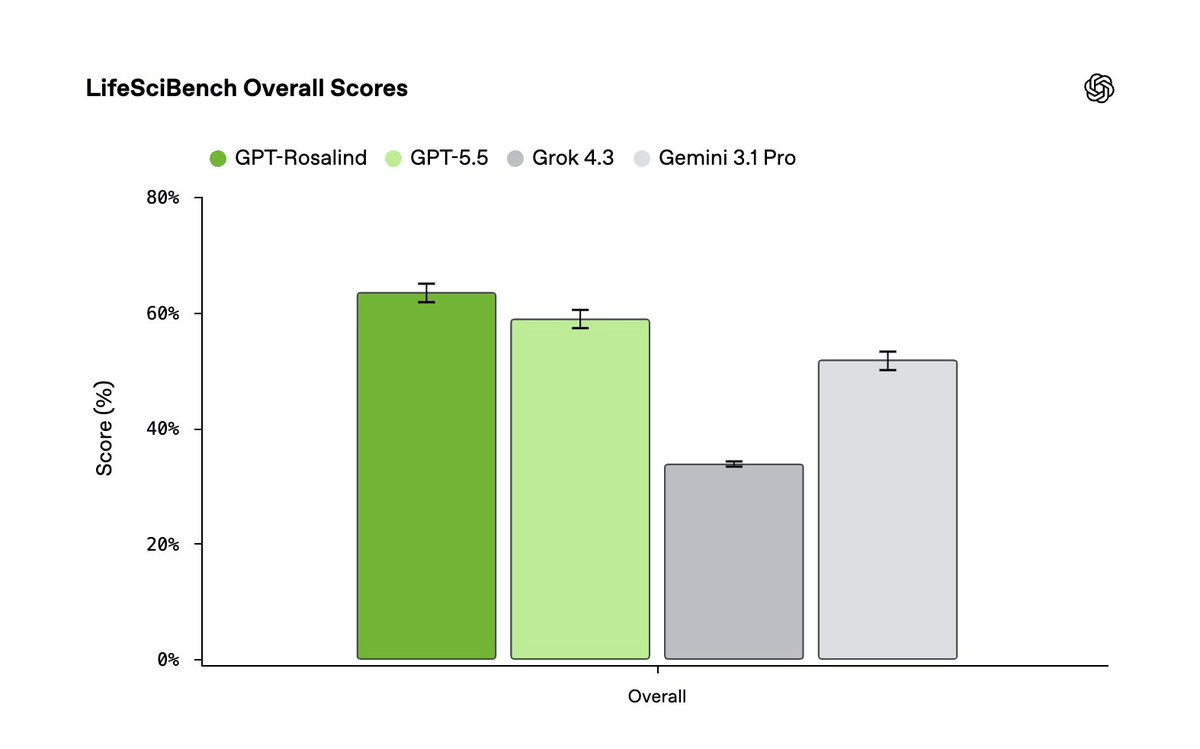
- GPT-Rosalind leads: GPT-Rosalind scores a 36.1% pass rate vs. GPT-5.5's 25.7%, also outperforming Grok 4.3 and Gemini 3.1 Pro.
- Real-world design, not trivia: 53% of tasks require working with scientific artifacts (figures, PDFs, sequence files); 79% require multi-step reasoning.
- Clear weaknesses remain: Pass rates drop to 14.8% on numeric tasks and 28.1% on artifact-heavy tasks — exact outputs like CRISPR designs still fail often.
- Gated access: GPT-Rosalind is in research preview for eligible orgs (Amgen, Moderna, Novo Nordisk); apply at openai.com.
- Benchmark is open: The preprint and contributor program are publicly available for the community to expand the dataset.
Biology benchmarks have a dirty secret: frontier models are acing them. GPT-5 reached 95.84% accuracy on MedQA and 95.22% average across all USMLE steps , numbers that far exceed typical human passing thresholds. But none of that means an AI can actually help a scientist design a drug. OpenAI is now trying to fix the measurement problem with LifeSciBench, a new benchmark built from the ground up to reflect what real life science research actually looks like.
LifeSciBench was designed to close the gap between narrow skill tests and realistic research work. Every task is grounded in the judgment of practicing life scientists with Ph.D.-level training and direct experience advancing drug discovery programs in biotech and pharmaceutical settings.
Why existing benchmarks miss the point
The problem with benchmarks like GPQA and MedQA is that they test isolated knowledge retrieval. Any fixed benchmark eventually gets trained against, either explicitly through data contamination or implicitly through the general capability improvements that labs are optimizing for. More fundamentally, they ask questions with clean, structured answers , which is almost never how real research works.
Agentic AI systems are becoming increasingly capable of performing scientific tasks, but their usefulness to life science researchers depends on how well they handle the complexity of real research. That work rarely looks like a single fact-recall question or a clean prediction problem. Researchers interpret incomplete evidence, reconcile conflicting results, design difficult experiments, troubleshoot assays, evaluate translational risk, and decide what to do next under uncertainty.
750 tasks, 173 scientists, 19,020 rubric criteria
LifeSciBench includes 750 expert-authored tasks spanning seven workflows and seven biological domains. The scale of the construction effort is notable: tasks were created by 173 expert scientists, each with Ph.D.-level training and biotechnology or pharmaceutical industry experience. Tasks could undergo as many revision cycles as needed before acceptance, averaging six self-directed automated review cycles and at least two rounds of expert reviews, with at least 90% agreement among reviewers in the relevant domain.
The seven workflow categories the benchmark covers are:
- Evidence Handling , extracting and reconciling findings from papers, figures, and experimental records
- Analysis , interpreting data and drawing domain-grounded conclusions
- Design, Optimization, and Prediction , proposing experiments, constructs, or molecules
- Scientific Reasoning , multi-step inference under uncertainty
- Validation and Operations , troubleshooting assays and wet-lab protocols
- Translation , connecting preclinical evidence to clinical implications (bench-to-bedside)
- Scientific Communication , producing expert-facing explanations and summaries
What makes this harder than a typical benchmark is the artifact requirement. The benchmark includes 1,062 attached artifacts spanning figures, PDFs, tables, sequence files, structure or chemical files, and web references. More than half of tasks (53%) require models to interpret or synthesize information from at least one artifact. Models can't just recall facts , they have to work with real scientific files.
Grading like a scientist, not a test machine
The grading system itself is a departure from standard benchmarking. LifeSciBench tasks are graded with a detailed, task-specific rubric that breaks down the expected response into specific scientific claims, calculations, decisions, and justifications. Across the benchmark, expert-developed rubrics include 19,020 criteria , an average of 25 per task , to assess both scientific correctness and usefulness for research decisions.
This design reflects how scientific work is evaluated in practice: many life science tasks cannot be graded by checking the final answer alone. A response may reach the correct high-level conclusion but still be judged incomplete if it overlooks a key assay limitation or fails to proactively bring up a highly consequential biological nuance. Two complementary metrics are reported: pass rate (percentage of tasks meeting a 70% success threshold) and score (average rubric reward, giving partial credit for individual criteria).
Where GPT-Rosalind leads , and where it falls flat
Frontier models are relatively strongest on tasks involving scientific synthesis, communication, and structured interpretation. GPT-Rosalind shows meaningful progress over GPT-5.5, improving overall exact pass rate from 25.7% to 36.1%. The overall LifeSciBench scores show that GPT-Rosalind currently outranks other AI models like GPT-5.5, Grok 4.3, and Gemini 3.1 Pro.
The strongest gains are in the highest-value scientific tasks:
- Scientific Communication pass rate increases from 56.3% for GPT-5.5 to 71.1% for GPT-Rosalind
- Translation rises from 36.8% for GPT-5.5 to 57.7% for GPT-Rosalind, suggesting rapid improvement in connecting preclinical evidence to clinical implications
- On tasks requiring expert-useful or actionable outputs, GPT-Rosalind scores 44.7%, compared with 29.1% for GPT-5.5
But the gaps are just as telling. Performance remains much weaker on artifact-heavy, design-heavy, and operationally constrained scientific work. Design, Optimization, and Prediction remains one of the hardest workflows, with GPT-Rosalind pass rate at 30.7%; Analysis is similarly difficult at 30.3%.
Artifact use is a particularly clear gap. GPT-Rosalind's pass rate drops from 45.1% on text-only tasks to 28.1% on tasks with artifacts or URLs. GPT-5.5 shows the same pattern, dropping from 29.9% to 21.9%. Exact outputs are even harder: GPT-Rosalind reaches only 14.8% on numeric tasks and 24.0% on sequence or structure outputs. For tasks like CRISPR donor design or siRNA design, where the output needs to be directly usable, this is a meaningful limitation.
The benchmark is also a compass for GPT-Rosalind's development
LifeSciBench was designed to measure and continuously improve the real-world impact of GPT-Rosalind. Unlike existing benchmarks that evaluate a single component of model performance or biological domain in isolation, LifeSciBench takes an end-to-end view of scientifically valuable work. It's not just a leaderboard , it's the internal compass OpenAI is using to steer the model's development.
When GPT-Rosalind launched in April 2026, OpenAI named Amgen, Moderna, the Allen Institute, and Thermo Fisher Scientific as early partners. OpenAI has since expanded research preview access, naming Novo Nordisk as one of the organizations using the life sciences model to support medical research. Access is gated: GPT-Rosalind is available in research preview through OpenAI's trusted access deployment structure for organizations that conduct legitimate scientific research with clear public benefit, have strong governance and safety oversight, and maintain controlled access with enterprise-grade security.
What this means for the field
The deeper implication here is a shift in how the industry should think about AI capability in science. High scores on GPQA or MedQA no longer tell you whether a model can be a useful research collaborator. Unlike existing AI benchmarks that test isolated capabilities, LifeSciBench evaluates end-to-end scientific workflow performance, making it harder to game through narrow capability optimization.
The scores confirm GPT-Rosalind outperforms GPT-5.5 across medicinal chemistry, genomics, and wet-lab support , but absolute pass rates remain modest, ranging from 21.6% on the most complex genomics tasks to 63.2% on wet-lab protocol support. The scores represent meaningful acceleration for expert researchers, not autonomous drug design.
LifeSciBench is a step toward measuring how useful AI systems can be for life science research, but it is not a substitute for studying models in live research environments. Strong performance on LifeSciBench should be interpreted as evidence of realistic task-level capability, not as a direct measure of downstream research impact. The next step, OpenAI says, is connecting benchmark performance to deployment studies in live research workflows , measuring whether AI actually accelerates discovery over longer time horizons.
The benchmark dataset and the paper are publicly available. Organizations interested in contributing tasks or requesting access to GPT-Rosalind can apply through OpenAI's contributor form or access request page. The full technical writeup is available as a preprint on OpenAI's site.