

OpenAI's Images 2.6 Generates 4B Weekly Images 32% Faster With Native GIFs
OpenAI's Images 2.6 adds native GIF generation, reusable reference images, and two API models that cut generation time by nearly half.
- OpenAI released ChatGPT Images 2.6 with native GIF generation from text or photo prompts
- Users can adjust GIF speed and edit individual frames in-chat before sharing
- Reusable reference images let you save characters, pets, and people to reuse across prompts
- Two new API models: GPT-Image-2.6 Flare (6 second generation, 46% faster) and Sunburst (higher quality)
- Image markup and SVG export added for refinement and vector output
- Available across all tiers in ChatGPT and Codex on web, desktop, mobile
OpenAI has updated its image stack to Images 2.6, adding native GIF generation, reusable reference images, visual markup, SVG export, and two API models tuned for different workloads.
According to the company’s release announcement, ChatGPT and the API now generate more than 4 billion images each week, up from 3 billion in September. The additions reduce several external steps in image workflows, including frame stitching, repeated reference uploads, vector tracing, and prose-only edit instructions.
Native GIFs arrive in ChatGPT
ChatGPT can create an animated GIF from a text prompt or uploaded photo, change its playback speed, and edit individual frames. Earlier workflows required users to generate frames separately and combine them in another application.
OpenAI’s “cat dancing” example shows the model producing related variations of one character and assembling them into a flipbook-style loop. Improved subject consistency keeps the character recognizable across frames. Because the feature builds animation from related still images without a continuous temporal model, complex motion, physical interactions, and scenes with several subjects may produce visible artifacts.
References rein in asset drift
Users can save reference images for characters, pets, mascots, and other recurring subjects, then retrieve them from a library for later prompts. The saved asset gives the model a stable visual reference across editing sessions.
Reference reuse should help with brand assets, storyboards, product concepts, and avatars, where repeated uploads add friction and successive edits can alter defining features. Results may still vary across generations, so workflows requiring exact geometry or brand compliance will need review.
Flare cuts latency while Sunburst favors consistency
OpenAI splits the API release between Flare for lower latency and Sunburst for stronger edit consistency, continuing the two-model strategy used in Images 2.5.
| Model | Priority | Best suited to |
|---|---|---|
| GPT-Image-2.6 Flare | Generation speed | Interactive interfaces, high-volume requests, and latency-sensitive applications |
| GPT-Image-2.6 Sunburst | Quality and edit consistency | Product imagery, character studies, and assets that require several revisions |
OpenAI’s published Flare benchmark shows generation time falling from 7.08 seconds with Images 2.5 to 4.84 seconds with Images 2.6. That represents about a 32% reduction in elapsed time, or roughly 46% more images produced over the same period.
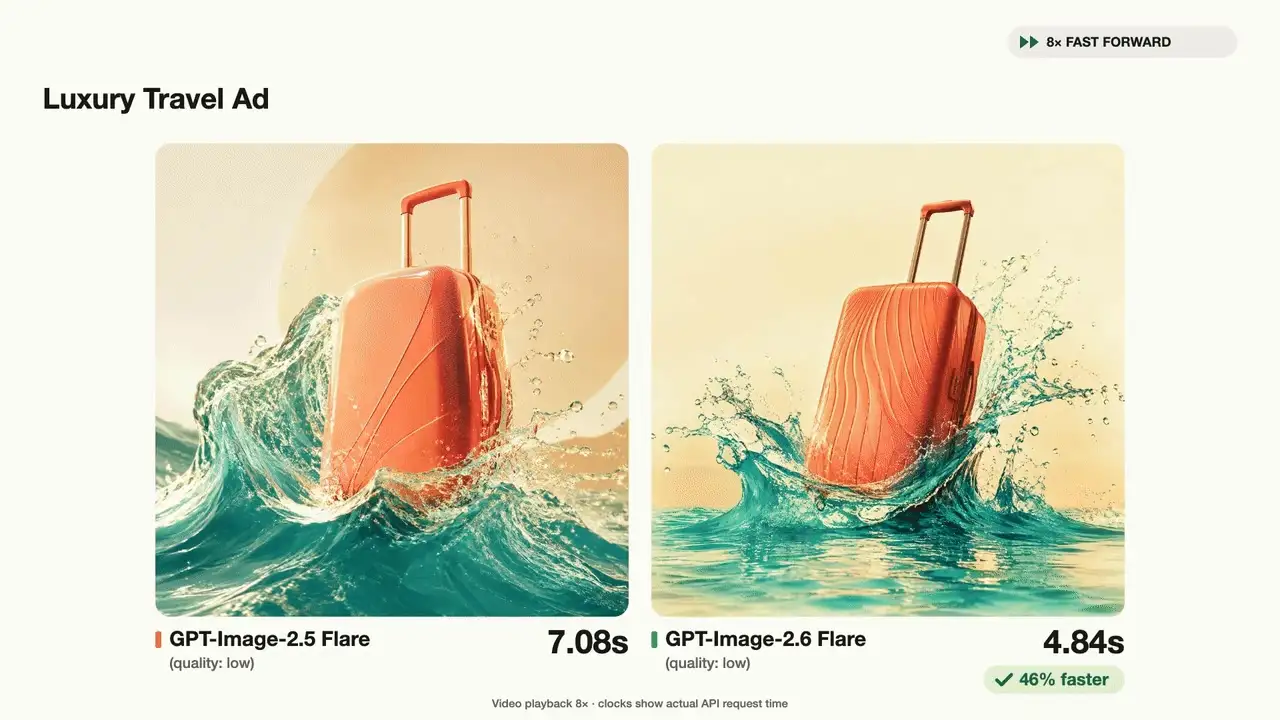
Sub-five-second generation can support inline image creation within chat replies, editors, and loading states. Production latency will vary with image dimensions, request volume, network conditions, and service load, so teams should benchmark their own request mix.
Markup gives edits a target
Image markup lets users annotate a generated asset and identify the region that should change. A visual instruction such as circling a logo position can provide clearer spatial guidance than describing the same edit entirely in text.
SVG export produces vector assets that can scale without raster pixelation, making it useful for logos, icons, and simple illustrations. Generated vectors may still require inspection for excess paths, malformed shapes, typography substitutions, and inaccessible structure.
Rollout, pricing, and open questions
OpenAI says the image features are rolling out to ChatGPT and Codex users, with ChatGPT access on web, desktop, and mobile. GIF generation has no separate paywall, although existing account-level usage caps still apply. Codex now shares usage limits with ChatGPT.
Flare and Sunburst are available through the API. The announcement does not include a new price sheet, so developers will need current API pricing and account limits before estimating production costs.
Details still unspecified
- Maximum GIF duration, frame count, dimensions, and file size
- GIF response formats and controls available through the API
- Reference-image retention, deletion, and data-handling behavior
- Rate limits and concurrency limits for Flare and Sunburst
- SVG feature support, including text, gradients, masks, and embedded raster content
Fewer steps in the image pipeline
Images 2.6 brings several common production tasks into one workflow: generating short animations, reusing visual references, marking edit regions, and exporting vectors. Flare’s lower latency also makes synchronous image generation more practical for applications that previously relied on pregenerated assets or background jobs.
Flipbook GIFs remain best suited to short loops, reactions, and stylized motion because frame-based generation can struggle with physical continuity and interacting subjects. Sunburst’s consistency and the reference library reduce drift, but applications with strict visual requirements will still need validation, retries, and human review.
Comments
