
OpenAI's GPT-6.2 Designs Real Proteins That Bind Drug Targets in the Lab
OpenAI's GPT-6 family designs new proteins using only reasoning and code, with wet-lab tests confirming binding across five targets.
Takeaways
- OpenAI's GPT-6 family designs proteins using only reasoning and code, no specialized biology models required.
- Wet-lab tests with Onava: 35 of 322 designed minibinders bound to all 5 targets including PD-L1 and VEGF-A.
- Redesigned antibody fragments retained binding in 179 of 272 cases (66%), a strong affinity-maturation signal.
- On MotifBench, latest internal model hit 43.7% vs 27.8% for RFdiffusion; docking beats DiffDock by 30+ points.
- Still relies on ESMFold2, Boltz-2, and ProteinMPNN for filtering; full structure prediction remains a weak spot.
- Preprint available; researchers can guide designs via natural-language prompts specifying shape, bonds, and binding sites.
OpenAI says its GPT-6 family can perform several protein-design tasks through natural-language reasoning and generated Python code. In wet-lab experiments with research partner Onava, GPT-6.2 contributed designs that produced 35 binders among 322 candidates across five protein targets. A separate sequence-design experiment yielded 14 binders among 107 tested proteins.
The OpenAI preprint, titled GPT-6 as a Universal Foundation Model for Protein Biology, has not been peer reviewed. Its results establish binding in specified assays. They do not establish therapeutic effects, safety, or performance in living organisms.
One prompt spans atomic and protein-scale constraints
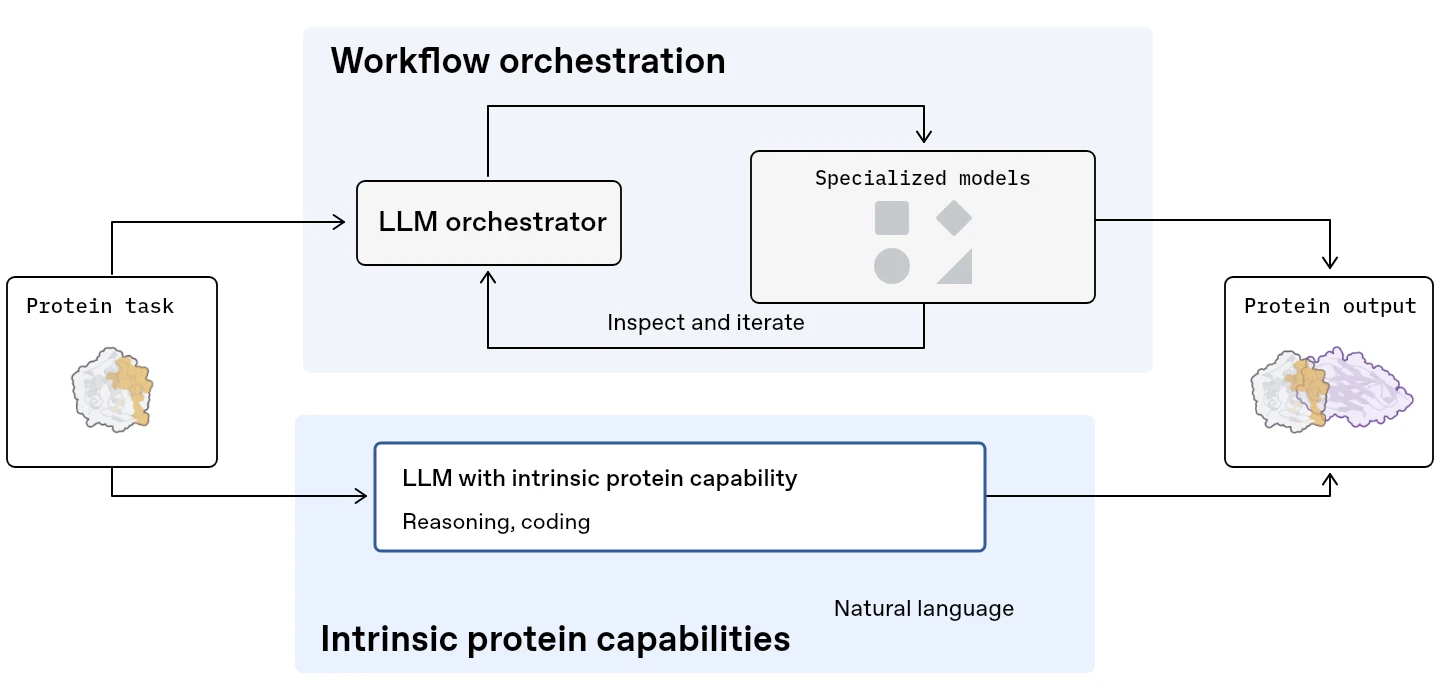
Protein-engineering pipelines usually combine several specialized systems. Backbone generators propose a protein’s three-dimensional geometry, sequence models choose amino acids, structure predictors estimate whether the sequence will fold as intended, and docking tools evaluate interactions with a target. Each component accepts particular inputs, which makes unusual constraints difficult to add without custom software or retraining.
In the reported experiments, researchers used prompts to specify constraints ranging from a bond between two atoms to the overall shape of a protein. GPT-6.2 predicted how small molecules bind, generated candidate protein backbones, and wrote Python to explore structural options. When researchers supplied the atoms involved in a known bond, the model used that information to position the rest of the molecule. Moving between tasks required new prompts rather than task-specific model training.
The wet lab yields binders across five targets
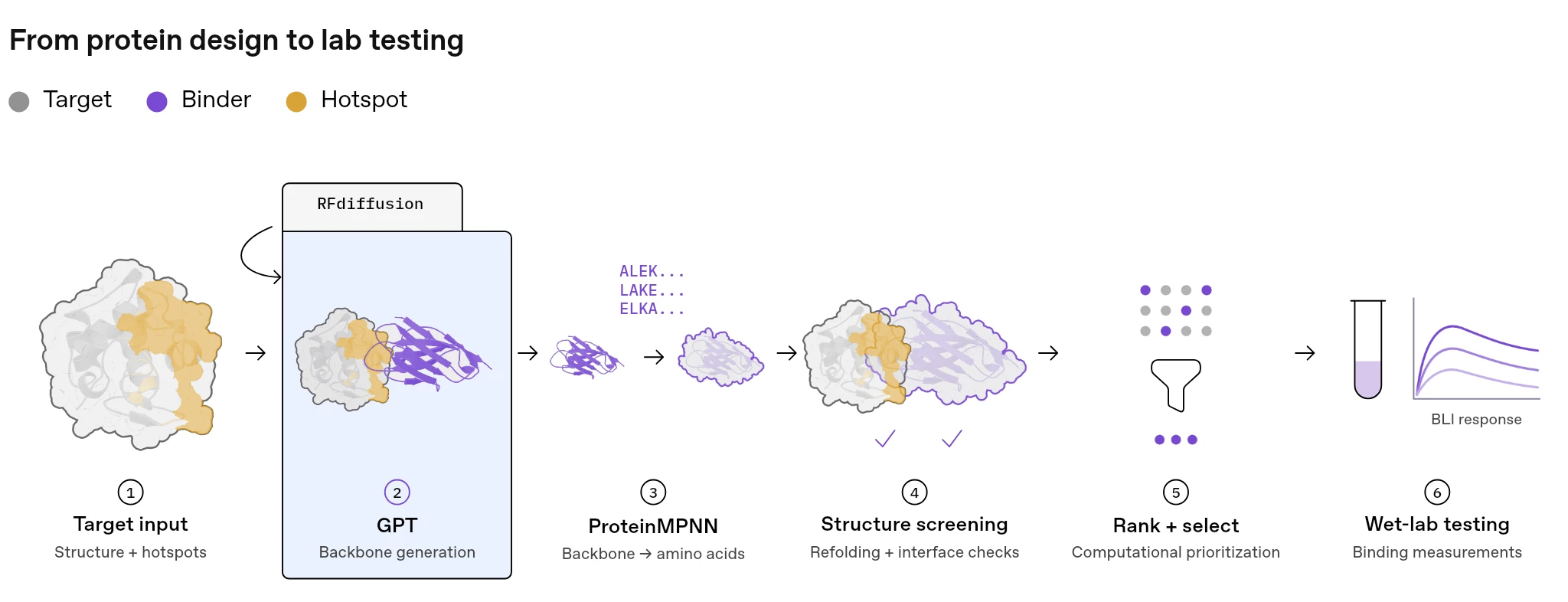
Onava’s first experiment gave GPT-6.2 the three-dimensional structures of five target proteins and markers identifying the desired binding sites. The model generated code to create candidate minibinder backbones, which are compact proteins engineered to attach to larger targets. SolubleMPNN then assigned amino acid sequences, and additional computational tools filtered the candidates before laboratory testing.
| Target | Positive binders |
|---|---|
| PD-L1 | 5 |
| IL-7Rα | 3 |
| TrkA | 1 |
| VEGF-A | 8 |
| IL-17A | 18 |
| Total | 35 of 322, or 10.9% |
PD-L1 is the checkpoint protein targeted by cancer immunotherapies such as pembrolizumab, sold as Keytruda. The reported counts represent positive binding measurements, not evidence that the candidates alter a biological pathway or work as drugs.
GPT-6.2 also proposed amino acid sequences for three unpublished minibinder backbones it had previously generated. Fourteen of 107 synthesized proteins, or 13.1%, bound their intended targets. For one 90-amino-acid PD-L1 binder, the model produced two sequences that differed from the original at 52 and 58 positions and from each other at 44 positions. That divergence weakens an explanation based on exact sequence recall, although it cannot exclude broader influence from training data.
Antibody loops survive extensive redesign
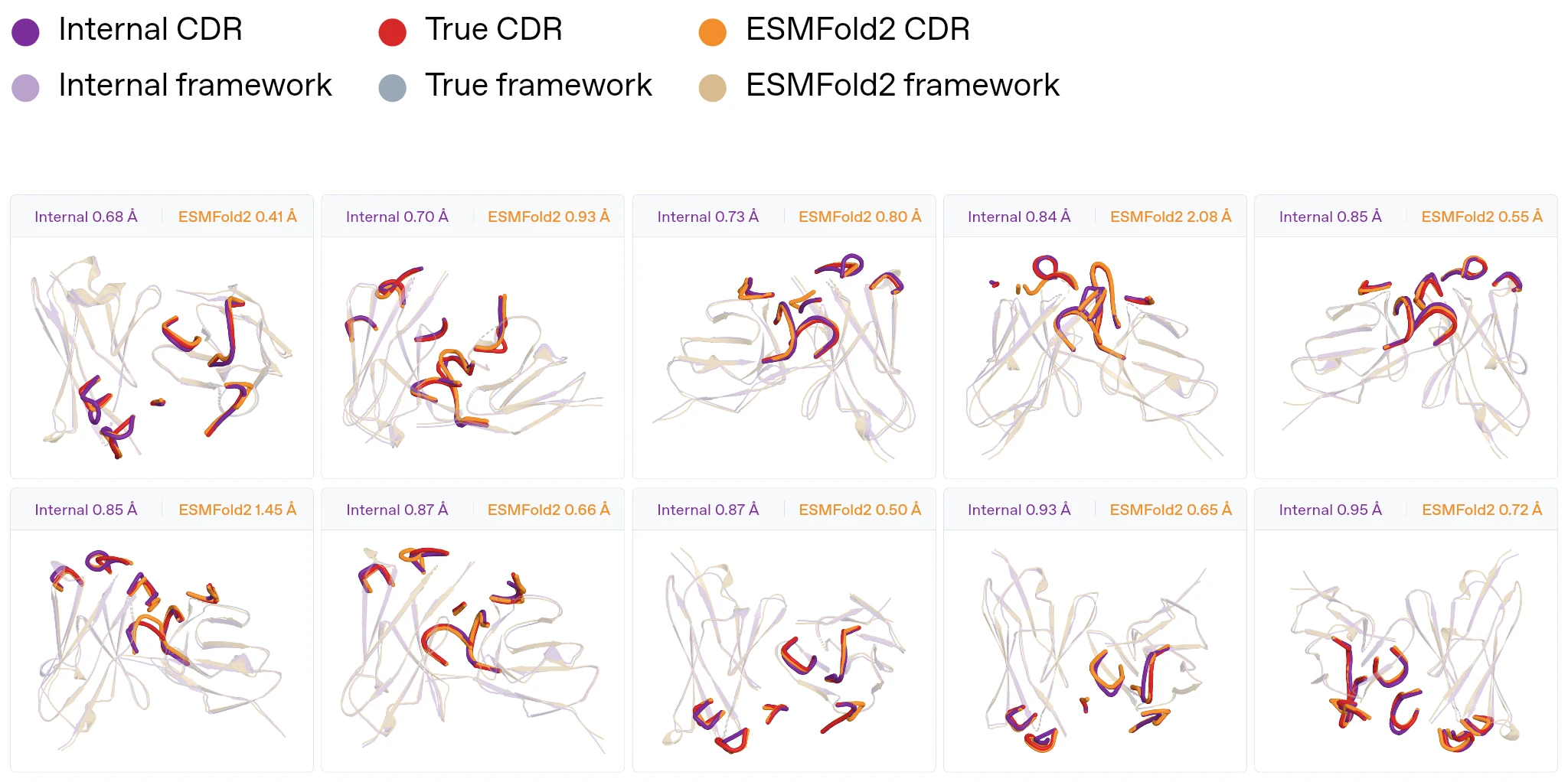
Affinity maturation modifies an antibody’s binding surface to improve properties such as strength or selectivity. GPT-6.2 redesigned complementarity-determining regions, or CDRs, which are the loops that make most of an antibody’s direct contact with its target.
| Experiment | Result |
|---|---|
| Six VHH single-domain antibodies targeting IL-4Rα | 128 of 182 designs, or 70%, showed signs of binding |
| Fragments from five therapeutic antibodies targeting PD-1 or PD-L1 | 179 of 272 designs, or 66%, retained binding |
These percentages measure whether redesigned fragments continued to bind. The experiments do not establish improved affinity, selectivity, stability, manufacturability, or therapeutic activity.
Benchmarks expose the task boundary
OpenAI reports strong results for motif scaffolding, fold design, and molecular docking, alongside a large deficit in full-sequence structure prediction. Motif scaffolding builds a protein around a required structural feature. Docking predicts how two molecules are positioned when they interact. TM-score measures structural similarity on a scale from 0 to 1, with higher values indicating a closer match.
| Task | General-model result | Specialized baseline |
|---|---|---|
| Motif scaffolding on MotifBench | 43.7%, latest internal model | 27.8%, RFdiffusion |
| CATH fold design | 18.9%, latest internal model | 17.1%, Proteina |
| Small-molecule docking on PoseBusters | 93%, GPT-6.2; 96%, latest internal model | 50%, DiffDock-L |
| Docking with a known bond on Scarpino | 92%, GPT-6.2; 97%, latest internal model | 60%, DiffDock |
| Full-sequence structure prediction by TM-score | 0.38, latest internal model | 0.93, ESMFold2 |
The percentages use task-specific success criteria and should not be compared across rows. On PoseBusters, GPT-6.2 closely matched the experimentally observed position and orientation of a small molecule in 93% of scored predictions. OpenAI also reports that mean antibody-docking DockQ scores rose with model generation, from about 0.05 for GPT-5.6 to 0.28 for GPT-6, 0.57 for GPT-6.2, and 0.81 for its unreleased internal model. DockQ also runs from 0 to 1, with higher scores indicating a better predicted complex.
The lab pipeline still has specialists
- Hybrid workflow: SolubleMPNN assigned sequences in the first minibinder campaign, while Boltz-2, OpenDDE, and ESMFold2 helped filter candidates. The 10.9% hit rate therefore evaluates a combined pipeline.
- Limited endpoint: The laboratory assays measured binding. Biological function, potency, toxicity, stability, and performance in organisms remain untested.
- Structure-prediction gap: The best reported internal model reached a TM-score of 0.38 for full-sequence structure prediction, compared with 0.93 for ESMFold2.
- Evidence status: The findings come from an OpenAI preprint and include results from an unreleased internal model. Independent replication and peer review remain pending.
Implementation still requires orchestration
The paper’s experiments map to a practical workflow that developers could build around a general-purpose model:
- Provide a target structure and explicit geometric constraints, such as a binding site, required contact, or preferred interface.
- Prompt the model to generate and execute Python that creates candidate backbones or docking poses.
- Assign amino acid sequences with the language model or a specialized sequence model, depending on the task.
- Rank candidates with independent structure predictors, docking checks, geometric filters, and confidence thresholds.
- Synthesize the leading candidates and measure binding experimentally.
The paper reports model experiments rather than a turnkey protein-design API, so production systems would still need sandboxed code execution, structural validation, prompt and model-version tracking, reproducible random seeds, candidate provenance, and standard biosafety review. Existing predictors remain useful as independent checks even when the language model performs the generative work.
Programmable molecular design remains the goal
OpenAI attributes the model’s flexibility to its ability to combine concepts from mathematics, physics, chemistry, and biology while writing code to search candidate structures. In one IL-7Rα example, the model proposed an interaction between the proteins and then explored shapes and amino acid choices that could support it. Researchers could also express constraints in natural language, including a beta-sheet interface that buries specified target residues.
OpenAI says future work will test harder targets, biological effects beyond binding, RNA design, proteins that bind multiple targets, and proteolysis-targeting chimeras, or PROTACs, which recruit cellular machinery to destroy selected proteins. For teams maintaining pipelines built from RFdiffusion, ProteinMPNN, Boltz-2, and custom filters, the immediate opportunity is a more flexible generative layer. Broader adoption will depend on independent validation, stronger full-structure prediction, reproducible tooling, and evidence that designed molecules perform their intended functions.
