
OpenAI's GPT-5.4 Runs 10,080 Drug Reactions to Crack a Decades-Old Chemistry Problem
GPT-5.4 and Molecule.one's Maria AI ran 10,080 reactions to find a surprising additive that improved a key drug-making reaction for over 80% of tested substrates.
Takeaways
- GPT-5.4 + Molecule.one's Maria AI ran 10,080 reactions to improve a key drug-making reaction (Chan-Lam coupling) in ~3 months.
- TEMPO additive was the surprise finding: yields improved for 88% of boronic acids and 83% of sulfonamides tested.
- Mean yield rose from 16.6% to 25.2%; reactions above 30% yield jumped from 15.6% to 37.5%.
- Bench-scale validation by human chemists confirmed results: 11 of 14 substrate pairs improved, 8 with >2x yield gains.
- The system covered the full research loop: literature review, hypothesis generation, experiment design, data analysis, and follow-up -- with humans steering and validating.
- OpenAI published a preprint; independent lab replication is the next test.
OpenAI and Molecule.one have published results showing that GPT-5.4, paired with an autonomous chemistry platform, drove a medicinal chemistry project from a blank-slate literature review all the way to a lab-validated scientific finding. The target: a notoriously stubborn reaction that drug makers have been trying to improve for decades.
The reaction in question is Chan-Lam coupling -- a copper-catalyzed method for forming carbon-nitrogen bonds that is widely used in drug synthesis. Chan-Lam coupling is useful in medicinal chemistry because it forms carbon-nitrogen bonds, which are common in medicines. However, the reaction does not work equally well for every class of molecule. In particular, coupling primary sulfonamides with boronic acids has historically produced low yields. Sulfonamides show up in drugs across oncology, antimicrobials, and diuretics, so a more reliable version of this reaction would meaningfully expand what medicinal chemists can build and test.
The System Behind the Science
This was not GPT-5.4 working alone in a chat window. The combined system paired complementary capabilities. Prompts written by scientists working with Maria AI were used with GPT-5.4 within a harness to generate and rank thousands of possible research proposals. Human chemists reviewed the small subset of proposals that ranked highest according to the system and selected four for laboratory testing.
The Maria platform combines frontier AI, micro-liter HTE (high-throughput experimentation) lab, and proprietary reaction data to power near-autonomous research for drug discovery and manufacturing. HTE is a technique where hundreds or thousands of miniaturized reactions are run in parallel at tiny volumes, enabling rapid screening of many conditions at once. Maria AI then translated selected high-level plans into detailed lab instructions, ran thousands of high-throughput experiments, analyzed the raw data, and returned structured results to GPT-5.4.
GPT-5.4's role spanned the full research loop:
- Reviewed scientific literature on Chan-Lam coupling
- Generated and ranked thousands of research proposals
- Identified primary sulfonamides as a high-value, underperforming substrate class
- Proposed that mild oxidants, including TEMPO, could improve the reaction
- Designed follow-up experiments after analyzing first-round data
- Suggested that TEMPO could be swapped for the cheaper analog 4-hydroxy-TEMPO with little loss in performance
The Surprising Find: TEMPO
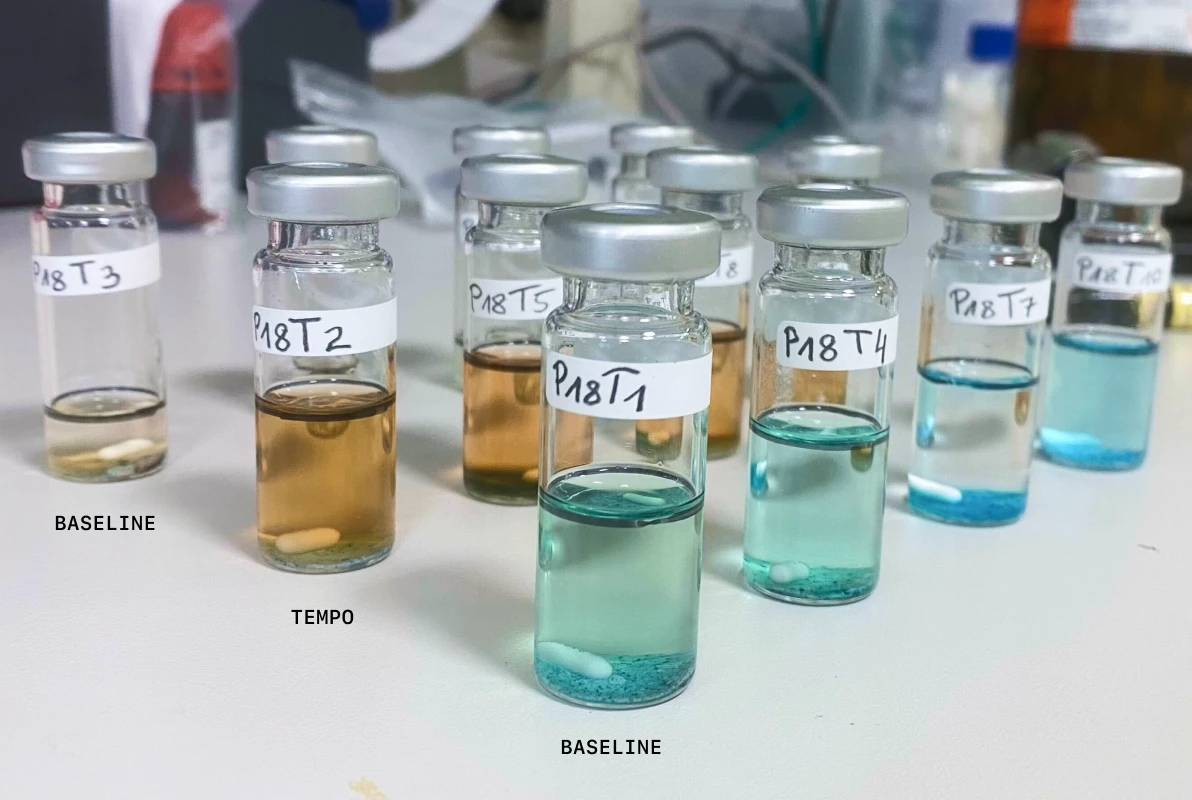
The most promising proposal, internally labeled OAI-M1-03, suggested using TEMPO (a stable organic radical compound, 2,2,6,6-tetramethylpiperidine-1-oxyl) as an additive. Chemists found the suggestion both surprising and interesting. TEMPO is not a new molecule -- it has appeared in chemistry literature -- but proposing it as a mild oxidant specifically to rescue the low-yield primary sulfonamide version of Chan-Lam coupling was the novel leap.
Across two cycles, Maria ran a total of 10,080 reactions -- more than a chemist running three reactions every day would run in a decade. That scale mattered because chemistry results can be misleading when they are tested on only a few examples. The sheer volume made it possible to identify TEMPO among ten tested oxidants, confirm the effect across diverse substrate combinations, and find its limits.
The Numbers That Matter
The results were striking. Under the optimized conditions, measured yields improved for 88% of the boronic acids and 83% of the sulfonamides tested. The mean yield rose from 16.6% to 25.2%, and the share of reactions above 30% yield increased from 15.6% to 37.5%. Crossing the 30% yield threshold is significant in practice -- it is often the point at which a reaction becomes useful enough to deploy in a real drug discovery workflow.
Micro-scale screening results do not always hold up at bench scale, so human chemists repeated the key experiments by hand. Human chemists reproduced representative reactions manually at bench scale and observed an increase in yield for 11 of 14 substrate pairs; for eight pairs the increase was greater than twofold. Four external chemistry experts reviewed the preprint and supported the view that the result was novel and worth sharing.
Near-Autonomous, Not Fully Autonomous
OpenAI is deliberate about the word "near-autonomous." Human judgment remained essential, and the workflow depended on specialized high-throughput infrastructure. The division of labor looked like this:
- GPT-5.4: literature review, proposal generation and ranking, experiment design, data analysis, follow-up hypotheses
- Maria AI: translating proposals into lab protocols, running and analyzing thousands of reactions
- Human chemists: steering prompts, selecting which proposals entered the lab, correcting experimental details (e.g., avoiding DMSO as a solvent), bench-scale validation, and writing up results
The full process took three months, from the first prompt on March 4th to sharing the OAI-M1-03 results with independent experts on June 4th. That is fast by the standards of experimental chemistry, where a single project can take years.
What This Does Not Show
The limitations are worth being clear about. This work does not show that AI can independently run a chemistry research program from end to end. It also does not establish that the method will generalize to other coupling reactions, other substrate classes, or manufacturing conditions. The yield estimates came from a high-throughput platform, and bench validation covered only 14 representative substrate pairs. Independent replication by other labs will be the real test.
There is also a safety dimension. Chemistry capabilities require careful treatment because the same tools that can support medicine and materials science could also be misused. OpenAI notes that the model had undergone relevant evaluations with the UK AI Security Institute, and the workflow added an additional layer of control: human chemists retained control of the physical infrastructure and selected which proposals entered the lab.
The Bigger Picture
This result is the latest in a string of OpenAI science demonstrations. OpenAI for Science is the division focused on applying frontier AI models to accelerate scientific discovery, working with researchers across universities, national laboratories, and industry. Previous results include contributions to a discrete geometry conjecture, gluon amplitudes in theoretical physics, and lowering the cost of cell-free protein synthesis.
The chemistry result is arguably the most operationally complete of these, because it closes the full loop: hypothesis, experiment, physical validation. Kevin Weil, VP of OpenAI for Science, has said "I think 2026 will be for science what 2025 was for software engineering. At the beginning of 2025, if you were using AI to write most of your code, you were an early adopter. Whereas 12 months later, if you're not using AI to write most of your code, you're probably falling behind." The Chan-Lam result is a concrete step toward making that prediction real for wet-lab chemistry.
For teams working in drug discovery, the practical implication is not that AI replaces chemists -- it is that the combination of a frontier reasoning model, a specialized agentic platform like Maria, and a high-throughput lab can compress months of exploratory chemistry into a tightly scoped, human-steered sprint. The full preprint is available for those who want to dig into the mechanistic details.