
OpenAI's ChatGPT Work and GPT-5.6 Turn AI Into a Full-Time Employee
OpenAI's ChatGPT Work agent, powered by GPT-5.6, can run multi-hour workflows across Slack, Drive, and Salesforce — turning a single prompt into finished deliverables
Takeaways
- OpenAI launched ChatGPT Work, a new agentic mode powered by GPT-5.6 that can run multi-hour workflows across connected apps like Slack, Drive, and Salesforce.
- GPT-5.6 introduces three tiers (Sol, Terra, Luna) with Sol featuring a max-reasoning mode and an "Ultra" configuration that spawns parallel subagents for complex tasks.
- The Codex desktop app merges into the new ChatGPT desktop app, giving developers and non-technical users a unified tool; the desktop version is free on all plans.
- Scheduled Tasks let users permanently delegate recurring work — weekly reports, meeting prep, feedback monitoring — to run automatically on a set cadence.
- ChatGPT Work is live today for Pro, Enterprise, and Edu plans on web/mobile; Plus and Business roll out within days; GPT-5.6 API pricing starts at $1/$6 per million tokens for Luna up to $5/$30 for Sol.
- A new auto-review security layer blocked 100% of adversarial data-extraction attempts in red-team testing, though enterprise governance policies remain essential as agent access to connected tools expands.
OpenAI has launched ChatGPT Work, a new agentic mode inside ChatGPT that can take on entire workflows from a single instruction. Powered by the newly released GPT-5.6 model and built on Codex's underlying technology, it can pull context from your connected apps, spend hours working through complex tasks, and deliver finished slides, sheets, docs, and web apps , without you needing to babysit every step.
More than 5 million people use Codex every week, and although it began as a coding agent for developers, more than 1 million people now use it for work outside software development. ChatGPT Work is OpenAI's bet that this same agentic capability can be packaged for every knowledge worker, not just engineers.
What GPT-5.6 Actually Brings
ChatGPT Work is powered by GPT-5.6, which makes ChatGPT state of the art at reasoning through multi-step tasks and creating materials that follow your templates and reference files. The model is the culmination of a rapid iteration cycle: OpenAI introduced GPT-5.6 two months after the release of GPT-5.5.
Sol is the flagship for complex agentic tasks; Terra is the everyday production option; Luna is the fastest and least expensive. Sol is designed for the hardest agentic tasks , long-horizon coding, cybersecurity research, and biology workflows , and carries a maximum-reasoning mode that gives the model more time to think through complex sequential problems, plus an "Ultra" configuration that spawns parallel subagents for tasks where speed matters more than depth.
How It Actually Works
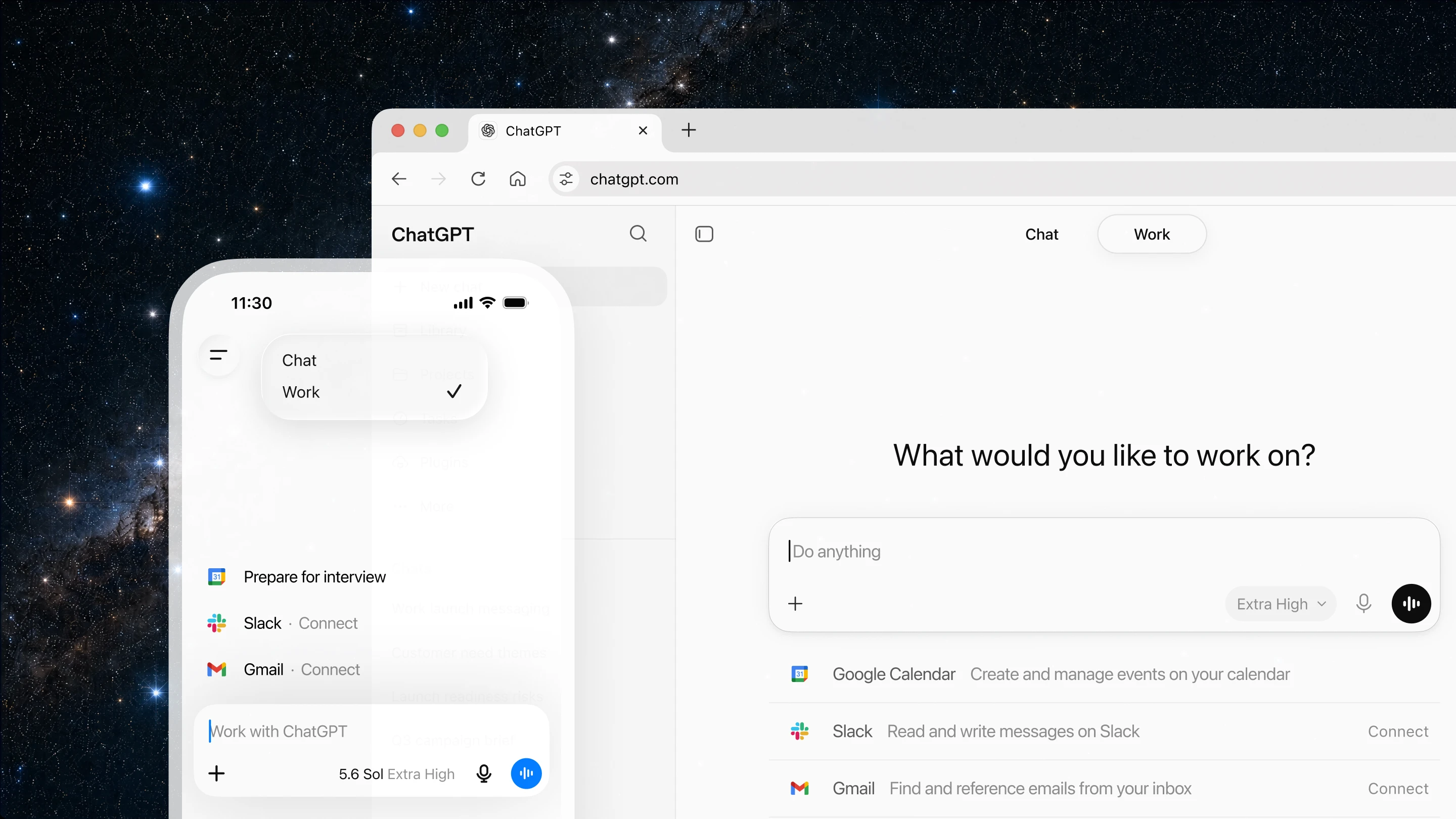
The core mechanic is simple: you connect your tools via plugins, describe the outcome you want, and ChatGPT Work figures out the steps. Plugins connect ChatGPT to apps and systems like Slack and Microsoft Teams, Google Drive and SharePoint, email, calendars, CRMs, project trackers, and other internal tools. ChatGPT will automatically know when to reference a plugin based on your prompt, but you can also direct ChatGPT to pull context from a specific app by typing "@" followed by the app name.
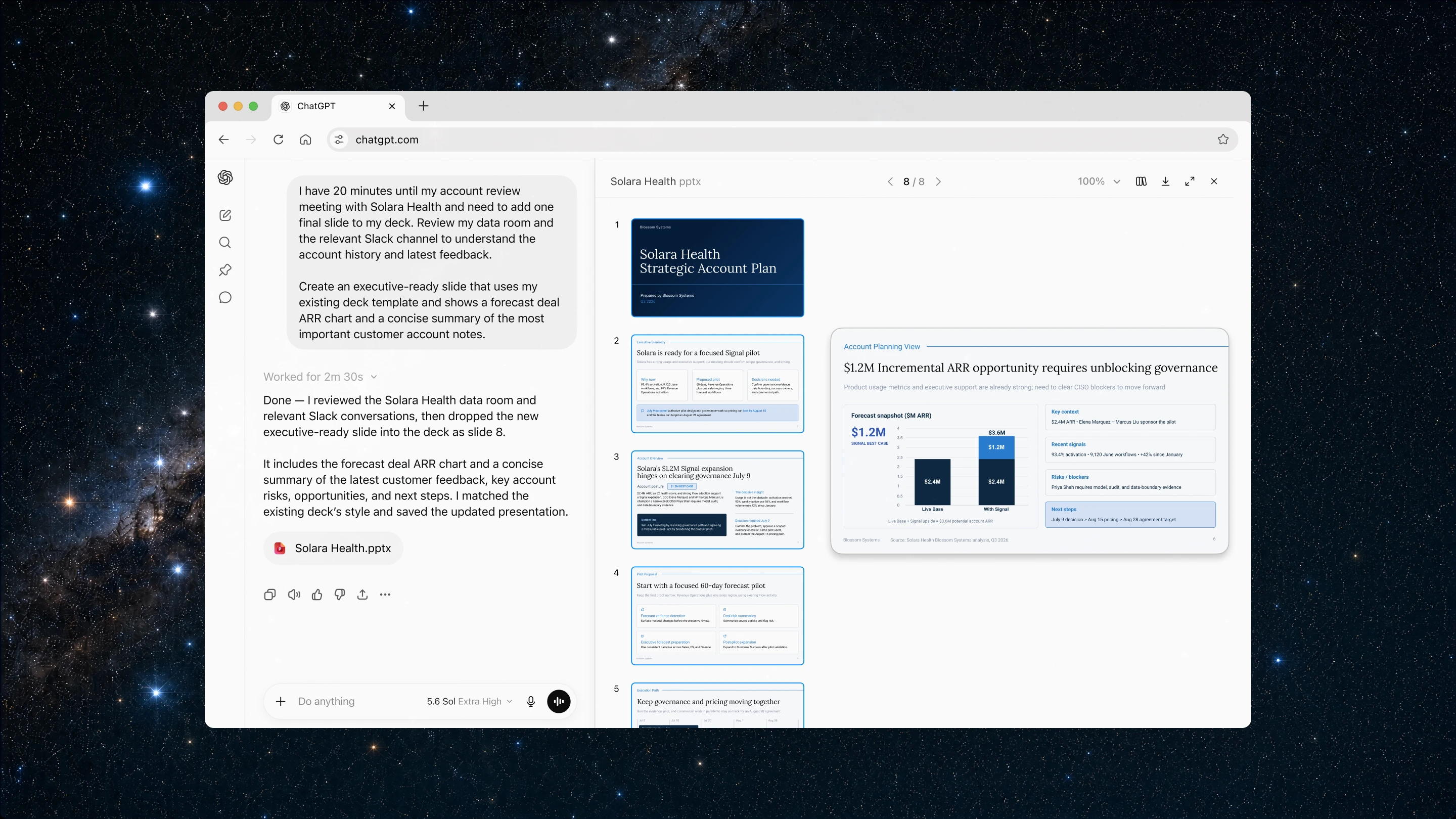
The output isn't just text. ChatGPT Work can produce:
- PowerPoint decks and Google Slides
- Spreadsheets with live data pulled from connected apps
- Written reports and analysis documents
- Interactive web apps via the new Sites feature (public beta)
With Sites, you can turn your work or ideas into an interactive site or web app and share it with your team or publicly through a URL. Sites are useful for things like live dashboards, project trackers, launch calendars, prototypes, internal portals, and interactive reports.
The Desktop App Merger
Alongside ChatGPT Work, OpenAI is consolidating its desktop presence. Starting today, the Codex app is merging with the new ChatGPT desktop app. Codex remains the same powerful coding agent for developers and technical professionals, now with new capabilities across core workflows, including inline editing within diffs, pull request review in the side panel, faster computer use powered by GPT-5.6, and support for multiple repositories in a single project.
On desktop, Computer Use lets ChatGPT use your computer on your behalf to execute tasks in the background across your apps, tools, and browser , clicking, typing, and moving files where they need to go. OpenAI is also sunsetting its standalone Atlas browser, migrating those users into the new ChatGPT desktop app's built-in browser instead.
Scheduled Tasks: The Automation Layer
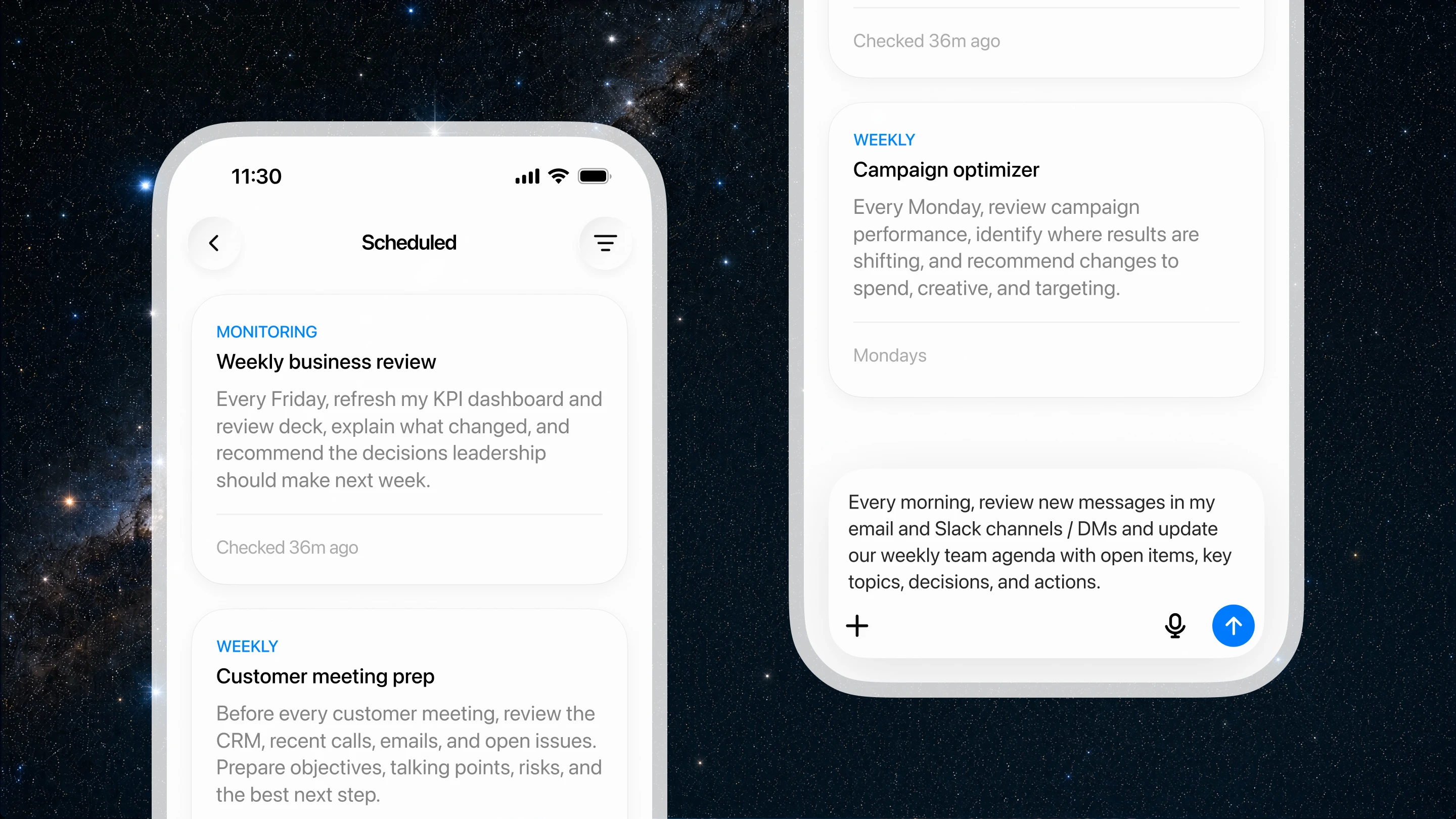
One of the most practically useful additions is Scheduled Tasks , a way to hand off recurring work permanently. Scheduled Tasks let you ask ChatGPT to perform an action once, repeat it on a schedule or when an event occurs, or monitor for changes over time. Concrete examples of what this unlocks:
- Review new Slack updates each week and refresh a recurring meeting agenda
- Check websites and dashboards each morning, summarize what changed, and send a report
- Monitor new customer feedback and turn recurring themes into prioritized product ideas
- Update a presentation when new feedback arrives by email
Real-World Results
OpenAI shared early beta results from enterprise users that give a sense of what the system can actually do at scale:
- Zapier: Used ChatGPT Work to build a repeatable system for reviewing thousands of leads each month, tracing customer touchpoints across Zapier's CRM, email, and other tools, and generating a weekly executive dashboard that revealed seven figures in potential sales.
- NVIDIA: Used ChatGPT Work to automate preparation for GTC, replacing an Excel workflow that consumed about 40% of pre-event time, and afterward synthesized hundreds of session transcripts and customer-meeting notes to assess whether GTC met its goals.
- Virgin Atlantic: Used ChatGPT Work to compare the airline's passenger experience with competitors as it developed its five-year plan, reducing weeks of analysis to hours.
- RingCentral: Used ChatGPT Work to turn manual monthly launch checks into a repeatable workflow, allowing one person to go from supporting one product manager to supporting roughly 50 product managers.
Nearly 100% of teams inside OpenAI, including finance and sales, now use ChatGPT Work and Codex to move faster, take on harder tasks, and spend more time with customers.
The Competitive Picture
ChatGPT Work lands in a market where every major platform is racing toward the same destination. Microsoft Copilot is Microsoft's AI assistant embedded across Word, Excel, PowerPoint, Outlook, and Teams , it's the strongest option for organizations deep in the M365 ecosystem, but it's locked to that stack. ChatGPT is platform-independent and cheaper at $20 versus $22-30/user/month for Copilot. It can't embed inside M365 apps the way Copilot does, but it works across arbitrary tools via Workspace Agents. For teams that use multiple platforms, ChatGPT is more flexible.
April 22, 2026 marked an unusual day in the enterprise AI agent wars, because within just a few hours OpenAI announced ChatGPT Workspace Agents, Google unveiled the new Gemini Enterprise Agent Platform, and Salesforce expanded its partnership with Google Cloud to connect Agentforce with Gemini. Three big tech players, same day, same goal: turn autonomous agents from a technology demo into a shareable tool inside real-world work teams. ChatGPT Work is OpenAI's answer to that escalating arms race , a more polished, more capable version of what it previewed in April.
Security: The Hard Part
When an AI agent can click, type, read files, and send messages on your behalf, security governance becomes critical. OpenAI has built several layers into ChatGPT Work. Auto-review adds another layer of protection by using OpenAI's most advanced models to review important actions involving connected tools and APIs before they happen, helping prevent unauthorized sharing of sensitive information. During adversarial red teaming, auto-review blocked 100% of attempts to extract protected data, including attacks the reviewing model had not seen during training.
Enterprise and Edu admins can centrally manage who has access, what company context ChatGPT can use, which tools it can connect to, and what actions it can take. The Compliance API provides visibility into ChatGPT Work conversations and actions at scale to support enterprise oversight. Still, security researchers have noted that 34.8% of enterprise ChatGPT inputs contain sensitive data like code, PII, and financials , more than triple the 11% rate from 2023. The more deeply an agent is woven into your infrastructure, the larger the surface area that needs governing.
Availability and Pricing
The rollout is tiered by plan:
- Web and mobile: Rolling out now for Pro, Enterprise, and Edu plans; Plus and Business users get access within the next few days
- Desktop app (Mac and Windows): Chat, Work, and Codex are available on every plan, including Free, and is available globally to download.
- Codex app users: Update as usual and the app becomes the new ChatGPT desktop app
ChatGPT Work is designed for longer, more involved work than a typical chat request, so usage works differently. Usage varies with the amount of work required, and more complex tasks may use more of your plan's included usage. ChatGPT Work follows the same usage structure as Codex. Enterprise admins can set spend controls in the Admin Console to manage usage as adoption grows.
GPT-5.6 API pricing for developers building on top of the model family: Sol is $5 input / $30 output per million tokens; Terra is $2.50 input / $15 output; and Luna is $1 input / $6 output.
What This Means for the Industry
The launch signals a fundamental shift in how OpenAI is positioning ChatGPT , away from a question-answering interface and toward a persistent work partner that operates across your entire tool stack. OpenAI holds 78-80% of enterprise AI usage as of early 2026, and ChatGPT Work is designed to deepen that moat by making the switching cost much higher: once your workflows, scheduled tasks, and app connections are built inside ChatGPT, moving them elsewhere becomes painful.
For developers, the Codex integration means the same desktop app now serves both the technical team (with full coding agent capabilities, diff editing, and PR review) and the broader organization (with document creation, scheduling, and app integrations). OpenAI is also launching Sol on Cerebras infrastructure capable of serving it at up to 750 tokens per second , a latency profile that makes extended agentic loops substantially more practical for real-time applications. That speed matters enormously when an agent is running a 50-step workflow and needs to stay responsive to user corrections mid-run.
The biggest open question is whether the "hours-long" autonomous work claim holds up in practice. Agentic systems that run long multi-step tasks still fail in non-obvious ways , misinterpreting a goal midway, making a wrong assumption about which file to update, or silently stalling on a tool call. The auto-review safeguard and the human-in-the-loop approval gates are the right instincts, but enterprise teams will need to build their own verification workflows around any output that feeds into a consequential decision.