

OpenAI's 10,000-Agent Swarm Solves a 100-Year-Old Math Mystery
An internal OpenAI model coordinated roughly 10,000 agents for 88 hours to produce a Lean-verified finite-time blowup proof for 3D Navier-Stokes.
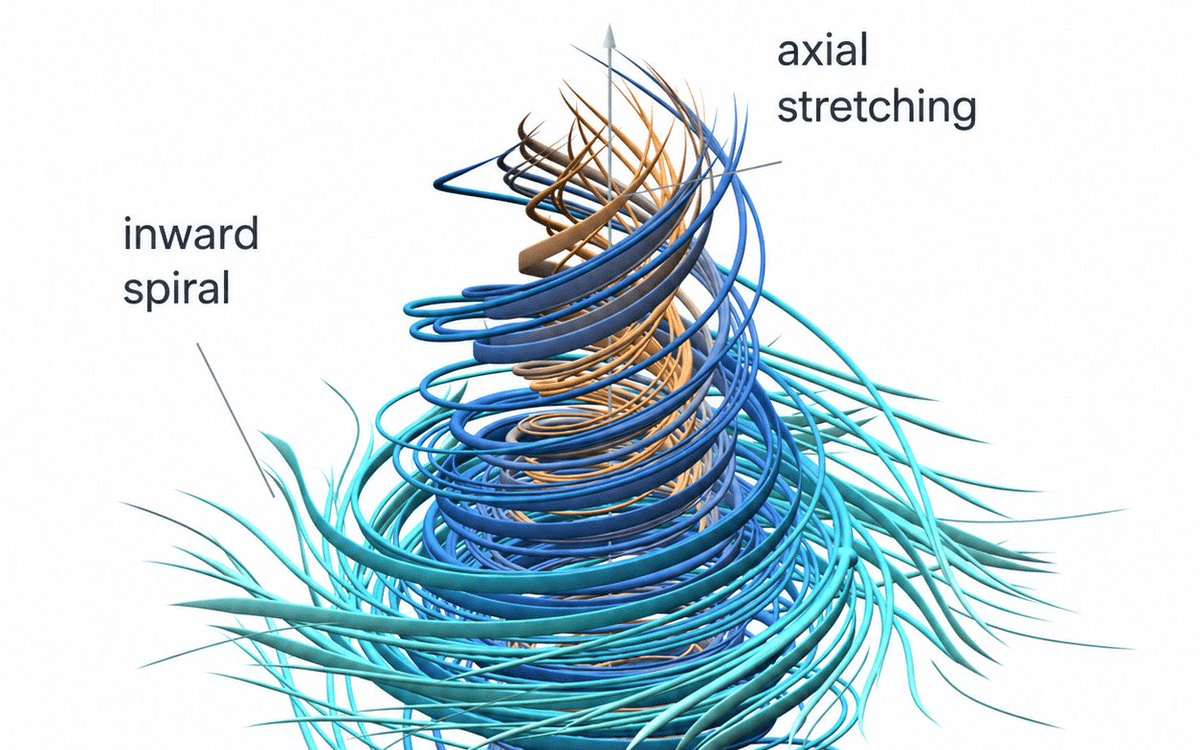
- OpenAI announces an AI-generated proof of finite-time blowup for 3D Navier-Stokes with Lean formalization.
- Roughly 10,000 coordinating agents ran for 88 hours, exchanging 2.7 million messages and 130 billion tokens.
- The internal model driving the agents is described as significantly more capable than GPT-6 Astra.
- Solution is a self-similar vortex spiraling inward with bounded energy but unbounded velocity at singular time.
- Agents also resolved the unforced Euler regularity problem as an intermediate result along the way.
- Concurrent human work by Alpöge (Anthropic) and Buckmaster (NYU) resolved the related forced Euler problem.
A coordinated swarm of AI agents has produced what OpenAI describes as a resolution to one of the seven Millennium Prize Problems: the Navier-Stokes existence and smoothness question. The announcement comes with a 165-page manuscript and a Lean formalization of the argument, both attributed to the model rather than to any human author.
The result is a disproof of global smoothness. The paper constructs a specific fluid flow that starts from rest, receives a smooth compactly supported force, keeps finite kinetic energy, and still develops unbounded velocity in finite time. For every positive viscosity, the construction yields a solution of the three-dimensional incompressible Navier-Stokes equations that blows up while kinetic energy stays bounded. In the Clay Institute's framing, this settles alternative (C); the periodic version settles alternative (D).
The vortex that devours itself
The construction is geometric. A vortex spirals inward around a vertical axis, its core radius shrinking faster than its axial length, producing a singular region that collapses into an increasingly slender column concentrated at the origin. The difficulty is that all the divergent terms in the momentum equation — acceleration, pressure gradient, momentum transfer, viscosity — must cancel precisely, so the external force on the fluid stays smooth even as the velocity blows up.
With τ = 1 − t denoting time remaining before blowup and h < 1/100 a small fixed exponent, the key scales are:
- Core radius shrinks as
τ^(1/2), axial length asτ^(1/2−h). - Azimuthal and axial velocities scale as
τ^(−1/2−h), becoming unbounded. - Total kinetic energy of the core scales as
τ^(1/2−3h), going to zero. - The angular Reynolds number diverges while the radial one stays O(1).
To smooth the residual, the authors add spatially oscillatory pulses whose nonlinear momentum fluxes cancel the singular part of the background flow, leaving something that extends smoothly through the singular time. Each pulse grows by extracting energy from the background shear, then gets damped by viscosity — a controlled bloom-and-decay cycle repeated along each pulse's lifetime.
How the agents worked
Since August 28, OpenAI has been training an internal model that has shown strong benchmark performance in mathematics, with training still ongoing. After hearing rumors that two Millennium Prize problems had been resolved externally, OpenAI ran this model against every open Millennium problem plus a set of related targets.
The agents could read from a cached version of the web, run code, and communicate within subgroups. The Navier-Stokes attempt used roughly 10,000 concurrent agents, seeded with different variants of the problem — some prompted toward a smoothness proof, others toward a disproof.
An unexpected intermediate result changed direction. Nearly 100 agents worked together for about 50 hours and produced a finite-time blowup result for the unforced Euler equations, the inviscid limit of Navier-Stokes. That success made blowup the more promising direction, and OpenAI redirected compute toward Navier-Stokes, using Codex to consolidate insights across agent groups.
| Metric | All problems | Navier-Stokes only |
|---|---|---|
| Wall-clock time | — | 88 hours |
| Agent messages | 4.9 million | 2.7 million |
| Output tokens | ~300 billion | ~130 billion |
| Lean verification | — | 17 hours (GPT-6 Astra) |
Can you trust a 165-page AI proof?
The argument is formalized in Lean, so a proof assistant has mechanically checked every logical step against a foundational library. Trusting the result requires trusting the Lean kernel and its axioms, not the model's reasoning. The manuscript itself reads as a conventional analysis paper, with a physical description of the flow, a proof outline, and appendices matching cumulative radial moments to attach an analytic inner profile to a heat-flow exterior.
The construction's lineage is visible throughout. It builds on convex-integration techniques from Buckmaster and Vicol, the unstable-vortex construction of Albritton, Brué, and Colombo, and Tao's earlier averaged-equation blowup. The novelty lies in executing all of it simultaneously — with a smooth compactly supported force, bounded energy, and every estimate closed.
The parallel human result
The rumor that prompted OpenAI's push turned out to concern work by Levent Alpöge (Anthropic) and Tristan Buckmaster (NYU). When the teams compared notes, Alpöge and Buckmaster had resolved the forced Euler problem, while OpenAI's agents had resolved unforced Euler and forced Navier-Stokes. The specific results differ, and OpenAI has stated it is not claiming the Millennium Prize.
What this changes
Assuming the Lean formalization survives scrutiny, several things shift:
- Frontier theorem proving. A 165-page original mathematics paper with mechanical verification is a different regime from IMO-style problem solving. The bottleneck moves from generation to human review and community consensus.
- Multi-agent scaling. Ten thousand agents coordinating for 88 hours, with a second model consolidating intermediate results, offers a concrete template for problems where the search space is too large for a single trajectory.
- Continuum fluid mechanics. Many researchers expected the smoothness alternative to hold. A correct blowup construction gives turbulence modeling a formal breakdown, not just a philosophical one.
- Model capability trajectory. OpenAI is using this result as evidence that its internal successor to GPT-6 Astra represents a step-change in capability, and as motivation to pace deployment more deliberately.
For developers building with current models, nothing changes tomorrow. The system here is internal, safeguarded, and not exposed through the API. What it demonstrates is that the ceiling for AI-assisted mathematical research has moved, and that the most interesting near-term work may look less like clever prompts and more like orchestrating fleets of agents against problems where a machine checks the answer before any human does.
Comments
