

OpenAI Presence Resolves 75% of Support Calls Without Human Help
OpenAI Presence brings white-glove AI agent deployments to enterprises, with voice and chat agents that resolve 75% of issues without human help
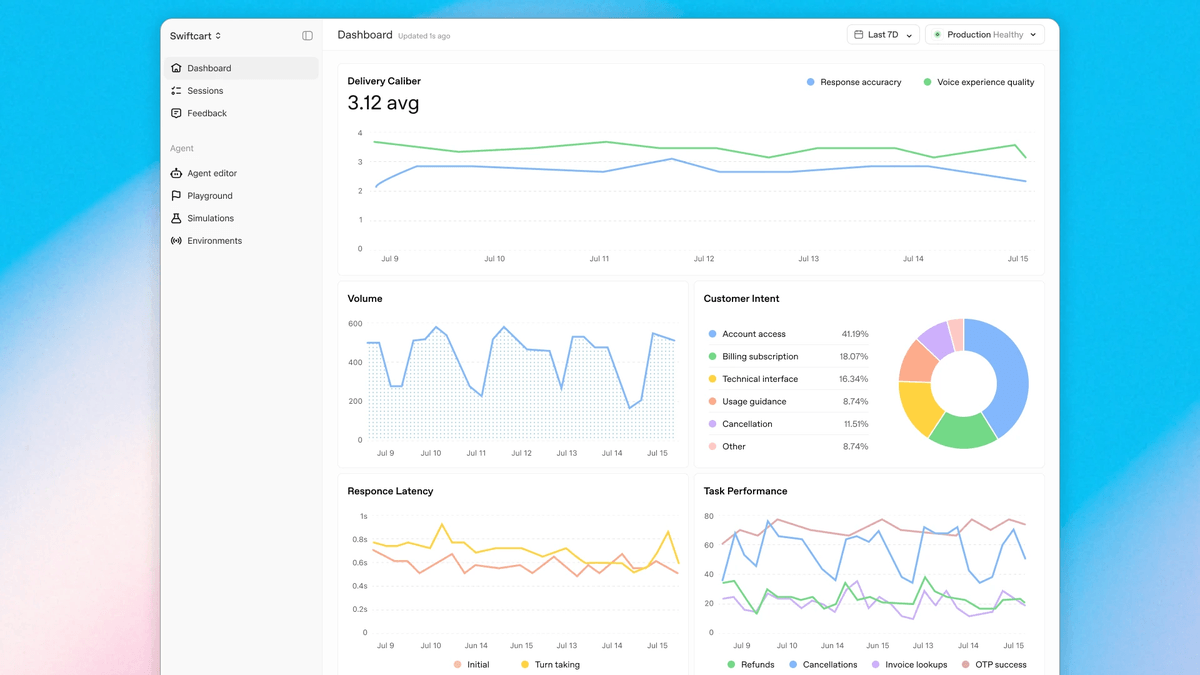
- OpenAI Presence launches as a managed enterprise AI agent platform for voice and chat, available in limited general availability. Details here.
- 75% resolution rate: OpenAI's own phone support line runs on Presence and resolves 75% of inbound issues without human help.
- Codex-powered improvement loop reduced human handoffs by 15 percentage points in just 10 days post-launch.
- BBVA, SoftBank, and IAG are named early design partners across banking, telco, and insurance.
- Not self-serve: deployments are led by OpenAI Forward Deployed Engineers; enterprises must contact their account team.
- Strategic context: enterprise is already 40%+ of OpenAI's $25B+ ARR and is on track to match consumer revenue by end of 2026, ahead of a planned IPO.
OpenAI Presence is OpenAI's new enterprise product for deploying production-grade AI agents across customer support, outbound sales, and internal workflows. Available today in limited general availability for eligible enterprise customers, it is a managed deployment service where OpenAI's engineers work alongside your team to get agents into production, not a platform you configure yourself.
What it actually does
Presence assigns each agent a defined job, a bounded knowledge base, and a limited set of approved actions. Deployments start with a specific task: resolving billing issues, handling insurance claims, or managing employee IT requests. The agent receives only the knowledge and system access that job requires.
The deploying company sets the policies: what the agent can do, when it needs approval, and when a human should take over. Escalation is a first-class feature. Agents are designed to hand off gracefully when they reach the edge of their authority, not to fail silently.
The improvement loop runs on Codex. After launch, production sessions and escalations surface gaps. Codex proposes updates that teams can review and approve, letting the agent adapt as customer behavior changes. The architectural bet is that Presence agents get measurably better over time without requiring a full redeployment.
The numbers that matter
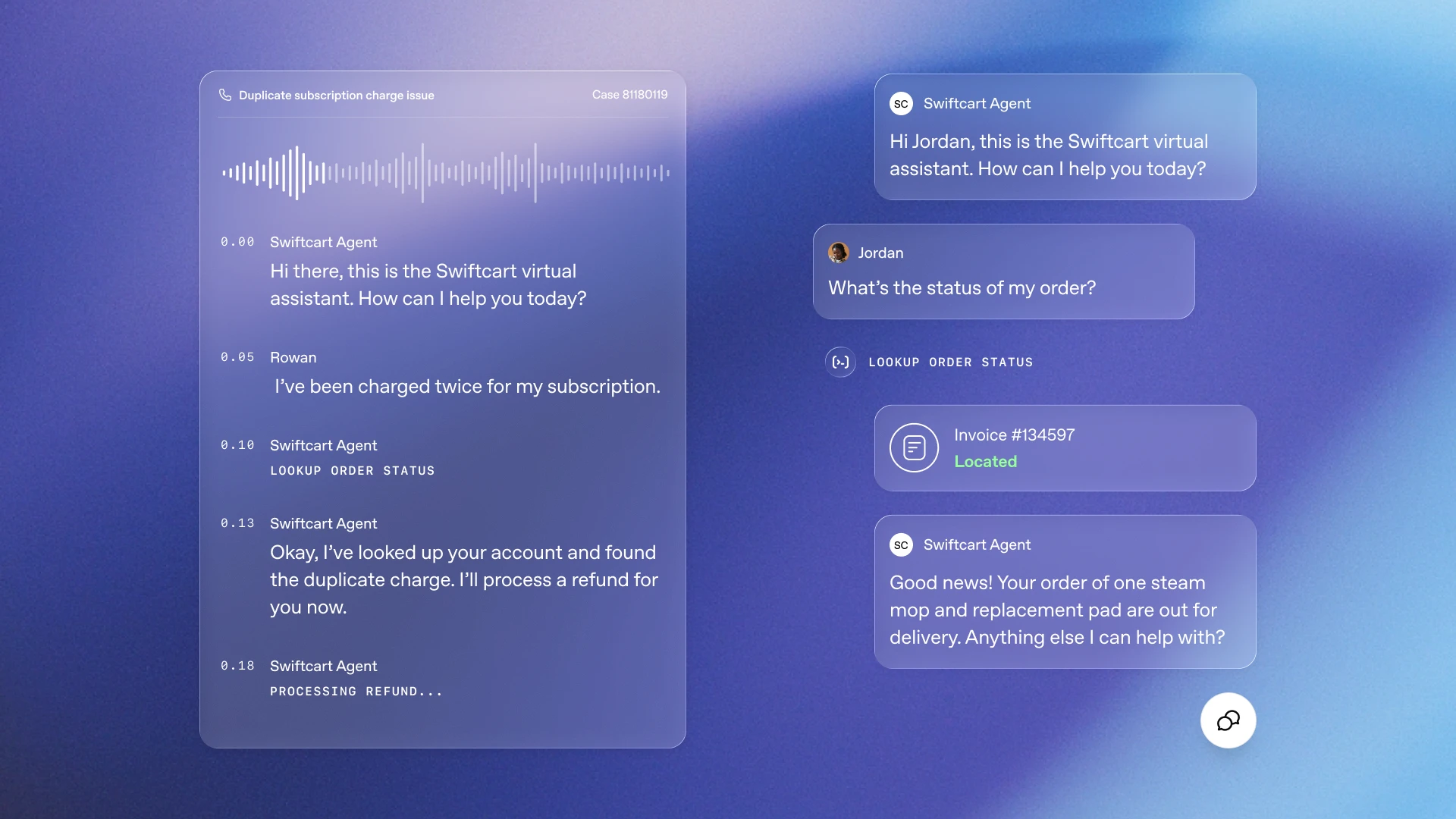
Presence powers OpenAI's own English-language phone support at 1-888-GPT-0090, handling open-ended requests, verifying callers, reading account context, and taking approved actions. Within weeks of launch, it met or exceeded the benchmarks used to grade frontline human-support quality and now resolves 75% of inbound issues without human assistance. The Codex improvement loop cut human handoffs by 15 percentage points in 10 days, a fast iteration cycle for any production support system.
Who is already building on it
Three enterprise partners are named as early design partners:
- BBVA is exploring AI-powered voice support for everyday banking in Mexico.
- SoftBank is testing natural Japanese-language customer conversations, with frontline teams rating the agent's Japanese quality highly.
- IAG (Insurance Australia Group) is exploring timely support during high-demand events like severe weather and natural disasters.
Banking, insurance, and telco are among the highest-stakes, highest-volume customer service environments in the world, and they are also the industries most resistant to deploying AI without strict guardrails. These are not test cases chosen for ease.
The testing infrastructure behind it
Before a Presence deployment reaches users, teams can run it against common requests, edge cases, and higher-risk scenarios. Simulations and graders check whether the agent reached the right outcome, followed policy, used tools correctly, and escalated when appropriate. Guardrails can intervene when an interaction moves outside the company's defined boundaries.
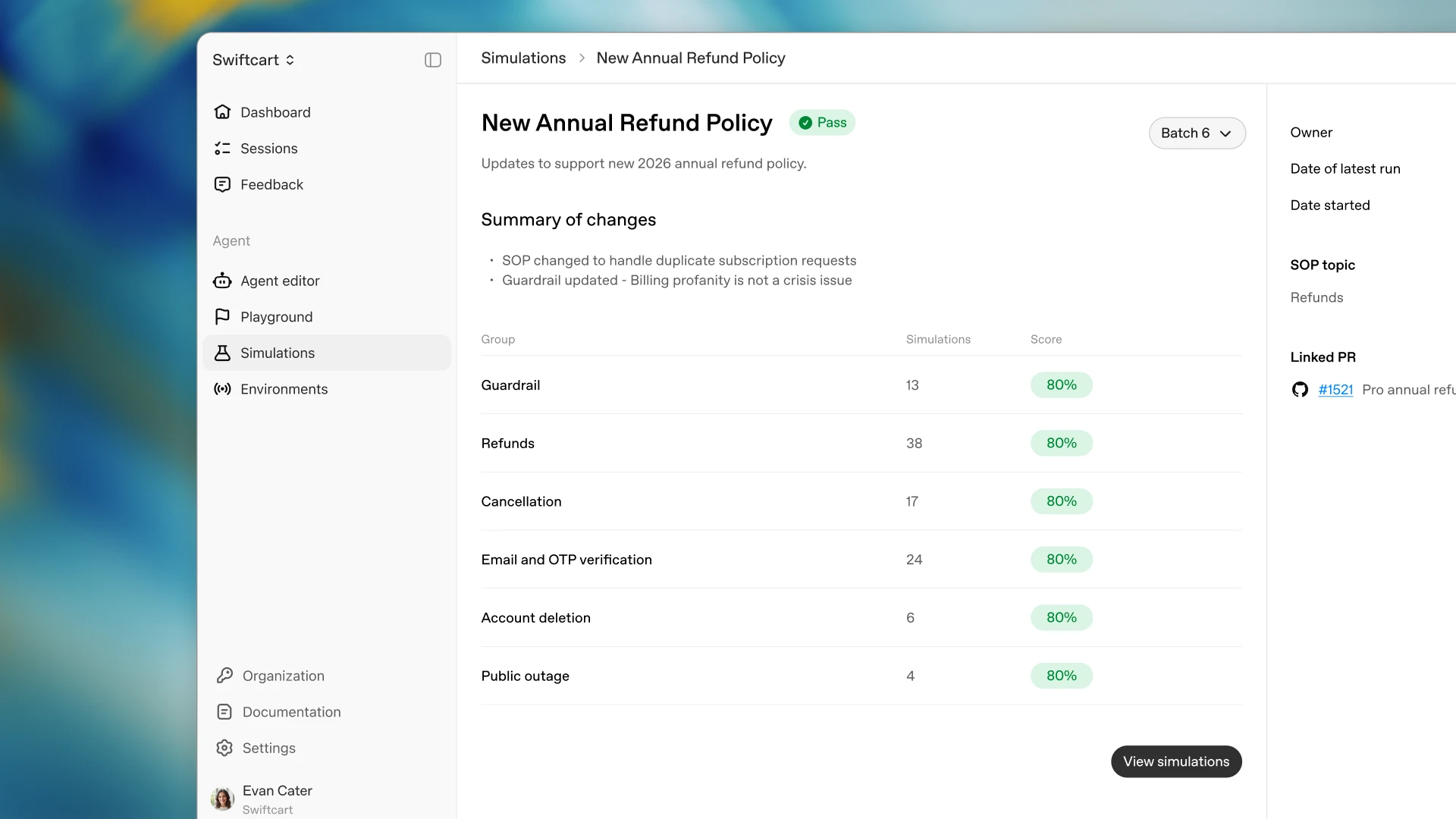
The simulation dashboard shown in product screenshots organizes test groups by policy category (refunds, cancellations, account deletion, public outage handling) and tracks pass scores per run. That kind of regression testing infrastructure is what separates a production agent system from a demo.
Why this launch matters strategically
OpenAI is refocusing resources on coding and enterprise ahead of its planned IPO, with enterprise already representing more than 40% of revenue and on track to reach parity with consumer by end of 2026. The company has crossed $25 billion in annualized revenue, and enterprise is the fastest-growing segment.
The competitive field is crowded. Gartner predicts 60% of businesses will implement AI agents for customer service by 2026. Salesforce and ServiceNow have both declared their intention to become the platform on which enterprise AI agents run. Microsoft Copilot Studio, Anthropic's enterprise push, and vertical-specific startups like Sierra and Decagon are all chasing the same contracts.
OpenAI's angle with Presence is a higher-touch model: rather than selling a platform for enterprises to build on themselves, OpenAI works alongside each customer to identify high-value workflows, connect the necessary knowledge and systems, establish permissions and policies, test the agent, and bring it into production. That approach is also a data flywheel. Every deployment generates insights that feed back into research and product.
Who wins and who loses
The clearest beneficiaries are enterprises stuck in pilot purgatory: companies that have proven AI agents work in demos but cannot get them to production quality. Presence is explicitly designed to solve that last-mile problem.
The picture is harder for AI agent startups. Platforms like Sierra, Decagon, and Ada have been selling exactly this kind of managed enterprise deployment. OpenAI entering with its own product, backed by its own models and a direct sales relationship, is a significant headwind for them.
For Salesforce Agentforce and ServiceNow, the threat is more nuanced. Presence needs to connect to your CRM, ticketing system, and billing platform. It uses that software as a tool rather than replacing it, so the risk is competitive pressure on the agent layer rather than displacement of the underlying SaaS stack.
What becomes possible
Getting a voice agent into production at enterprise scale previously required stitching together speech-to-text, a reasoning model, text-to-speech, a policy layer, an escalation system, and a feedback loop from different vendors. Presence bundles those components: policies and standard operating procedures, guardrails, approved actions, simulations, evaluation tools, and the Codex improvement loop in a single managed product.
The Codex loop itself is worth noting separately. Using Codex to propose updates to agent policies and escalation rules, not just software code, extends the tool into a new category of artifact. That is a meaningful expansion of what it was originally designed to do.
How to get access
Presence is available to eligible enterprise customers through a limited general availability program. Deployments are led by OpenAI Forward Deployed Engineers and select global systems integrators. There is no self-serve option and no public pricing. To get in, contact your OpenAI account team.
For teams already using the OpenAI API for voice applications, OpenAI has confirmed continued support for frontier model access through the API. Presence is an additive offering. The broader trajectory, though, is clear: OpenAI is moving up the stack from model provider to full-service enterprise deployment partner, and Presence is the most explicit signal of that shift yet.
Comments
