

OpenAI Makes GPT-6 Prompt Caching 90% Cheaper and Fully Visible
OpenAI overhauls prompt caching for GPT-6 with a new dashboard, miss diagnostics, explicit breakpoints, and prewarming to cut agent latency and cost.
- OpenAI improved prompt caching for GPT-6 with higher default hit rates and up to 90% discount on cached input.
- New Prompt Caching Dashboard tracks hit rates over time and breaks down cached vs uncached tokens.
- Diagnostics API returns structured reasons for cache misses and counts affected tokens per request.
- Explicit cache breakpoints let developers pick which prompt prefixes to reuse across calls.
- Reasoning effort can now change mid-conversation without invalidating cached context on GPT-6.
- Manus reported hit rates moving from 85% to over 90%; another team cut inference costs 36%.
OpenAI makes GPT-6 prompt caching visible and configurable
OpenAI has upgraded prompt caching for GPT-6 with higher default hit rates, explicit cache controls, a usage dashboard, and diagnostics for cache misses, according to OpenAI’s announcement. The company says eligible cached input tokens can receive discounts of up to 90%, reducing the cost of persistent agents that make dozens or hundreds of related API calls.
Prompt caching reuses work from the beginning of an earlier request when a new request starts with the same token sequence. Long-running agents repeatedly send system instructions, tool schemas, and conversation history, so a stable prefix can reduce both input processing and latency. Changes near the beginning of that prefix reduce the amount available for reuse.
For GPT-6, eligible shared prefixes reused within a 30-minute window now qualify for cache discounts. The higher default hit rates require no configuration, while the new controls give developers more influence over which content remains reusable.
| Change | Developer impact |
|---|---|
| Higher default hit rates | More repeated input can qualify for cached pricing automatically. |
| Usage dashboard | Teams can track hit rates and cached token volume by model. |
| Miss diagnostics | Structured reasons identify prompt changes that reduced reuse. |
| Breakpoints and prewarming | Applications can select reusable prefixes and populate the cache before user traffic arrives. |
Cache misses become traceable
OpenAI’s new caching dashboard shows the share of input served from cache, charts hit rates over time, and separates cached and uncached tokens for each model. That visibility can reveal regressions after changes to prompts, tools, or agent configuration.
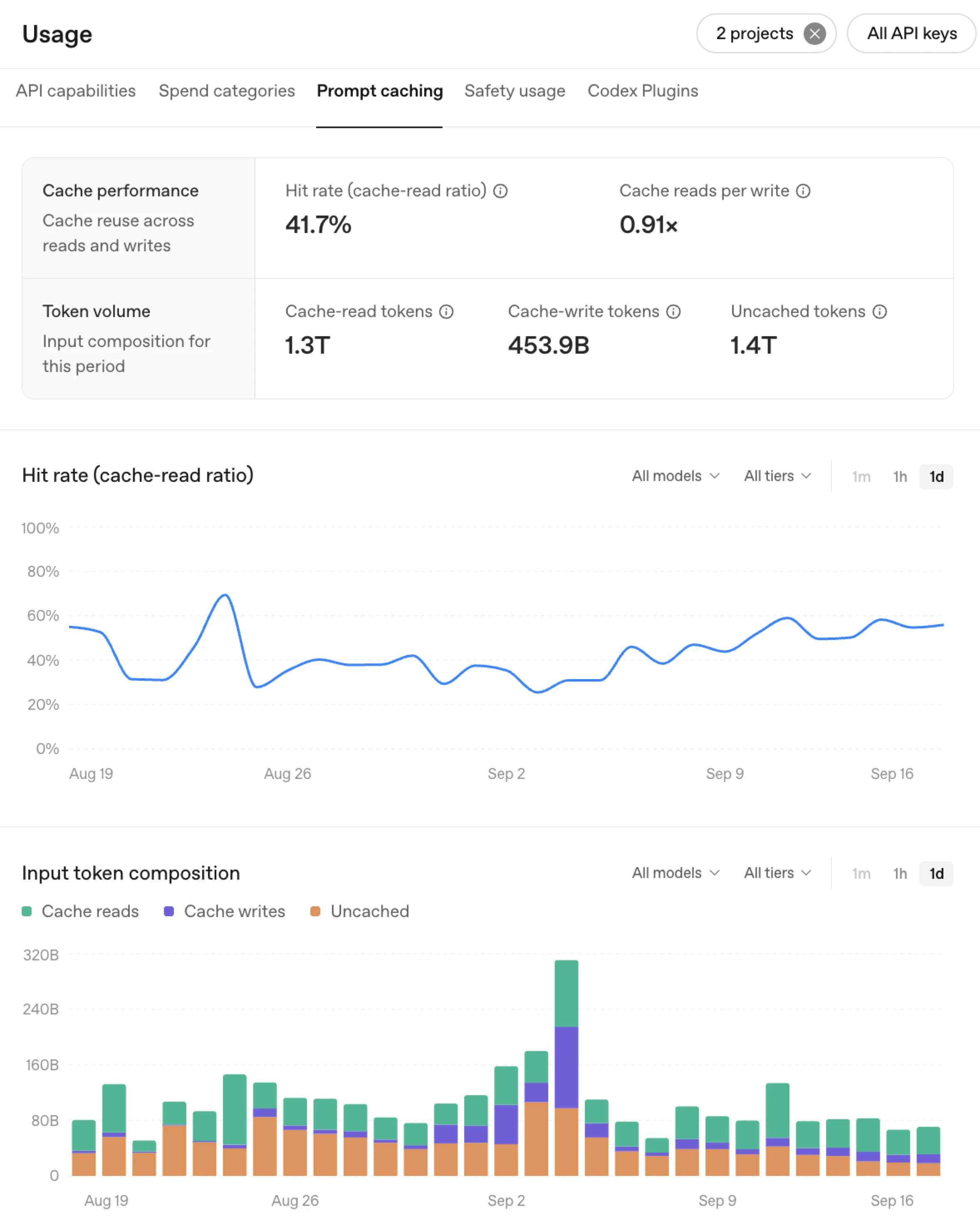
When a hit rate drops, the diagnostics guide describes an API that compares a request with a recent similar request. The response provides a structured miss reason and counts the affected tokens:
{
  "prompt_cache_diagnostics": {
    "type": "cache_miss",
    "reason": "tools_changed",
    "comparison_reusable_tokens": 5629,
    "cache_missed_tokens": 5629
  }
}
A reason such as tools_changed points to a modified or reordered tool schema. Because caching depends on an identical token prefix, an early change can invalidate reuse for every token that follows it. The reusable and missed token counts show the size of that impact.
Controls keep prefixes stable
The new controls focus on preserving stable prompt sections as an agent accumulates messages, changes reasoning settings, and selects tools:
- Explicit cache breakpoints. Mark selected prompt prefixes as reusable, giving the application clearer control over cache boundaries.
- Reasoning changes within a conversation. GPT-6 models can change reasoning effort between responses by appending a
configuration_updatewhile retaining the original request-level reasoning-effort setting. This allows a difficult step to use more reasoning without invalidating the existing cached prefix. - Append-only tool changes. Keep tool definitions in a stable order and use
allowed_toolsto expose the relevant subset for each call. Settool_choicetononewhen the model should call no tools. Append revised instructions at the end of the context so earlier content remains stable. - Prewarming. Send shared instructions, tool definitions, or reference material at startup so the first user request can reuse an existing prefix. Teams should include the prewarm request when calculating total cost and latency.
Early users report higher hit rates
OpenAI’s launch materials include production and evaluation results from several customers:
| Team | Reported result |
|---|---|
| Manus | Its OpenAI model cache hit rate rose from about 85% to consistently above 90% in less than a week. |
| Session-agent team | Explicit breakpoints increased evaluation hit rates from 83% to 91%, reduced cache writes by roughly two-thirds, and cut inference costs by 36%. |
| GitHub Copilot | Prompt tokens requiring fresh processing fell by more than 50% from its previous baseline. |
These customer-reported figures cover different production and evaluation workloads. Each team should measure hit rate, latency, cache writes, and total input cost against its own traffic patterns.
A five-step rollout
- Establish a baseline. Use the dashboard to record hit rates, cached token share, latency, and input cost by model over a representative period.
- Stabilize the prefix. Place durable system instructions and tool schemas first. Append user queries, retrieved passages, and other volatile content later.
- Control prompt changes. Keep tool definitions in a fixed order, add explicit breakpoints where useful, and gate tool availability with
allowed_toolsortool_choice. - Prewarm shared contexts. Test startup calls for high-reuse prompts, then verify that subsequent savings cover the additional request.
- Diagnose regressions. Query the diagnostics endpoint after a hit-rate drop and correlate its reason code with recent prompt, schema, or configuration changes.
Anthropic and Google also offer prompt caching, and developers have long used stable system prompts and deterministic tool ordering to improve reuse. OpenAI’s GPT-6 update formalizes those practices through supported controls, while the dashboard and diagnostics connect each cache miss to a concrete prompt change and its token cost.
Comments
