

OpenAI Cuts Cursor's Access to GPT Models After SpaceX Takeover
OpenAI will cut off Cursor's direct model access on November 12, citing distrust of SpaceX after the Musk-led firm's $60B takeover.
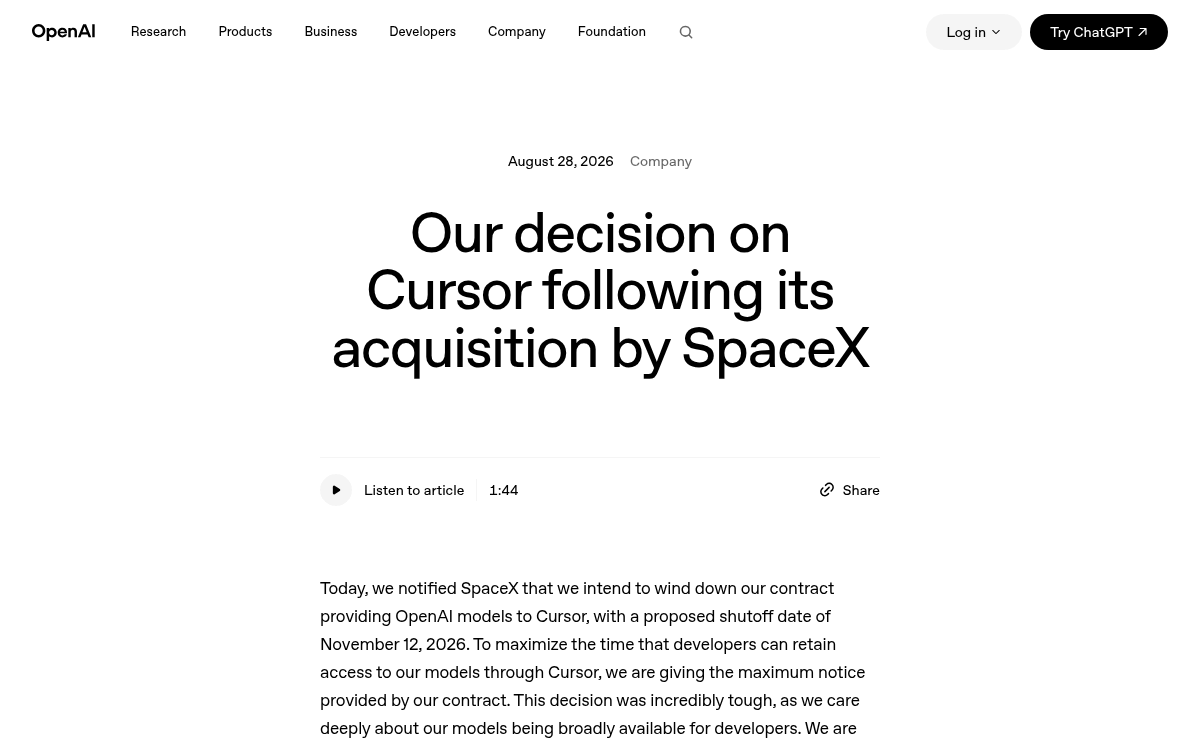
- OpenAI is ending its Cursor partnership with a November 12 shutoff for direct model access.
- OpenAI cites SpaceX and Musk companies' history of violating terms of service as the core reason.
- SpaceX closed its $60B all-stock acquisition of Cursor parent Anysphere on August 14, 2026.
- Cursor now sits inside SpaceXAI alongside Grok and xAI's Colossus compute infrastructure.
- OpenAI ties the timing to accountability for its upcoming frontier model Astra.
- Anthropic, Codex, and Windsurf are best positioned to absorb displaced Cursor traffic.
OpenAI has pulled the plug on one of the most important integrations in the AI coding world. In a short public notice, the company said it is winding down the contract that gives Cursor direct access to its models, with a hard shutoff proposed for November 12. The reason, stated bluntly: OpenAI does not trust SpaceX to honor its terms of service now that Elon Musk's rocket company owns the popular AI code editor.
The move severs a nearly four-year commercial relationship and reshuffles the competitive map for AI-assisted programming. It also signals how frontier labs plan to defend their most valuable models as the industry consolidates under a shrinking number of very large owners.
The trust argument, in OpenAI's own words
OpenAI framed the decision as risk management rather than retaliation. The company said it typically relies on custom contracts to ensure compliance with its terms of service, and that integrations at the scale of a SpaceX partnership require safety guarantees it no longer believes it can get. It cited two prior incidents to justify pulling out.
After Musk acquired Twitter (now folded into SpaceX), OpenAI says the company broke the terms of their contract. More damaging, Musk admitted under oath earlier this year that xAI, now also part of SpaceX, had violated OpenAI's terms of service. OpenAI also invoked its upcoming frontier model Astra, arguing that as capabilities advance it has a new level of accountability to ensure the model is used within its rules.
The contract, according to OpenAI, includes a change-of-control clause that gave it a limited window to walk away after the acquisition. The company is using the maximum notice period to keep Cursor developers on GPT models for a few more weeks.
How Cursor ended up inside SpaceX
The backstory is one of the most aggressive consolidation plays the AI market has ever seen. SpaceX agreed to acquire Anysphere, the company behind Cursor, in a $60 billion all-stock deal announced June 16, 2026, widely described as the largest acquisition of a venture-backed startup ever. The transaction officially closed on August 14, completing a process that began with an April model-training partnership.
The economics were staggering even by AI standards. Cursor reached roughly $4 billion in annualized revenue in under four years, of which approximately $2.6 billion comes from enterprise B2B customers. At $60 billion, SpaceX paid about 15 times revenue, one of the largest multiples ever attached to an AI software company. Anysphere shareholders received SpaceX Class A stock priced against a seven-day volume-weighted average.
Cursor now sits inside SpaceXAI, the division formed when SpaceX acquired xAI in February. That single corporate roof houses Grok, Colossus-scale training infrastructure, and now the most popular AI-native IDE on the market. It is exactly the kind of vertically integrated stack that made OpenAI nervous.
What developers actually lose
Cursor's product identity has always centered on model choice. Users can route the same prompt to different frontier models and pick whichever produces better code. Losing first-party access to OpenAI's models breaks a real workflow for a lot of teams. Here is what changes on November 12 if nothing else moves:
- Direct in-editor access to GPT-family models through Cursor's OpenAI integration is expected to end.
- Cursor's own
Composermodels and Anthropic's Claude family remain available. - Grok and any future joint SpaceXAI or Cursor models continue as first-party options.
- Developers can still call OpenAI models via their own API keys where Cursor allows a bring-your-own-key path, though that changes billing, rate limits, and enterprise procurement.
OpenAI is trying to keep those developers in its ecosystem. The company said it is ready to go above and beyond to support the developers who rely on its models in Cursor during the transition, which is corporate-speak for a coming migration push toward Codex and the OpenAI API.
Astra changes the calculus
Timing matters. OpenAI recently confirmed Astra as its "next major model family," after an internal version solved ten open problems in math and theoretical computer science. It also disclosed that internal evaluations of Astra showed significant advancements in agentic coding and cybersecurity, and that it could not rule out critical cyber capabilities under its Preparedness Framework.
A model that strong, sitting inside a code editor owned by a direct competitor with a documented history of contract disputes, is exactly the scenario OpenAI's safety and legal teams want to avoid. Cutting the pipe before Astra ships makes the accountability story much cleaner.
Winners, losers, and second-order effects
The immediate winners are obvious. Anthropic's Claude models likely pick up incremental Cursor traffic overnight, and Anthropic's own Claude Code product has fewer reasons to fear the Cursor plus OpenAI combo. Grok and the first jointly trained SpaceXAI and Cursor model, developed for several months on xAI's Colossus infrastructure with Cursor employees working out of xAI offices, now have a clearer path to being the default in-editor experience.
The losers include developers on team plans who standardized on GPT for specific tasks, enterprises with procurement locked to Cursor as their single AI IDE, and arguably Cursor itself, which loses the strongest signal it had that it was truly model-agnostic. Analysts flagged exactly this risk earlier in the year: Cursor's greatest post-acquisition exposure was never an immediate product failure but a gradual loss of trust among developers and enterprise buyers.
Second-order effects deserve their own list:
- Every frontier lab now has a template for change-of-control kill switches in enterprise contracts. Expect them everywhere.
- AI IDE buyers will start pricing in ownership risk alongside model quality. A tool controlled by a hyperscaler or rocket company is a different procurement conversation than a neutral vendor.
- OpenAI's Codex and Windsurf (which OpenAI already owns) get a natural upgrade path for the Cursor exodus, especially for teams that want deep GPT integration.
- The multi-model routing thesis takes a hit. If suppliers can revoke access when the wrapper changes hands, the "best model for the job" pitch has a fragility problem.
What is now possible that was not before
For SpaceXAI, the split is an accelerant. With OpenAI out of the default model pool, the joint Cursor plus Grok model gets prime shelf space inside one of the most-used coding environments in the industry. That is the kind of distribution xAI could not buy at any price a year ago.
For OpenAI, the decision sets a precedent that frontier models come with strings attached even for paying customers. It is a bet that Codex, the API, and direct product surfaces are enough to keep developers loyal without Cursor as a distribution channel.
What to watch before the shutoff
Several questions remain open. Cursor has not publicly detailed a migration plan for GPT-dependent workflows. SpaceX has not said whether it will contest OpenAI's use of the change-of-control clause or seek an alternative arrangement. The timing also overlaps with Astra's rollout, which means the deadline could shift if either side finds a face-saving off-ramp.
The safer bet is that the shutoff happens on schedule. If you run Cursor in production with OpenAI models as your default, this is the quarter to test Claude, Composer, Grok, and Codex side by side and decide where your team actually wants to live.
Comments
