

OpenAI Builds ChatGPT for Teens a Full College Planning Tool
OpenAI is rolling out a College Planner, flashcards, and quizzes inside its under-18 ChatGPT tier, with early usage data showing heavy learning use.
- OpenAI is adding College Planner to ChatGPT for Teens in the coming weeks
- Launch targets US students in grades 10 to 12 applying to four-year colleges
- Tool unifies deadlines, requirements, financial aid, scholarships and fee waivers per school
- 1.2 million teens used Learning Visualizations in a single week, OpenAI says
- New flashcards, quizzes, and iOS multi-photo note capture roll out alongside
- Boston Children's Hospital will run a ~22-student council advising on teen AI safety
OpenAI gives ChatGPT for Teens a college planner
OpenAI is expanding its under-18 version of ChatGPT with a college-planning tool, faster note uploads, generated study materials and a teen advisory council. The teen education update extends the company’s push into education while addressing scrutiny over how chatbots affect younger users.
ChatGPT for Teens is the restricted experience applied to accounts OpenAI identifies as belonging to people under 18. The company uses age-prediction technology to route users into the experience, which limits some content and adds interventions such as break reminders. The latest release builds on previously introduced features including Study Mode and Learning Visualizations.
One plan for deadlines and aid
College Planner combines application requirements, deadlines, tasks and financial-aid steps for every school on a student’s list. Students can update their progress, review a timeline and ask ChatGPT questions about individual requirements. OpenAI’s announcement describes planning and guidance features, with no application-submission function.
The initial release targets US high school students in grades 10 through 12 who plan to attend four-year colleges. OpenAI expects to add more countries and support two-year colleges, technical colleges and trade schools. The company provided no specific launch date, saying rollout would begin “in the next few weeks.”
Financial-aid tools can explain requirements, track school-specific deadlines and surface scholarships and fee waivers. OpenAI is also supporting College Advising Corps, which places recent graduates as advisers in under-resourced high schools, and funding an AI fellowship for those advisers.
The announcement leaves several implementation details unresolved. OpenAI has not explained where College Planner gets each school’s requirements, how often that information is refreshed or whether institutions can correct inaccurate records. It also gives no details about integrations with application systems, data retention or export options. Those gaps affect whether students can rely on the planner as a primary record or need to verify every deadline with colleges.
Who gets what, and when
| Feature | Availability | Purpose |
|---|---|---|
| College Planner | US students in grades 10 through 12; rollout expected within weeks | Tracks applications, deadlines, tasks and financial aid |
| Multi-photo note capture | Available first on iOS; Android support in development | Combines photographed pages into one PDF |
| Flashcards and quizzes | Available through uploaded notes in the teen experience | Converts source material into saved decks or interactive practice |
| Teen advisory council | Three-year program with about 22 participants | Tests tools and recommends safety and literacy changes |
Usage figures come with caveats
OpenAI also published its first engagement figures for the teen experience, covering adoption, session length and responses to break reminders.
- Nearly 1.2 million teens used Learning Visualizations, and more than 180,000 used Study Mode, during one week.
- OpenAI reports about 2.7 million additional learning-related messages, on average, among teens with access compared with those without it. The announcement does not specify the unit of analysis for that figure.
- Average daily use remains below 15 minutes, while fewer than 2% of teens use ChatGPT for more than three consecutive hours.
- More than 80% of those longer sessions include at least one learning-related prompt.
- In nearly half of conversations that displayed a break reminder, the teen paused or ended the chat within five minutes.
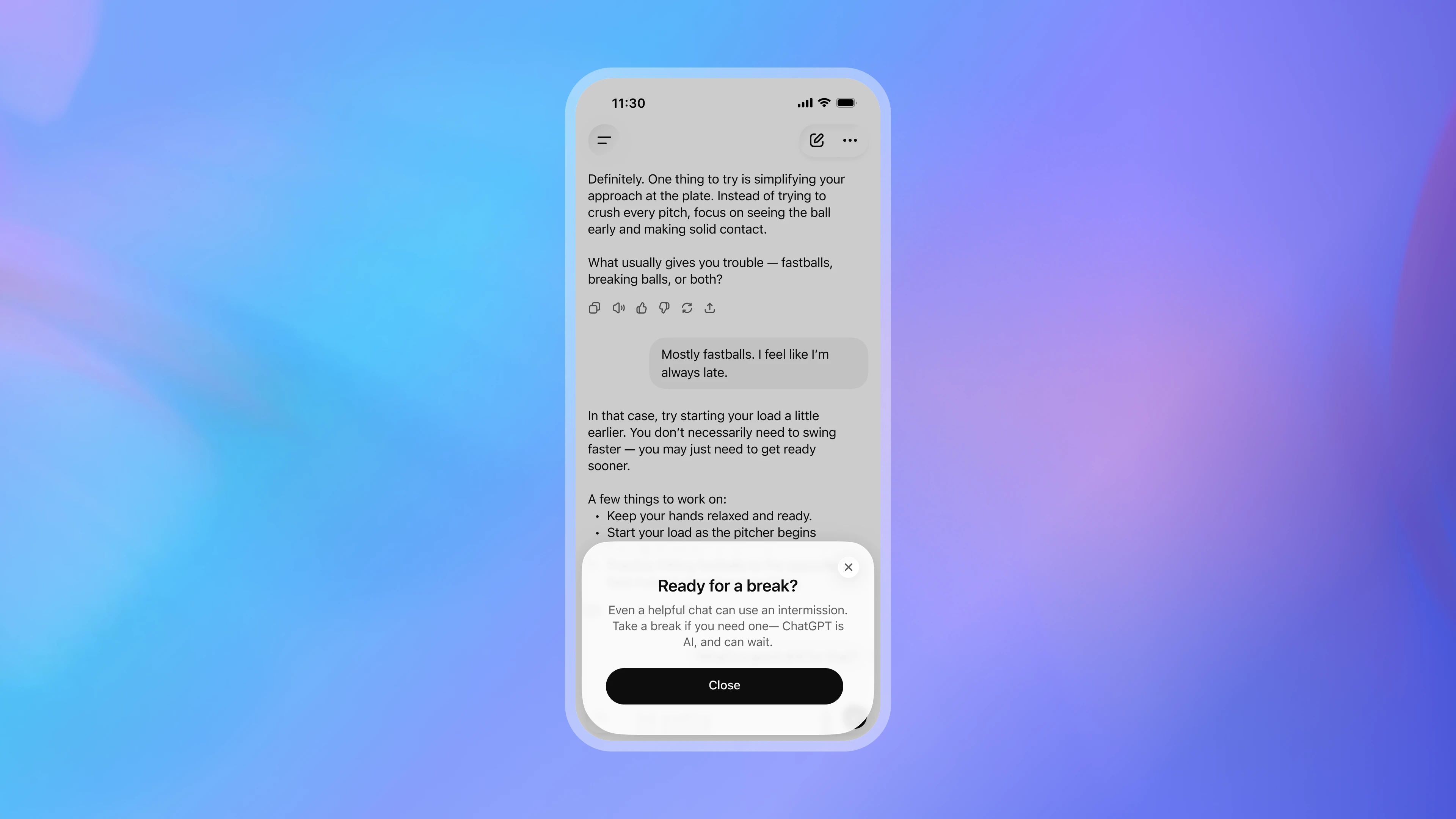
The figures are company-reported and lack several details needed for independent evaluation, including sample sizes, geographic coverage, observation dates and the method used to classify learning-related prompts. The break-reminder statistic also lacks a control group, so it does not establish whether the reminder caused users to leave.
OpenAI contrasts the daily-use figure with an estimate that teenagers spend roughly five hours per day on social media. The comparison combines different product categories and potentially different measurement methods, limiting what it shows about relative engagement or risk.
Safety scrutiny shapes the release
The update arrives as OpenAI faces legal and regulatory scrutiny over protections for younger users. The family of a teenager who died by suicide has sued the company, alleging that ChatGPT’s safeguards failed and contributed to his death. The lawsuit’s claims remain unproven in court. OpenAI has since expanded age prediction, teen-specific defaults, parental controls and in-product interventions.
OpenAI is funding Boston Children’s Hospital’s Digital Wellness Lab for three years to run a council of roughly 22 teenagers. Participants will test proposed tools and recommend changes to safety defaults, parental controls and AI-literacy features. The council creates a formal feedback channel through an external institution, although OpenAI has not committed to adopting or publishing its recommendations.
Notes become decks and quizzes
The study updates focus on reducing the work required to move paper notes into ChatGPT. Continuous multi-photo capture lets students photograph several pages in sequence and combine them into a single PDF. OpenAI says the feature is available on iOS, with Android support in development.
Students can convert uploaded notes into flashcard decks stored in their ChatGPT Library or generate interactive quizzes that run inside the conversation. The workflow combines document capture, content extraction and generated practice materials without requiring a separate study app.
OpenAI moves up the education stack
College Planner adds a persistent workflow to ChatGPT’s existing tutoring and study features. Combined with multi-image document ingestion, generated assessments and teen-specific safety controls, it places OpenAI in direct competition with education products built around a narrow layer of model prompts.
Specialized education products can still differentiate through verified institutional data, counselor collaboration, school-system integrations, accessibility, stronger privacy controls and evidence of learning outcomes. OpenAI’s distribution and first-party access to ChatGPT give it an advantage when comparable features sit inside a service students already use.
OpenAI has announced no API, SDK or integration points for College Planner, note capture, break reminders or the advisory process. Developers should treat them as first-party ChatGPT features unless the company later exposes corresponding platform capabilities.
Comments
