

Open-Source Digital Twin Cuts EV Charging Planning Time by 82%
Researchers publish an agent-based simulation platform that embeds metaheuristic optimizers directly into the loop, trimming search cost by 82% for charger and solar planning.
 PRO
- Paper proposes a digital twin framework fusing agent-based EV simulation with embedded optimization.
- PSO finds near-optimal charger and solar configurations in ~50 evaluations vs 280, an 82% compute cut.
- Dynamic slot-availability notifications lift user satisfaction by 10% in high-demand scenarios.
- Solar output drops 21% October to March in Hanoi; wind adds under 5% for a 28% cost bump.
- Six optimizers (hill climbing, SA, tabu, reactive tabu, GA, PSO) are embedded in the simulator.
- Code, config, and appendix released on GitHub under the GAMA platform.
A team of researchers has published a paper proposing a digital twin framework for planning electric vehicle charging infrastructure at a neighborhood scale. Rather than the usual pipeline of running a simulation and then feeding results into a separate optimizer, they fuse the two steps into one interactive tool and demonstrate it on a real university campus in Hanoi. The accompanying code is available on GitHub.
Why static models keep falling short
EV rollout planning has typically leaned on static mathematical models that oversimplify how drivers actually behave and how weather affects renewable supply. Agent-based simulations have started to close that gap by modeling individual drivers, but they still tend to focus narrowly on where to place a station, largely ignoring operational policies, seasonal energy variability, and the interactive dashboards planners need.
The digital twin concept, a virtual replica of a physical system used for what-if analysis, has been floated for city logistics, but its application to EV charging infrastructure planning remains largely unexplored. This paper is a shot at that gap.
How the twin is built
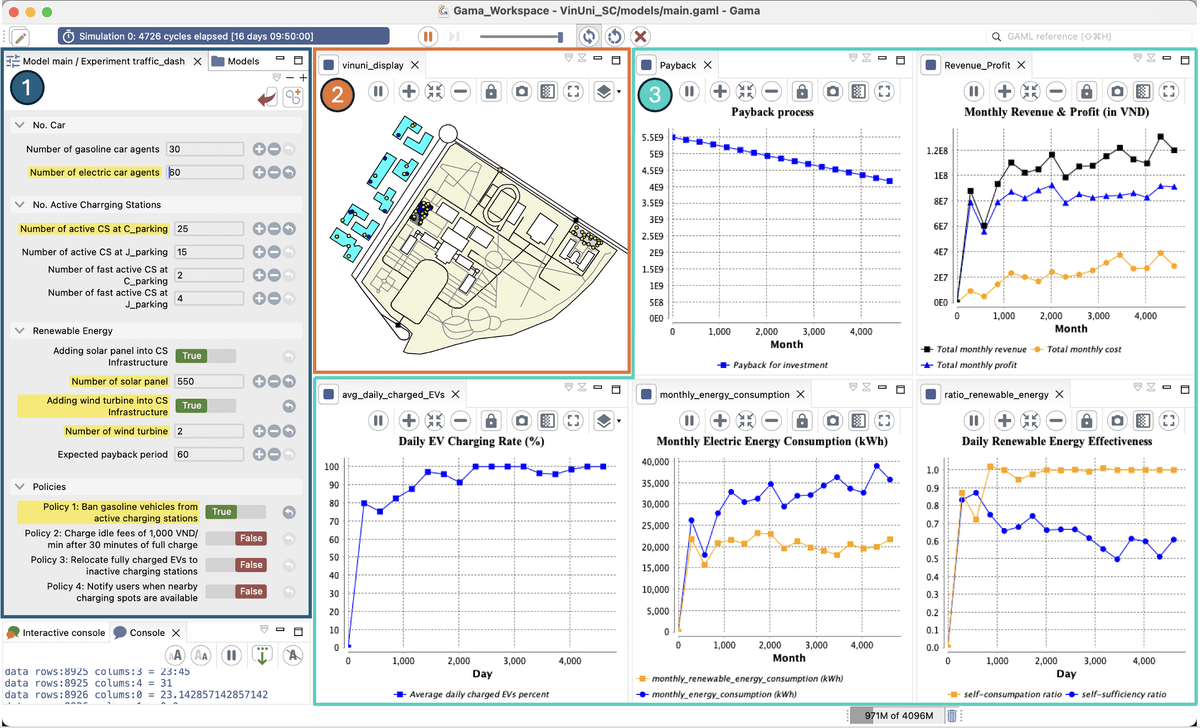
The framework is implemented on the GAMA simulation platform, with three interacting sub-models: a charging station layer, an energy layer covering solar, wind and battery storage, and a traffic layer where EV and gasoline agents make decisions. Each simulated vehicle carries state like battery level, satisfaction, and priorities for fast versus slow charging. Arrivals follow a bimodal empirical distribution calibrated from a week of field observations on campus, and each vehicle's state of charge is re-randomized daily to capture behavioral variability.
This story is for Pro members
You've reached the end of the free preview. Upgrade to AlphaSignal Pro to read the full article - and everything else behind the paywall.
Comments
