

Odyssey's Agora-2 Lets 20 Players Share One AI-Generated World
Odyssey's Agora-2 simulates a shared Diablo II style world for up to 20 humans and agents in real time, with no game engine underneath.
- Odyssey released Agora-2, a multi-agent world model simulating shared environments for up to 20 humans and agents in real time.
- Playable preview pits 4 humans against 16 RL-trained agents in a Diablo II style world, no game engine underneath.
- Architecture splits a simulation model, a shared world server, and per-participant flow-matching rendering models.
- Shared server-side state keeps entities coherent even when off-screen, fixing a core weakness of prior video world models.
- Agents trained via RL and coupled to PROWL so simulator and policies improve together.
- Details in the Agora-2 technical report; try it at agora.odyssey.ml.
Agora-2 synchronizes 20 participants in a generated world
Odyssey has released a playable research preview of Agora-2, a neural world model that predicts how an environment changes after participants act. Agora-2 supports up to 20 humans and agents inside a shared world simulation. Learned models predict movement, combat effects, enemy reactions, and pixels, while a central server keeps every participant synchronized.
- Session capacity: Up to 20 participants, including four humans and 16 reinforcement learning agents.
- Output: A separate generated pixel view streams to each participant in real time.
- Architecture: A simulation model updates shared state, and a rendering model converts that state into individual views.
- Training data: Captures pair visual observations with actions and state from a Diablo II environment.
A server gives the model memory
Most video world models generate one viewer’s next observation from that viewer’s action history. Such a setup lacks an authoritative record of objects, participants, and events shared across independent viewpoints. Agora-2 maintains that record explicitly, allowing one participant’s action to affect what every other participant sees.
Odyssey says Agora-2 supports five times Agora-1’s participant count, spans multiple environments, and handles more complex interactions over longer sequences. Odyssey-3, by comparison, models a single participant’s experience rather than a synchronized group.
The training corpus pairs frames with actions and structured state. From those examples, Agora-2 learns statistical representations of navigation, projectiles, collisions, combat, and interactions among players and monsters. The constrained action-RPG setting supplies recurring entities and clear cause-and-effect sequences for testing shared-state prediction.
State first, pixels second
Agora-2 divides generation between two learned components and an authoritative world server. The components exchange structured state rather than relying on generated frames alone.

- Encode participants: The simulation model receives entity properties, recent actions, and nearby geometry.
- Predict interactions: Attention mechanisms weigh relationships among entities, including their positions and recent behavior, when estimating each action’s consequences.
- Merge state: The world server reconciles those predictions into one authoritative account of the environment.
- Render viewpoints: Each participant’s renderer receives the shared state alongside that participant’s recent visual history.
- Continue the loop: Newly generated views become visual history for the next update.
Entity properties remain in the server’s canonical state when an object leaves a participant’s view. When that object returns, the renderer can use retained state instead of reconstructing it solely from old frames. Authoritative multiplayer servers use a similar persistence model, with Agora-2 supplying the client view through neural generation.
Training the renderer away from shortcuts
Each participant receives a personal view conditioned on the shared environment, relevant entities, interaction effects, and recent frames. Visual history helps preserve appearance across updates, while structured state tells the renderer what the simulation currently contains.
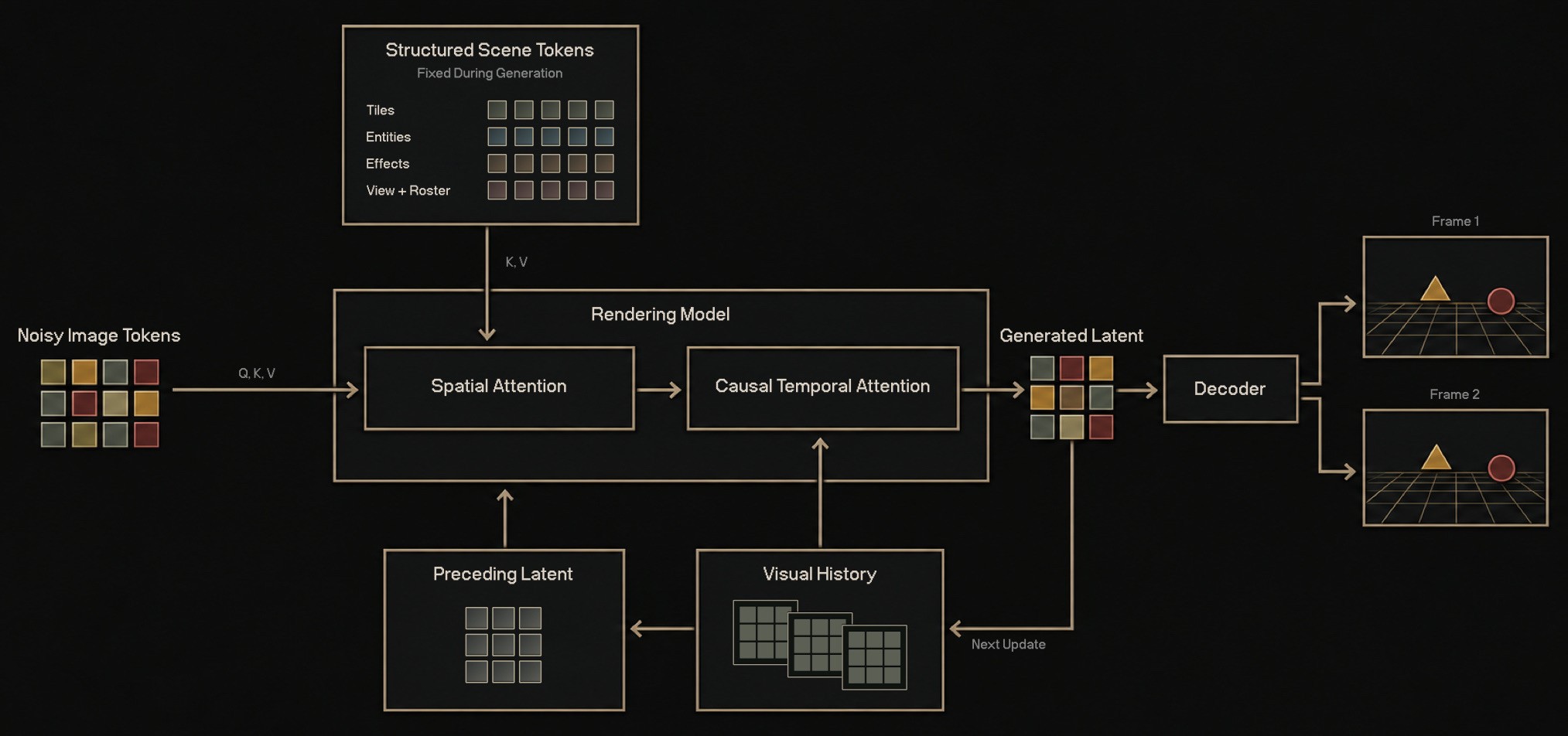
- Flow matching: Training presents sequences at different noise levels and teaches the model a path from noisy frames toward clean ones, using an objective related to diffusion models.
- Visual-history dropout: Odyssey frequently removes recent frames during training, forcing the renderer to use supplied state instead of copying its previous output.
- Entity-weighted loss: Errors involving players and monsters receive extra weight, directing more model capacity toward interactive objects than background tiles.
At inference time, every generated view feeds into the next update. That recurrent process connects user input, shared-state prediction, and rendering across the full session.
Agents learn from partial views
Odyssey trains the 16 opponents with reinforcement learning, a method that improves an agent’s policy through rewards from repeated interaction. The agents learn to pursue opponents, navigate around obstacles, and recover after becoming stuck or separated.
Those agents act from partial observations rather than receiving unrestricted access to the server’s full state. Recent observations help them track nearby participants and adjust their behavior as positions change.
Odyssey links this work to PROWL, a project that uses agent experience to improve a world model’s training data. The proposed feedback loop alternates between improving the simulator and training stronger policies within it.
A path beyond action RPGs
Odyssey proposes the shared-state architecture for domains where several humans and agents must interact over extended sequences. Each application would require domain-specific data, validation, and safety controls.
| Domain | Potential experiment |
|---|---|
| Robotics | Train several robots to coordinate tasks with humans and other machines. |
| Autonomous driving | Generate learned behavior for surrounding vehicles instead of relying entirely on scripted traffic. |
| Cybersecurity | Run attacker-and-defender simulations in which both sides adapt their policies. |
| AI safety | Observe coordination, collusion, and harmful strategies inside a controlled environment. |
| Interactive media | Generate world behavior and visual content from models instead of encoding every interaction by hand. |
Where the preview stops
The preview covers a narrow slice of one game environment, so it does not establish broad generalization across visual styles, physics, entities, or action spaces. Generated views also depend on compressed neural representations and recurrent visual history, creating opportunities for identity, geometry, and state errors to accumulate during longer sessions.
Session capacity stops at 20 participants, leaving throughput, latency, GPU cost, and output quality at larger scales unresolved. Comparative benchmarks against conventional simulators would also be needed to measure training value, scenario diversity, long-run consistency, and cost per generated interaction.
Odyssey identifies generalization as an open problem. Extending the architecture to a foundation world model such as Odyssey-3 would require representations that describe unfamiliar entities, actions, and relationships while preserving coherent interaction across independent viewpoints.
Stress tests for the browser demo
Agora-2 combines an authoritative multiplayer topology with learned state transitions and neural rendering. That design creates a shared environment in which several policies can interact, making multi-agent world models more practical as research simulators.
A hands-on session can expose several properties that screenshots and short clips cannot capture:
- Whether crowded encounters remain synchronized across participants.
- Whether off-screen entities preserve their properties when they return.
- How visual identity and geometry change during longer sessions.
- How responsiveness changes as more humans and agents join.
- Whether agents recover coherently from unusual positions or blocked paths.
The browser preview provides access to the live system, while the technical report documents the architecture and training methods.
Comments
