

Odyssey Builds One AI Backbone to Control Robots, Cars, Drones, and Games
Odyssey unveils a single foundation world model that controls robots, humanoids, cars, drones, and video game characters with only hours of task data.

- Odyssey unveiled Odyssey-3, an autoregressive diffusion transformer foundation world model for embodied control.
- Same frozen backbone controls robot arms, humanoids, cars, drones, and video game characters via lightweight action decoders.
- Sim-only driving policies reached 77% of real-footage policies' distance between interventions on Indian roads.
- Humanoid work with Flexion generalized to lighting changes that broke VLA baselines.
- Zero-shot transfer: GTA-trained mobility policy produced horseback movement in Red Dead Redemption 2.
- Public release planned in coming weeks; already deployed with robotics, driving, gaming, and defense partners.
Odyssey-3 shares a world-model backbone across robots, cars, drones, and games
Odyssey has announced Odyssey-3, an autoregressive diffusion transformer designed to simulate environments and control several kinds of embodied systems. The company presents it as a reusable foundation model: developers keep the pretrained backbone fixed and train a compact action decoder on observations and controls from a target robot, vehicle, drone, or game. If the reported transfer holds across independent tests, the design could reduce platform-specific data collection and full-model retraining.
One backbone, many controllers
Odyssey describes its model as an autoregressive diffusion transformer. Autoregression predicts sequences one step at a time, and diffusion generates outputs through iterative refinement. Odyssey combines those methods to model how environments evolve and how actions change them. According to the company, the same pretrained backbone supports every demonstration.
For each target system, developers collect experiential data consisting of paired observations and actions. A learned decoder then translates the model’s internal representations into joint movements, steering inputs, flight controls, or game commands. Training updates the decoder while the backbone remains frozen, preserving its pretrained parameters and limiting the number of components that require adaptation.
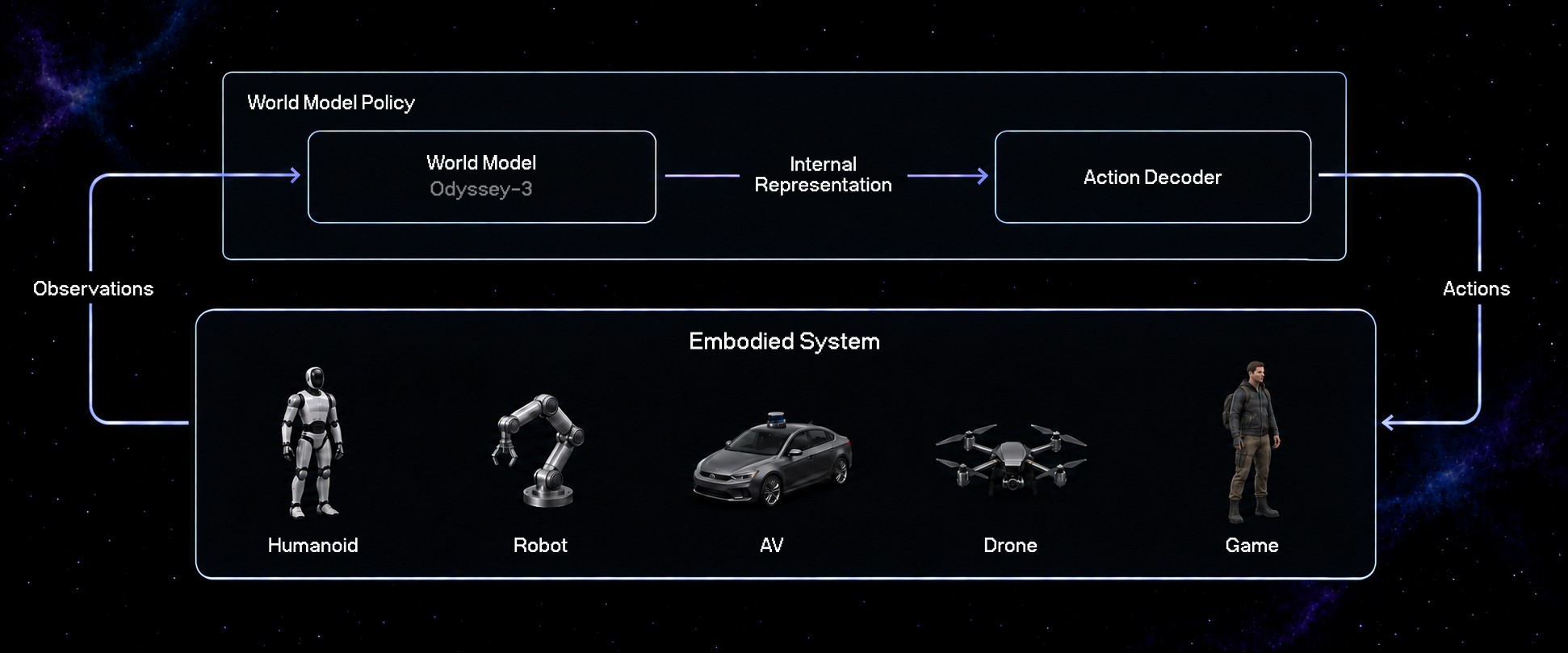
Five demos, different limits
Odyssey reports control experiments across five domains, plus a separate project that uses the model to train other AI agents.
| Domain | Training data | Reported result |
|---|---|---|
| Robot arms | Tens of hours of demonstrations | The model controlled several arms and completed multi-step tasks. Odyssey also observed recoveries absent from the demonstrations, including reorienting a gripper after a missed grasp and retrieving objects from unusual positions. |
| Humanoids | Tens of hours of teleoperation data | In collaboration with Flexion, Odyssey ran tasks in real time and reported stronger generalization than the tested vision-language-action baselines, including continued operation under lighting changes that disrupted those baselines. |
| Autonomous driving | 20 hours of simulated driving | The policy generated trajectories in real time and drove in closed loop on Indian roads. Policies trained entirely in simulation traveled about 77% as far between safety-driver interventions as policies trained on real footage. |
| Drones | Tens of hours of simulated flight | The resulting policy maintained stable flight and avoided obstacles in a simulated indoor environment. Physical flight was not reported. |
| Video games | Extended GTA V play, including about two hours used for a transfer experiment | A mobility policy trained on GTA V produced horseback movement in Red Dead Redemption 2 without game-specific training examples, a setup Odyssey describes as zero-shot transfer. |
PROWL turns the model into a training environment
Odyssey also uses Odyssey-3 as an interactive simulator through a companion project called PROWL. AI agents act inside generated environments and learn from the consequences. Their failures can supply examples for improving the world model, while the model produces additional situations for training the agents.
That feedback loop could support stress testing and exposure to rare scenarios before hardware deployment. Simulation alone cannot establish physical safety because modeling errors may omit real hazards or create unrealistic ones. Agents trained through PROWL would still require evaluation on physical systems and under independently designed tests.
The economics hinge on transfer
Embodied AI systems commonly depend on data collected for a particular body, task, and environment. A transferable backbone concentrates broad dynamics learning in pretraining and limits later work to a smaller decoder. Potential gains include fewer trainable parameters, shorter adaptation cycles, and reuse across control interfaces, provided the backbone captures the physics and causal structure each platform requires.
The cross-game experiment offers evidence for representations that extend beyond one environment. A policy learned from GTA V footage generated movement for a different character in Red Dead Redemption 2. One example cannot establish broad transfer, however, or distinguish abstract locomotion knowledge from transfer enabled by similar controls and visual patterns.
The evidence still has gaps
- Independent validation: The figures come from Odyssey’s announcement. Independent benchmark results are not yet available.
- Driving metrics: The 77% result is relative to a policy trained on real footage. Developers still need absolute intervention-free distances, route details, traffic conditions, trial counts, and variance.
- Physical coverage: The drone experiment remains in simulation. The robot-arm and humanoid claims need task-level success rates across hardware, environments, and viewpoints.
- Collection costs: Tens of hours is modest by embodied-AI standards, but teleoperation remains expensive and must be repeated for each new embodiment.
- Implementation details: The announcement does not specify the parameter count, pretraining-data composition, inference hardware, control frequency, latency, or decoder-training recipe.
- Generalization: Odyssey has announced a benchmarking partnership with Poke & Wiggle to test the model across bodies and viewpoints. Results from that work have not been published.
Access remains gated
Odyssey says it plans to release Odyssey-3 publicly within weeks of the announcement and directs developers to its developer portal. At publication, no public download or pricing had been announced. The company also has not specified the release format, license, checkpoint access, API limits, or hardware requirements.
Odyssey says organizations in robotics, autonomous driving, gaming, and defense are already using the model, though it has not identified those users or described their deployments. Independent benchmarks will need to measure data efficiency, control reliability, latency, and sim-to-real transfer against body-specific baselines. Consistent gains on those measures would support Odyssey’s case for a shared foundation model across embodied systems.
Comments
