

NVIDIA Shrinks Qwen3.5-122B to Run on a Single Blackwell GPU
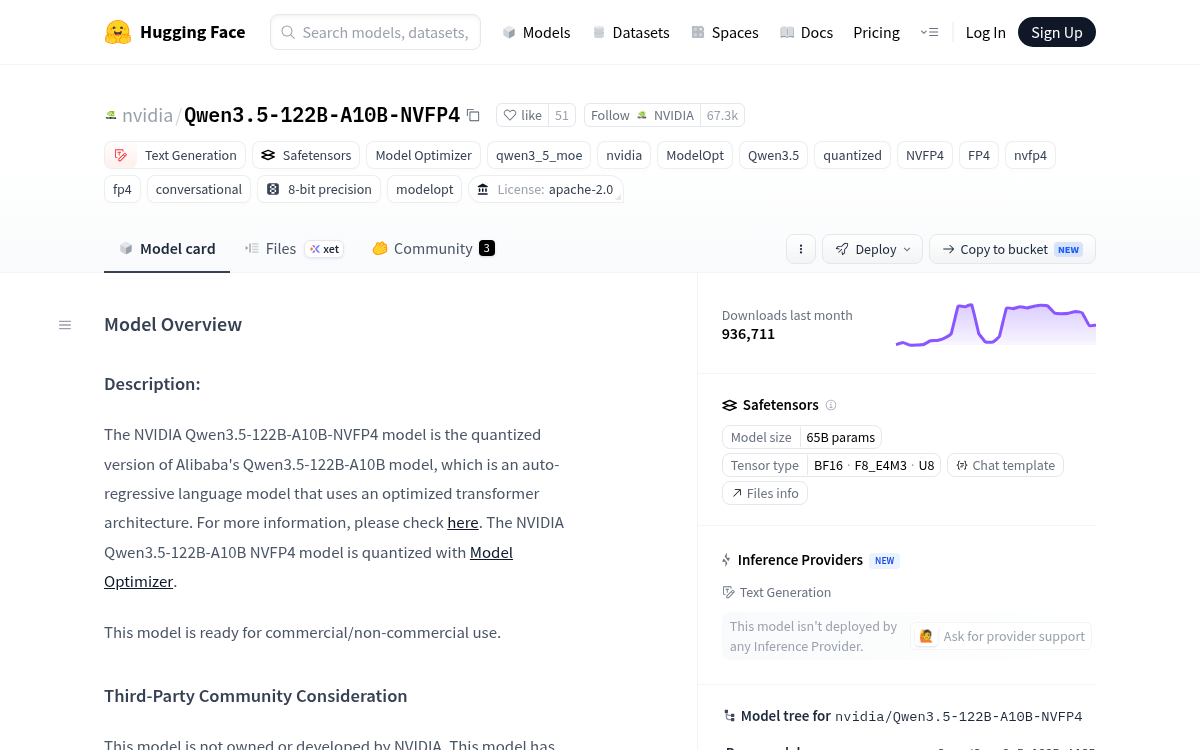
NVIDIA released a pre-quantized NVFP4 build of Qwen3.5-122B-A10B that shrinks the MoE model roughly 4x with near-zero accuracy loss on Blackwell.
 PRO
- NVIDIA released an NVFP4 quantized Qwen3.5-122B-A10B, a 122B MoE with 10B active params.
- 4x smaller than BF16, fits on a single B200 with tensor-parallel-size 1.
- Accuracy within 0.4 points of FP8 on MMMU Pro, GPQA Diamond, SciCode, and IFBench.
- NVFP4 uses E2M1 values with 16-element blocks, FP8 E4M3 block scale, plus FP32 per-tensor scale.
- Ships with vLLM support, FP8 KV cache, and 262K context window out of the box.
- Blackwell-only for native FP4 tensor core acceleration; Apache 2.0 licensed.
NVIDIA has published a pre-quantized NVFP4 checkpoint of Alibaba's Qwen3.5-122B-A10B, a Mixture-of-Experts model with 122B total parameters and roughly 10B activated per token. The release targets Blackwell owners who want a 4-bit checkpoint they can serve directly through vLLM without running their own calibration pipeline. It has crossed 900K downloads on Hugging Face.
How NVFP4 works
NVFP4 is a 4-bit floating-point format tied to Blackwell tensor cores. Each value is stored in E2M1 (one sign bit, two exponent bits, one mantissa bit) with symmetric per-group quantization at a group size of 16, finer than MXFP4's group size of 32. Each 16-value block stores one 4-bit number per element, one shared FP8 scaling factor, and one FP32 per-tensor scaling factor, averaging around 4.5 bits per value. The two-level scaling preserves dynamic range in weights that mix very large and very small values, which is where earlier FP4 schemes tended to fall apart.
Compared to FP16, memory footprint drops by roughly 3.5x; compared to FP8, by about 1.8x. Both figures are higher overhead than typical INT4 at block size 128, but NVFP4 earns it back in hardware: Blackwell tensor cores run matmuls directly in FP4, so there's no mid-inference dequantization step to bloat latency. INT4 inference requires unpacking weights back to 16-bit before computation; NVFP4 skips that entirely.
This story is for Pro members
You've reached the end of the free preview. Upgrade to AlphaSignal Pro to read the full article - and everything else behind the paywall.
Comments
