

NVIDIA's RULER Exposes How Most LLMs Fake Their Context Windows
NVIDIA's RULER benchmark exposes the gap between claimed and real context windows, and its v2 update raises the bar further with multi-step reasoning tasks.
 PRO
- NVIDIA's RULER benchmark tests whether LLMs can actually use their claimed context windows, not just technically accept long inputs.
- Only half of models claiming 32K+ context windows maintain reliable performance at 32K on RULER's 13 tasks.
- Almost all models fall below RULER's performance threshold before reaching their advertised context length.
- RULERv2 (submitted to ICLR 2026) adds systematic difficulty progression and covers 33 models including 7 closed-source ones.
- RULERv2 finds that explicit retrieve-then-solve decomposition consistently beats single-step implicit reasoning on long contexts.
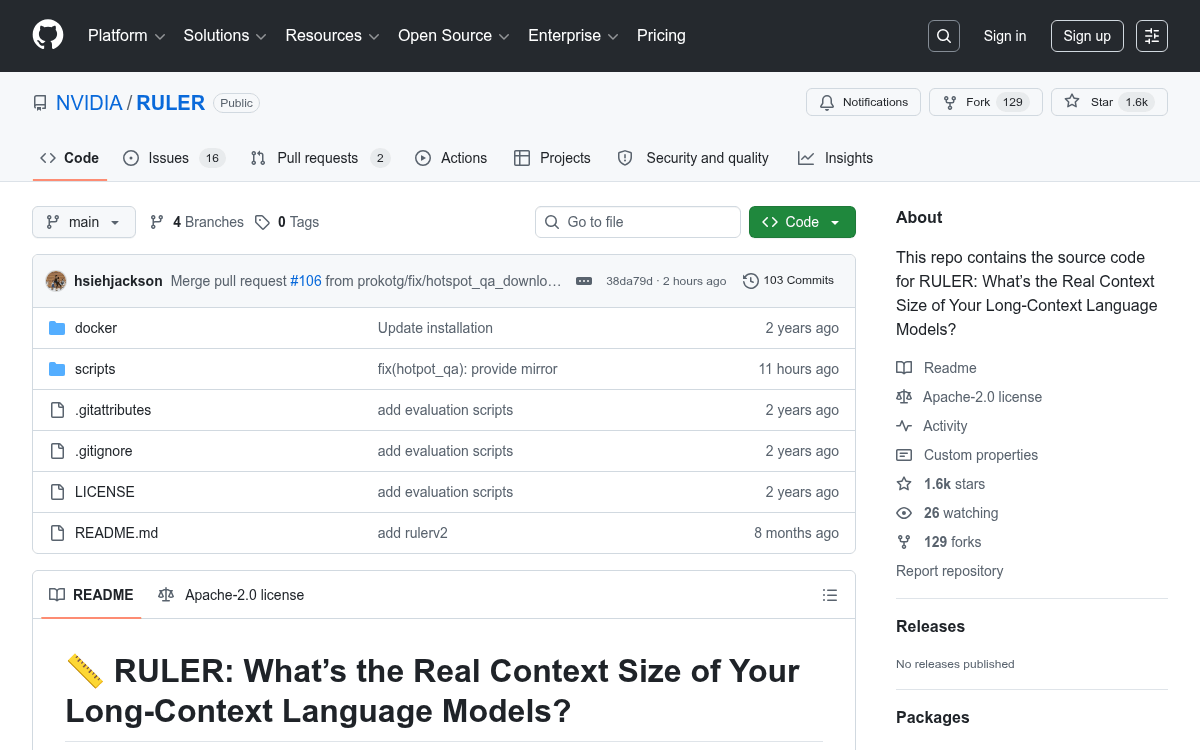
- The repo is open-source (Apache 2.0) and supports HuggingFace, vLLM, TensorRT-LLM, OpenAI, and Gemini backends.
Every major LLM release now comes with a headline context window: 128K, 256K, even 1M tokens. But can these models actually use all that context? NVIDIA's RULER benchmark was built to answer exactly that question, and the findings are uncomfortable for most model vendors.
The problem with "needle in a haystack"
The needle-in-a-haystack (NIAH) test, which examines the ability to retrieve a piece of information from long distractor texts, has been widely adopted to evaluate long-context language models. The issue is that it's too easy. Despite achieving nearly perfect accuracy in the vanilla NIAH test, all models exhibit large performance drops as the context length increases on harder tasks. A model that scores 99% on NIAH can still fail badly when it needs to do something more complex with a long document.
RULER is a synthetic benchmarking framework designed to evaluate the real context handling capabilities of long-context language models. RULER consists solely of synthetic tasks, offering the flexibility to control sequence length and task complexity. Synthetic input in RULER reduces reliance on parametric knowledge, which interferes with the utilization of long-context input in realistic tasks.
What RULER actually tests
RULER contains diverse task categories: retrieval, multi-hop tracing, aggregation, and question answering, providing a flexible and comprehensive evaluation of LLM long-context capabilities. That's 13 tasks in total, spanning four categories that progressively stress different cognitive demands on the model.
Here's what each category covers:
- Retrieval: Extended NIAH variants with multiple keys, multiple values, and multiple queries simultaneously hidden in the haystack
This story is for Pro members
You've reached the end of the free preview. Upgrade to AlphaSignal Pro to read the full article - and everything else behind the paywall.
Comments
