

NVIDIA's OpenShell Locks Coding Agents Inside Kernel-Level Security Boundaries
NVIDIA's open-source OpenShell gives autonomous AI agents a kernel-enforced sandbox with hot-reloadable YAML policies, solving the enterprise deployment gap.
 PRO
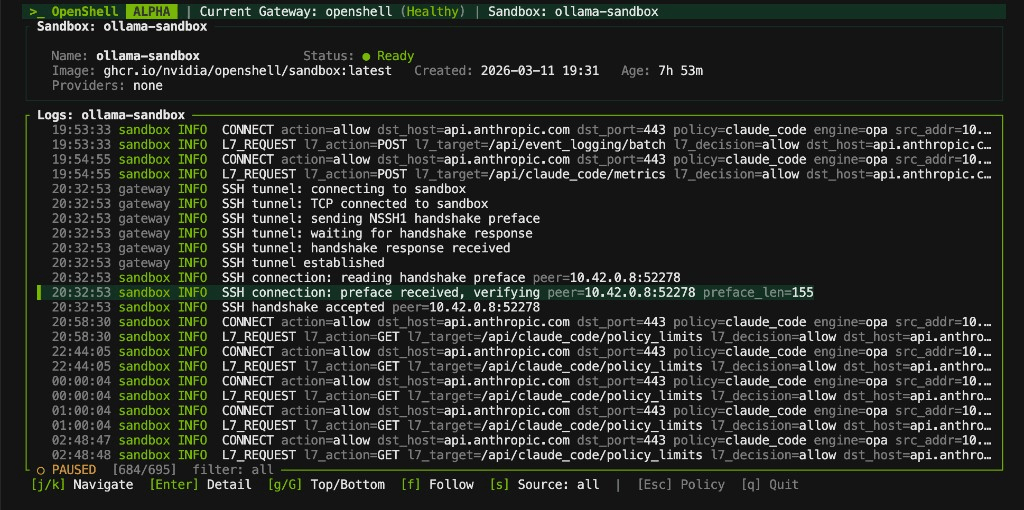
- NVIDIA open-sourced OpenShell at GTC 2026 -- a kernel-level sandbox runtime for autonomous AI agents, free under Apache 2.0.
- Four enforcement layers: filesystem isolation (Linux Landlock), network egress via OPA proxy, process privilege dropping, and inference privacy routing.
- Policies are YAML files that hot-reload on running sandboxes with no restart -- network and inference rules update live via
openshell policy set. - Supports Claude Code, Codex, OpenCode, and Copilot CLI out of the box; GPU passthrough is experimental for local inference workloads.
- v0.0.37 adds pluggable compute drivers (Docker, Podman, Kubernetes, MicroVM), OIDC + RBAC gateway auth, and Helm chart support.
- Still alpha (single-user mode); multi-tenant enterprise deployments are on the roadmap but not yet available.
Every team building with coding agents eventually hits the same wall: the agent needs broad access to be useful, but granting that access is a security nightmare. Security teams consistently reject agent deployments for the same reasons -- agents need to read files, execute commands, and make API calls, but that access cannot be unlimited in enterprise environments where compliance, data protection, and audit requirements are non-negotiable. The previous options were grim: neuter the agent until it's useless, or give it full access and hope for the best.
NVIDIA's OpenShell introduces a third option: let the agent operate freely within strictly enforced boundaries that security teams can audit and approve. Released under Apache 2.0 at GTC on March 16, 2026, it's an open-source runtime that wraps any autonomous agent in kernel-level isolation governed by declarative YAML policies. The latest release, v0.0.37, adds pluggable compute drivers, OIDC + RBAC gateway auth, Helm chart support, and Debian/RPM/Homebrew packages.
The threat model that motivated this
Every capable agent sits on what researchers call the "lethal trifecta": privileged access to private data, exposure to untrusted content like web pages and third-party plugins, and the ability to communicate externally. These capabilities introduce risks related to unauthorized skills, hidden behaviors, prompt injection, and unintended system access. A single malicious instruction embedded in a webpage or tool response can redirect an agent to exfiltrate credentials or modify files it was never supposed to touch.
The key insight behind OpenShell is that you are not trusting the model to do the right thing -- you are constraining it so that the right thing is the only thing it can do. This is a fundamentally different philosophy from prompt-based guardrails or application-level checks, which can be bypassed. OpenShell enforces at the OS level.
This story is for Pro members
You've reached the end of the free preview. Upgrade to AlphaSignal Pro to read the full article - and everything else behind the paywall.
Comments
