
NVIDIA's NCCL 2.30.7 Frees GPUs From the Hidden Communication Tax
NCCL 2.30.7 ships zero-SM collectives, MPS partition support, and major GIN networking enhancements for large-scale GPU training and inference
 Pro
Takeaways
- NCCL 2.30.7 ships hierarchical zero-SM collectives (AllGather, All2all) that free GPU compute cores during communication.
- Zero-SM collectives use hardware Copy Engines and a CPU proxy instead of GPU kernels; enabled via
NCCL_CTA_POLICY_ZERO. - GIN (GPU-Initiated Networking) gets a new GPU Push Interface backend, explicit signal semantics, and better queue controls.
- Experimental MPS + MLOPart support allows up to 2 NCCL ranks per physical GPU for dense inference deployments.
- Symmetric memory improvements include asymmetric buffer size support and batched CE operations for faster RMA paths.
- Known issue: one-sided RMA APIs require a warm-up call from every rank; zero-SM APIs require CUDA 12.5+. Full release notes.
NCCL (pronounced "Nickel") is the communication backbone of virtually every large-scale GPU training job. PyTorch's distributed training, Megatron-LM, and most inference serving frameworks all rely on it to synchronize gradients and activations across GPUs. The library just shipped version 2.30.7, and the headline feature is something the community has been asking for: collective operations that consume zero GPU streaming multiprocessors (SMs).
The SM tax problem
Every time NCCL runs a collective operation (like AllReduce or AllGather), it traditionally launches a CUDA kernel that occupies some of your GPU's SMs. Those SMs are unavailable to your compute kernels while communication is in flight. On large clusters running dense transformer models, this "SM tax" is a real bottleneck: you're paying for communication headroom even when you want to overlap compute and communication.
The new zero-SM collectives work by routing communication through hardware copy engines and a CPU-side proxy thread instead of launching GPU kernels. This frees up SM capacity for the application when using AllGather, AlltoAll, or Scatter, and is enabled by registering buffers into symmetric windows and using the NCCL_CTA_POLICY_ZERO flag in the communicator config.
The practical implication: on Blackwell-class systems with NVLink, you can now run communication and computation truly in parallel without either stealing resources from the other.
What's actually in 2.30.7
The release bundles four major areas of work:
- Zero-SM hierarchical collectives , AllGather and All2all variants that use an RMA CPU proxy for inter-node communication and Copy Engines for intra-node communication, enabling better overlap of compute and communication. Enable with the
NCCL_CTA_POLICY_ZEROflag. - GIN (GPU-Initiated Networking) enhancements , GIN, first introduced in 2.28.7, lets GPU kernels directly initiate network sends without going through the CPU. This release adds an experimental GPU Push Interface (GPI) backend, explicit strong/weak signal semantics, and better queue depth controls. It also ensures GIN works when NIC fusion is enabled.
- Symmetric memory improvements , Symmetric memory is a shared address space that all ranks can directly read/write. This release adds support for asymmetric buffer sizes during window registration, optimizes ReduceScatter kernel performance, and adds batched copy engine operations for faster RMA put/wait paths.
- MPS + MLOPart support (experimental) , CUDA's Multi-Process Service (MPS) lets multiple processes share a single GPU. NCCL now leverages Memory Locality Optimized Partition (MLOPart), supporting up to 2 ranks per physical GPU with MPS, which matters for dense inference serving deployments.
The GIN trajectory
GIN deserves special attention because it represents a fundamental shift in how NCCL thinks about networking. Traditionally, all network operations go through a CPU proxy thread: the GPU kernel finishes, signals the CPU, and the CPU initiates the network transfer. GIN bypasses this by letting the GPU kernel itself push data over InfiniBand.
The Q2 2026 roadmap includes multi-context and exclusive-context GIN support, VA-based GIN signals with strict window ordering, and advanced GIN queue control including queue depth, manual credit management, and aggregation. The 2.30.7 release delivers much of this, with the GPI backend being the newest experimental addition.
One important caveat: the one-sided host APIs using zero-SM (like ncclPutSignal and ncclWaitSignal) require CUDA 12.5 or greater. If you're on an older CUDA stack, you won't get these features.
Practical notes for upgrading
There are a few things worth knowing before you pull the update:
- The release drops support for v11 and v12 GIN plugin APIs. If you have custom GIN plugins, they need to be updated.
- A known issue: NCCL one-sided host RMA APIs (e.g.,
ncclPutSignal) require every rank to call the API as a one-time initialization warm-up. This will be fixed in an upcoming release. - There's also a potential corruption issue when multiple symmetric windows are carved from the same backing memory allocation , already fixed on the dev branch, so expect a patch soon.
- The release unifies coding style using clang-format, so diffs against the previous version will look noisier than usual.
Getting it
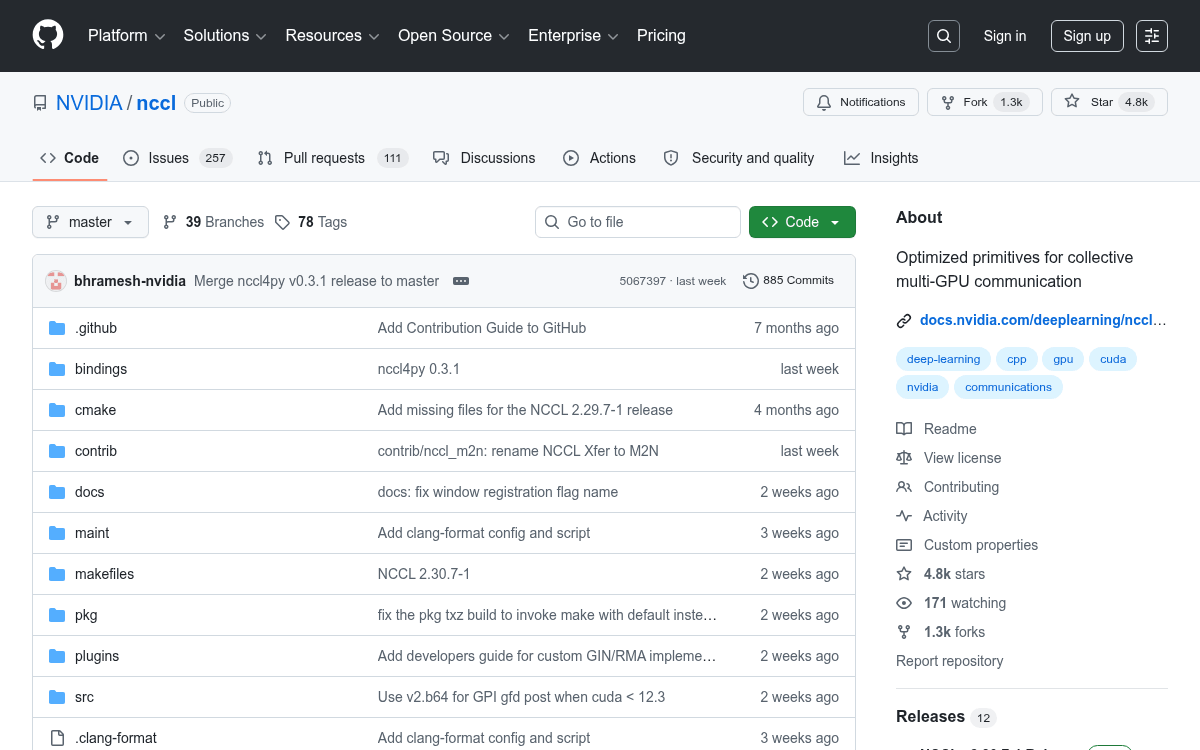
NCCL implements multi-GPU and multi-node communication primitives optimized for NVIDIA GPUs and networking, providing routines such as all-gather, all-reduce, broadcast, reduce, reduce-scatter, and point-to-point send and receive. It's free and open source. The latest release is available on PyPI as nvidia-nccl-cu12. You can also build from source via the GitHub repo, or download prebuilt binaries from the NVIDIA developer portal. The full release notes cover all the bug fixes and known issues in detail.
For teams running large-scale training on Blackwell or GB200 systems, the zero-SM collectives alone are worth the upgrade. The ability to run AllGather completely off the SM pipeline is a meaningful efficiency gain when communication is on the critical path.