
NVIDIA's GRAIL Trains Humanoid Robots With 20,000 Fully Virtual Demos
NVIDIA's GRAIL generates 20,000+ robot training sequences entirely in simulation using video AI, then deploys them on a real humanoid with 84–90% success rates
 Pro
Takeaways
- What it is: GRAIL is a fully digital pipeline from NVIDIA/UCLA that generates humanoid robot training data using 3D assets and AI video generation, with no physical robot needed until deployment. [Paper]
- Scale: Produces 20,000+ motion sequences covering pick-up, whole-body manipulation, sitting, and terrain traversal across 1,000 object assets and 1,000 terrain configs.
- Key innovation: Builds the 3D scene before generating video, so camera, scale, object geometry, and robot proportions are all known — eliminating the depth and scale ambiguity that plagues video-based reconstruction.
- Real-world results: Policies trained only on GRAIL-generated data achieve 84% success on diverse object pick-up and 90% on stair-climbing on a real Unitree G1 humanoid.
- Benchmarks: 88.9% physics-based tracking success rate vs. 24% for the next best baseline; 81.4% manipulation success vs. ~49% for prior methods; preferred by 74.7% of users in a perceptual study.
- Availability: Dataset on Hugging Face, code on GitHub under a non-commercial NVIDIA license; each motion includes the synthetic video, 4D reconstruction, and retargeted robot trajectory.
Training a humanoid robot to pick up objects or climb stairs normally means building physical setups, wiring up actors with motion-capture suits, and teleoperating the robot through every scenario you want it to learn. That process is expensive, slow, and nearly impossible to scale across the thousands of objects and terrain types a real-world robot will encounter. Humanoid robotics is hitting a data wall: teleoperation and motion capture took the field far, but they don't scale to every object, terrain, and behavior.
A team from NVIDIA and UCLA has published GRAIL, a digital generation pipeline that remains fully virtual until deployment, composing 3D assets, simulator-ready scenes, and priors from video foundation models to synthesize interactions without rebuilding physical environments or teleoperating the robot. The result is a dataset of over 20,000 motion sequences covering pick-up, whole-body manipulation, sitting, and terrain traversal, all generated without a single physical robot demonstration.

The core insight: build the 3D world first, then generate the video
Most prior work that uses video to train robots tries to reconstruct 3D motion from unconstrained, in-the-wild footage. That approach runs into a fundamental problem: a single 2D video doesn't tell you how far away objects are, what the exact camera angle is, or how big the person in the frame actually is. Every one of those unknowns introduces ambiguity that makes the recovered motion less useful for a robot.
GRAIL starts from fully specified 3D configurations in which object geometry, camera parameters, metric scale, environment depth, and a robot-proportioned character are known before video generation and reused during reconstruction. By locking down all of those variables upfront, the reconstruction problem becomes well-constrained. Instead of starting with an unconstrained video and trying to infer the 3D world, GRAIL builds the 3D world first and then generates the video.
How the pipeline works, step by step
The pipeline has three major stages. The first stage assembles a photorealistic 3D scene and generates a reference video of a human interacting with an object. The second stage reconstructs the precise 4D motion (positions over time in 3D space) of both the human and the object from that video. The third stage converts those human motions into robot-executable actions and trains policies that generalize across many objects and terrains.
Stage 1: Robot-centric video generation. GRAIL uses the procedural scene generator Infinigen to build indoor environments, places a human character asset that has been pre-fitted to match the Unitree G1's proportions, and renders an initial frame in Blender with known camera intrinsics and extrinsics. A vision-language model (ChatGPT) then writes a text prompt describing the intended interaction, and a video foundation model (Kling 2.5 Turbo Pro) generates a 5-to-10 second video at 1920x1080 from that first frame. Because the camera parameters are fixed and known, the generated video is already anchored to the 3D scene.
Stage 2: Interaction-aware 4D reconstruction. The team recovers the full 4D trajectory of both the human and the object from the generated video using a combination of tools:
- Human body: GENMO estimates per-frame SMPL-X body pose parameters. The body shape is held fixed at the pre-fitted character morphology, eliminating shape ambiguity.
- Hands: WiLoR refines per-frame MANO hand parameters for each hand independently. Missing detections from occlusion are filled by temporal interpolation and smoothed with a Savitzky-Golay filter.
- Object: FoundationPose, fine-tuned for RGB-only operation, tracks the object's 6-DoF pose across all frames, initialized from the known first-frame position.
After independent estimation, a joint optimization step refines both trajectories simultaneously. It minimizes a combined loss with five terms: keypoint alignment (2D body and hand keypoints), object projection alignment, metric depth alignment (using MoGe-2 depth estimation anchored to the known ground-truth background), contact alignment (using a VLM to identify which hand is touching the object in each frame), and regularization terms for foot contact, velocity, and temporal smoothness.

Stage 3: Task-general tracking policies. The recovered human motions are retargeted to the Unitree G1 using GMR. GRAIL then trains two complementary tracking policies on top of SONIC, a pretrained whole-body controller, using PPO reinforcement learning across 64 NVIDIA L40 GPUs with 1,024 parallel environments each:
- Object-aware latent adaptor: A lightweight 3-layer MLP that injects a 64-dimensional residual into the frozen controller's latent token space and emits binary open/close hand primitives. It observes the object's current pose, shape encoding (via Basis Point Set), and crucially, the delta between the reference future object pose and the current simulated pose. The controller itself stays frozen; only the adaptor is trained.
- Scene-aware tracker: Fine-tunes the full controller end-to-end together with a 3-layer CNN height-map encoder that processes an 11x11 terrain grid around the robot. This enables the robot to adapt its whole-body motion to stairs, curbs, slopes, and chairs.
Both policies are trained jointly over large pools of related trajectories rather than fitting one policy per sequence, which dramatically reduces the amortized training cost. A full policy run takes roughly 30 hours on 64 L40 GPUs, but because it jointly trains 2,000–4,000 motions, the amortized cost per motion is only about 0.5–0.9 minutes.

What the numbers say
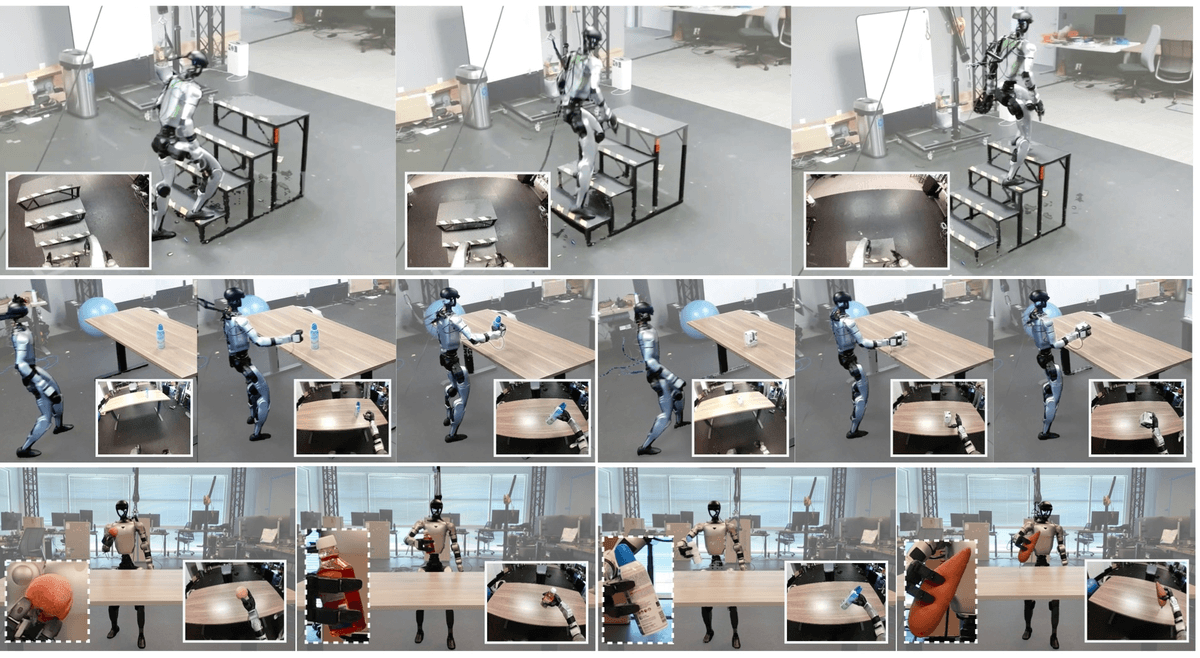
GRAIL produces over 20,000 sequences spanning pick-up, whole-body manipulation, sitting, and terrain traversal, and transfers to real Unitree G1 deployment for object pick-up and stair-climbing. The dataset draws from 1,000 object assets sourced from Robocasa, ComAsset, OMOMO, and Hunyuan3D, paired with 1,000 procedurally generated terrain configurations.
On the HOI generation benchmark against three baselines (HOIDiff, CHOIS, and DAViD), GRAIL achieves an 88.9% physics-based tracking success rate. The next best competitor, DAViD, reaches only 24.0%. GRAIL also scores highest on perceptual interaction quality (3.58 out of 5 vs. 2.74 for DAViD) and lowest on both contact distance and mesh penetration. In a user study with 30 participants, GRAIL was preferred for affordance realism by 74.7% of votes and for physical plausibility by 70.9%, compared to single-digit percentages for HOIDiff.
On the task-general manipulation tracking benchmark of 124 motions across 43 objects, GRAIL achieves an 81.4% success rate, compared to 48.5% for HDMI and 49.2% for ResMimic. The ablation study reveals that the object-aware latent adaptor is critical: removing it drops success rate to 39.7%, even though body tracking accuracy improves, confirming that accurate body imitation alone is not enough for reliable object interaction.
For real-world deployment, using only GRAIL-generated data, egocentric visual policies achieve 84% real-world success on diverse object pick-up and 90% success on stair-climbing on a Unitree G1 humanoid. The pick-up policy also generalizes to unseen objects, maintaining 80% success on items like spray cans, lint rollers, and flashlights that were never seen during training.
What's available and what it's limited by
NVIDIA has released the dataset on Hugging Face, containing physics-validated 4D human-object interaction trajectories for the Unitree G1, generated by an end-to-end pipeline that acquires a 3D asset, generates a synthetic interaction video, reconstructs the 4D HOI, retargets the motion to the G1 skeleton, and drives a SONIC tracking policy in Isaac Lab. Each motion ships with the source synthetic video, the 4D HOI reconstruction, the retargeted G1 robot trajectory, the post-RL object trajectory, and the object's USD asset. The code is available on GitHub under a non-commercial NVIDIA license.
The pipeline has real limitations. It requires 3D object assets upfront, which means it cannot handle arbitrary real-world objects without a modeling step. Reconstruction quality degrades under severe occlusion, fast motion, or inconsistent object appearance from the video foundation model, and the failure-filtering step discards a non-trivial fraction of sequences. The full generation pipeline takes roughly 14 minutes per sequence on a single A100, with the joint optimization step accounting for about 8 of those minutes. The system also currently handles only binary open/close grasp primitives rather than fully dexterous finger control, which limits the complexity of manipulation it can demonstrate.
The broader implication is significant: GRAIL covers both object-centric interactions and scene-centric whole-body motion, with object-centric motions coupling navigation, grasp geometry, and contact-rich whole-body control. If the approach holds up as object asset libraries grow and video generation models improve, it could substantially reduce the physical data collection bottleneck that currently limits how quickly humanoid robots can be taught new skills.