

NVIDIA's Earth2Studio Unifies Every Major AI Weather Model in Four Lines of Code
NVIDIA's open-source Earth2Studio gives Python developers a unified API to run, chain, and benchmark state-of-the-art AI weather models in minutes
 PRO
- What it is: Earth2Studio is NVIDIA's open-source Python toolkit for running AI weather/climate inference pipelines with a unified API.
- Largest model zoo: Supports 20+ pre-trained models including FourCastNet3, GraphCast, AIFS, Aurora, Pangu, StormCast, and GenCast Mini.
- v0.15.0 adds observational data: New satellite (Himawari AHI), station (GHCN-Daily), and real-time conventional obs sources, plus Orbit-2 precipitation downscaling.
- v0.16.0 alpha in progress: Adds ECMWF AIFS 2.0 with wave variables, stochastic ensemble variant, and NCEP CFSv2 seasonal forecast data.
- Agent-ready: New AI agent skills let Claude/Codex scaffold full forecast workflows via the NVIDIA Skills catalog.
- Free and open-source: Apache 2.0 license; inference only — training is handled by the separate PhysicsNeMo repo.
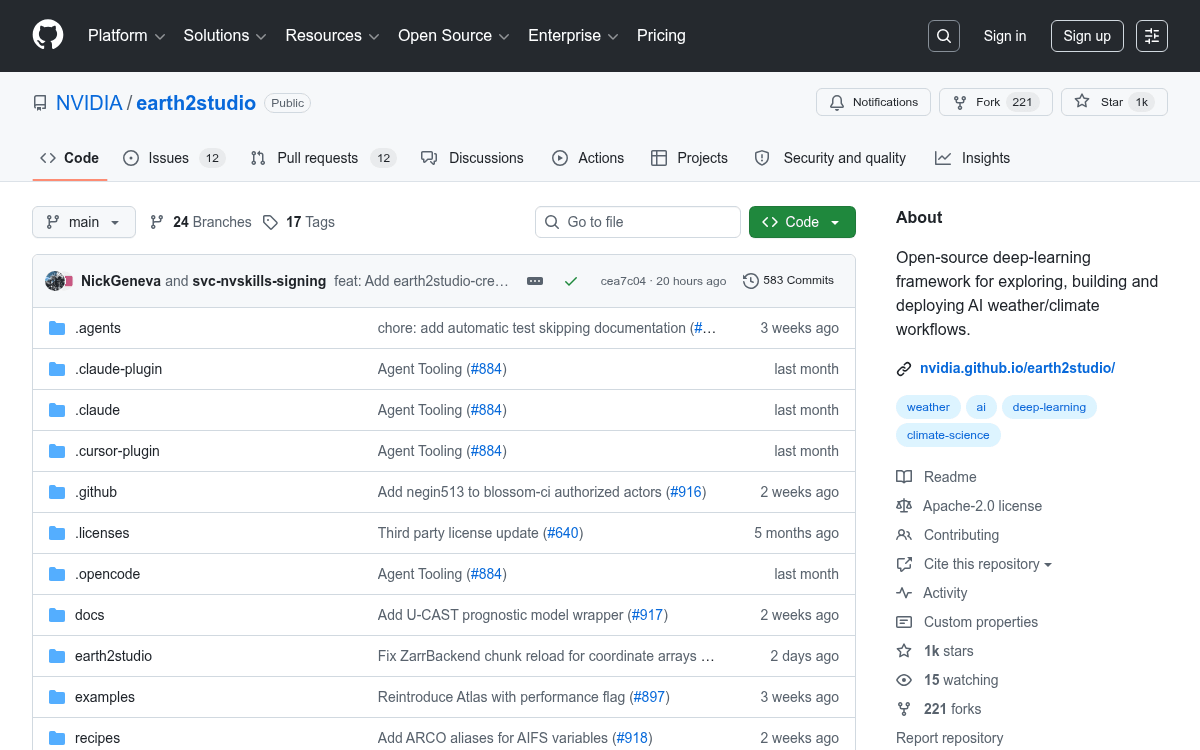
Earth2Studio is NVIDIA's open-source Python framework for building AI-driven weather and climate inference pipelines. It sits above the raw model weights and data formats, giving you a composable toolkit to fetch atmospheric data, run forecasts with pre-trained models, apply diagnostics, and write outputs , all through a single unified API. The repo has crossed 1,000 GitHub stars and is actively maintained, with version 0.15.0 shipping recently and a 0.16.0 alpha already in progress.
The problem it solves
AI weather forecasting has exploded in the last two years. GraphCast, Pangu-Weather, FourCastNet, AIFS, Aurora , each comes with its own checkpoint format, coordinate system, data preprocessing logic, and inference loop. Stitching them together for a real workflow means writing a lot of glue code. Earth2Studio replaces that glue with a shared vocabulary and protocol, so swapping one model for another is a one-line change.
The framework is built around five composable component types:
- Prognostic models , time-stepping models that auto-regressively roll out atmospheric fields into the future (typically 6 hours per step)
- Diagnostic models , time-independent transforms that derive new quantities from a forecast (precipitation, wind gusts, tropical cyclone tracks, solar radiation)
- Data sources , standardized connectors to operational feeds (GFS, IFS, HRRR), reanalysis archives (ERA5, ARCO), and satellite observations
This story is for Pro members
You've reached the end of the free preview. Upgrade to AlphaSignal Pro to read the full article - and everything else behind the paywall.
Comments
