
NVIDIA's Cosmos3-Edge Squeezes a Robot Brain Into a 4B On-Device Model
NVIDIA drops a 4B-parameter open world model that runs on Jetson, generating 32 robot actions per inference at 15 Hz control rates.
 Pro
Takeaways
- Cosmos3-Edge is a 4B-parameter open omnimodal world model for physical AI at the edge.
- Combines an autoregressive tower and a diffusion tower sharing multimodal attention layers.
- Handles text, image, video, and action trajectories for 10+ robot embodiments.
- Runs on Jetson Thor at 15 Hz control with 32 actions per inference.
- Ranks #1 among 4B models on VANTAGE-Bench and SOTA for robot policy learning.
- Released under OpenMDW1.1 with vLLM, Diffusers, and PyTorch support.
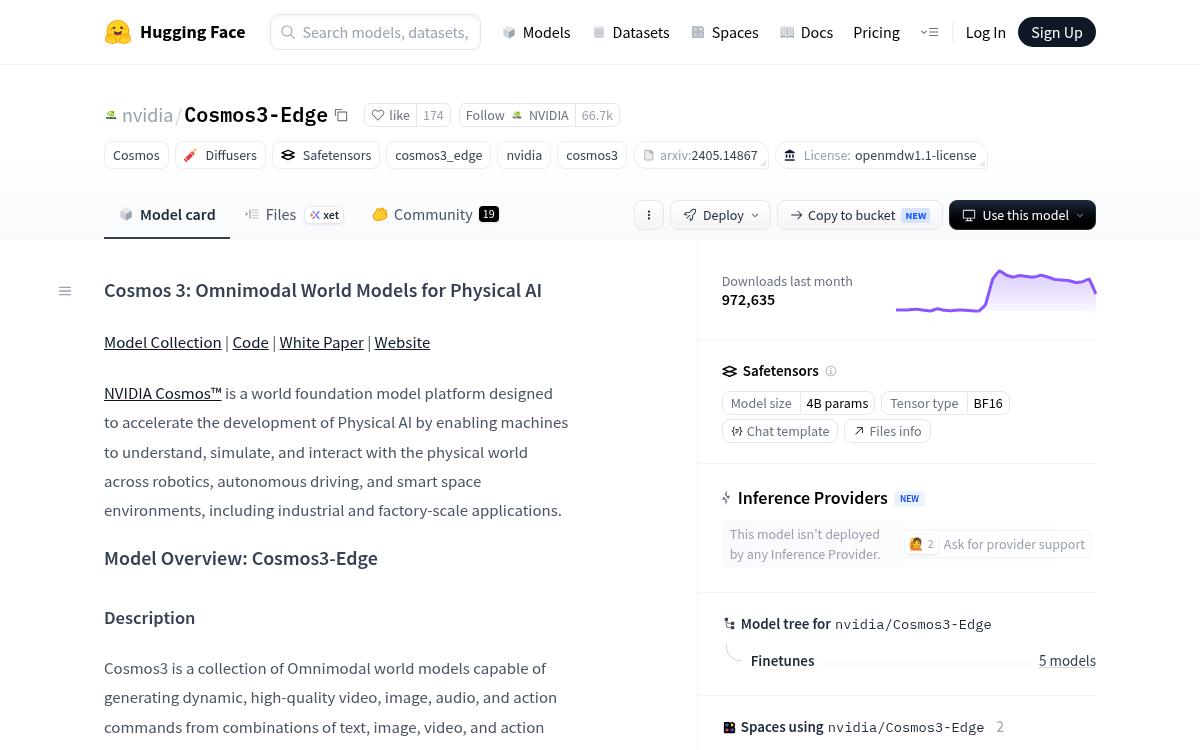
NVIDIA has released Cosmos3-Edge, a 4-billion-parameter open world model built for on-device physical AI. It targets the awkward middle ground where robots and vision agents need data-center-class multimodal reasoning but only have a Jetson module in the chassis. The model already has close to a million downloads on Hugging Face, and it ships under the permissive OpenMDW1.1 license for commercial and research use.
The pitch: one compact model that can watch a scene, reason about it in natural language, predict what happens next as video, and emit robot actions. It operates at robot-control resolution (640×360 observations), generating 32 actions per inference on NVIDIA Jetson Thor while sustaining real-time control at 15 Hz.
Two towers, one brain
The architecture is a Mixture-of-Transformers (MoT) with two specialized transformer stacks that share attention layers. An autoregressive transformer handles discrete token generation, while a diffusion transformer handles continuous multimodal generation. Text comes out through next-token decoding; images, video, audio, and actions come out through iterative denoising. The clever bit is that the two towers keep separate normalization layers and MLPs but share multimodal attention layers, which align information across language, video, audio, and action.
Attention behavior is also modality-aware. Language uses causal attention, where each token attends to the tokens that came before it, while diffusion tokens attend more broadly to the available context, supporting coherent prediction and generation. In practice this means Cosmos3-Edge can chain a reasoning trace and a generated video rollout inside the same forward pass, without bolting together separate VLM and video-diffusion pipelines.
Actions as first-class citizens
Most video models treat actions as an afterthought. Cosmos3-Edge treats them like any other modality. Physical systems describe motion differently: a vehicle uses ego pose, a camera uses camera motion, a robot arm uses end-effector pose. Cosmos 3 maps these embodiments into a common representation encoding translation, rotation, and manipulation state as compact geometric vectors.
The supported embodiments cover most of what a researcher actually has in the lab:
- General camera motion and autonomous vehicle control (9D)
- Egocentric human motion (57D)
- Single and dual Franka Panda arms with RobotiQ grippers (10D and 20D)
- Agibot humanoid (29D), UR arms, Google robot, WidowX 250, UMI (all 10D)
This unlocks two modes that are useful in isolation and powerful together. Forward dynamics takes an image and an action chunk and predicts the resulting video. Inverse dynamics takes a video and infers the actions that produced it. In policy mode, Cosmos 3 predicts an action together with its expected visual consequence, generating what the system should do while simulating what is likely to happen next.
Benchmarks and where it fits
NVIDIA positions Edge against its own Cosmos3-Nano (16B) and the older Cosmos-Predict2.5-2B, plus a swath of general VLMs. Among similar-size 4B models, Cosmos 3 Edge ranks #1 on VANTAGE-Bench for vision analytics and sets the state of the art for robot policy learning, smart infrastructure, and robotics tasks.

On image-to-video generation, the trade-off is more nuanced. Cosmos3-Edge is designed to be the throughput champion in its family. According to the model card, at 480p and 24 fps on a single H100, it delivers the highest frames-per-second generation rate while staying competitive on PAIBench, RBench, and PhysicsIQ physical-consistency scores.

Latency numbers are worth knowing before you plan a deployment. Generating 189 frames of 480p video takes roughly 24 seconds on an H100 in PyTorch, 27 seconds via vLLM-Omni, and about 137 seconds on a Jetson AGX Thor T5000. The action-only paths are much faster: on B200, forward dynamics takes 2.44s and policy DROID inference finishes in under a second.
How it was built
Training used 1.3B data points across 393 dataset entries, collected between 2024 and 2026. The mix is heavily weighted toward physical AI signals: 767M image and 348M video generation samples, plus 7M action samples and 22M text reasoning samples. Public sources include OpenImage, Coyo700M, and a large YouTube video corpus; private data includes egocentric footage, Nexar dashcam clips, and AgiBot robotics logs. Synthetic augmentation is huge here too, with over a billion synthetic captions generated by Qwen3-VL and tens of millions of synthetic images from HiDream-I1 and Qwen-Image-2512.
Alongside the base model, NVIDIA also shipped Cosmos3-Edge-Policy-DROID, a variant post-trained on the DROID robotic manipulation dataset, plus step-distilled versions of the larger Super models. The distilled Super variants cut sampling from 50 denoising steps down to 4 and drop the need for classifier-free guidance, delivering up to 25x faster inference than the base model with little to no loss in generation quality. The distillation recipe uses Improved Distribution Matching Distillation (DMD2), and NVIDIA has open-sourced the training scripts in the Cosmos GitHub repo.
Actually running it
The model plugs into vllm-omni, standard vllm, PyTorch, and Hugging Face Diffusers via a Cosmos3OmniPipeline. Only BF16 is officially tested, and supported GPUs cover Ampere, Hopper, and Blackwell. A minimal serving command looks like this:
vllm serve nvidia/Cosmos3-Edge \
  --omni \
  --host 0.0.0.0 \
  --port 8000 \
  --init-timeout 1800
That exposes an OpenAI-compatible endpoint at /v1/videos/sync for generation and standard chat completions for the reasoner. Multi-GPU scaling uses --ulysses-degree for context parallelism or --tensor-parallel-size for tensor parallelism, and --enable-layerwise-offload helps on memory-constrained GPUs. The reasoner supports up to a 256K token context window, unusually generous for a model this size.
Limitations worth budgeting for
The honest limitations section in the model card is worth reading before you build anything safety-critical. Because the model lacks an explicit physics simulator, 3D geometry, 4D space-time evolution, object permanence, contact dynamics, and physical laws are only approximated, producing artifacts such as disappearing or morphing objects, unrealistic collisions, and physically implausible motions. Long-horizon rollouts drift, out-of-distribution scenes degrade quality, and the reasoner can hallucinate spatial relationships. NVIDIA explicitly warns that outputs should not be treated as physically accurate simulation or safety-certified decisions.
Why this matters
The interesting move here is packaging a VLM, a video generator, and a robot policy into a single 4B checkpoint that fits on a Jetson. Until now, teams doing embodied AI usually stitched together three or four separate models: a VLM for scene understanding, a diffusion model for imagination, and a policy network for control. Cosmos3-Edge collapses that stack while keeping the generative side in the loop, which matters for teams building world-model-based RL, sim-to-real synthetic data pipelines, or plan-and-execute robot agents that need to reason before they move. Whether the physical realism holds up outside benchmarks is what the next wave of downstream deployments will decide.