
NVIDIA's Cosmos 3 Unifies Robot Reasoning, Video, and Action in One Open Model
NVIDIA's Cosmos 3 fuses vision reasoning, video generation, and robot action prediction into one open omnimodal world model for physical AI.
 Pro
Takeaways
- NVIDIA released Cosmos 3, an open omnimodal world model unifying reasoning, video generation, and robot action prediction.
- Two checkpoints on Hugging Face: Nano (16B) and Super (64B); Edge variant coming for real-time inference.
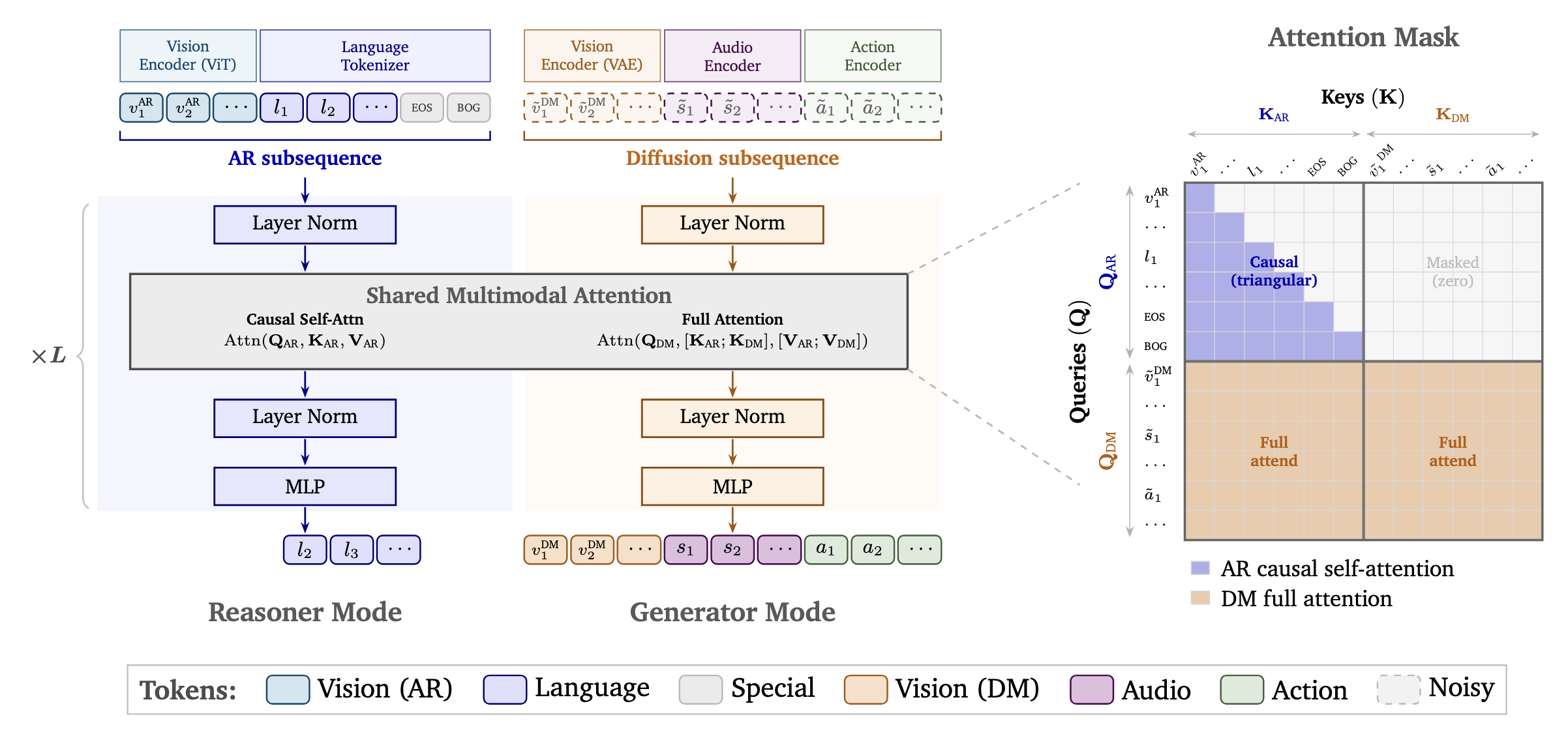
- Mixture-of-Transformers architecture pairs an autoregressive VLM reasoner with a diffusion generator sharing 3D mRoPE positional embeddings.
- Trained on 20 trillion multimodal tokens including 1B images, 400M videos, audio, and human plus robot action data.
- Leads open-source leaderboards on R-Bench, Physics-IQ, RoboLab, VANTAGE-Bench, and TAR for vision understanding.
- Runs via Diffusers for research or vLLM-Omni for OpenAI-compatible production serving under OpenMDW license.
NVIDIA just dropped a swing at one of the hardest problems in robotics: teaching machines to predict what happens next in the messy physical world. Cosmos 3 is an open omnimodal world model that can watch a video and reason about it, generate a physically plausible future, and even spit out the joint angles a robot would need to act on that prediction, all from the same network.
NVIDIA released Cosmos 3, a family of omnimodal world models for physical AI that combine physical reasoning, world generation, and action generation inside one open model. The release ships as two open-weight checkpoints on Hugging Face: a Super version with 64.6 billion parameters and a Nano version with 15.7 billion parameters, both available with no gatekeeping, with an Edge variant for real-time on-device inference coming later.
One model, three jobs
Earlier Cosmos releases kept perception and generation as separate models. Cosmos 3 collapses them. It uses a Mixture-of-Transformers architecture built around two towers: a reasoner tower that is a vision-language model interpreting images, video, and text autoregressively to understand motion, object interactions, and physical context, serving as the brain that reasons about the world before any generation happens. The second tower is a diffusion-based path for physics-aware video and actions, conditioned on the reasoner's understanding, with information flowing one way from reasoner to generator, and both towers share a 3D multimodal RoPE.
That split shows up in the two runtime surfaces developers actually use:
- Reasoner: text and vision in, text out. Captioning, temporal localization, embodied reasoning, 2D grounding, physical plausibility classification.
- Generator: text, vision, sound, or action in; video, sound, or action out. Synthetic training data, forward and inverse dynamics, robot policy rollouts.
The headline trick is that the model treats action as a core modality with dedicated action tokens, accepting text, image, video, and JSON action arrays as inputs and producing images, video, synchronized sound, action states, and text. Action conditioning spans camera, vehicle, egocentric, single-arm, dual-arm, and humanoid embodiments, with each embodiment using a fixed action dimension such as 9D for cameras.
The data behind it
NVIDIA trained Cosmos 3 on 20 trillion tokens of multimodal data, including nearly a billion images, 400 million real and synthetic videos, ambient audio, text and action data from humans and robots, with that action data being what makes Cosmos different from a regular video generator since it models how machines move, not just how scenes look. The scale matters because Cosmos 3 tackles a fundamental challenge in physical AI: enabling robots, autonomous vehicles or vision agents to generalize in the real world with limited training data and fragmented simulation stacks, by pairing a reasoning transformer with an expert generation transformer so the model understands object interactions, motion and spatial-temporal relationships before generating video and action trajectories.
Generation specs developers care about
Generation supports 256p, 480p, and 720p resolution tiers, with frame counts ranging from 5 to 300 and defaulting to 189, which equals about 7.9 seconds of video at 24 FPS, while sound is generated as stereo AAC at 48 kHz. Aspect ratios cover 16:9 down to 9:16. Precision is BF16, and the supported GPU lineup covers Ampere, Hopper, and Blackwell.
Running it
There are three paths to inference, depending on whether you are tinkering or serving production traffic:
- Diffusers for Python-first generator research. The pipeline is
Cosmos3OmniPipeline, which loads the full checkpoint including the reasoner, diffusion path, and media tokenizers. - vLLM-Omni for production generator serving behind an OpenAI-compatible API, with endpoints like
POST /v1/videos/syncfor text-to-video and image-to-video. - vLLM for the reasoner alone, behind a chat-completions API that follows Qwen3-VL message conventions.
A minimal text-to-video call with Diffusers looks like this:
import torch
from diffusers import Cosmos3OmniPipeline
from diffusers.utils import export_to_video
pipe = Cosmos3OmniPipeline.from_pretrained(
    "nvidia/Cosmos3-Nano",
    torch_dtype=torch.bfloat16,
    device_map="cuda",
)
result = pipe(prompt="A mobile robot navigates a warehouse aisle.",
              num_frames=189, height=720, width=1280, fps=24.0)
export_to_video(result.video, "out.mp4", fps=24)
For the 64B Super model, you split weights across GPUs with --tensor-parallel-size and can optionally enable layerwise CPU offload to cut peak memory at the cost of latency. The repo also ships a Docker image (vllm/vllm-omni:cosmos3) that covers every modality, including video-to-video, sound, and action endpoints that have not yet merged into the upstream vLLM-Omni PR.
What it is actually good at
On benchmarks, NVIDIA is claiming the top of the open leaderboards. For generation, Cosmos 3 is the open-source state-of-the-art on R-Bench, and also leads PAI-Bench, Physics-IQ, and RoboLab on public leaderboards, while on Artificial Analysis it leads two open-source leaderboards covering text-to-image and image-to-video without audio. On the reasoning side, Cosmos 3 is the top-ranked open vision language model on VANTAGE-Bench for smart-infrastructure scene understanding and the TAR challenge for traffic anomaly reasoning.
To make those numbers mean something, NVIDIA built its own human eval. The HUE framework evaluates video generation quality using atomic binary verification, decomposing each generated video into single-fact yes/no questions across four dimensions (semantic alignment, physical laws, geometric reasoning, and visual integrity) spanning seven Physical AI domains, with questions generated by a VLM pipeline, refined by human experts, and released as open source on Hugging Face.
What it is bad at
NVIDIA is unusually candid about failure modes. The model can produce artifacts in long, high-resolution, or physically complex outputs. Expect temporal inconsistency, unstable camera or object motion, imperfect sound-video alignment, object morphing, inaccurate 3D structure, and implausible physical dynamics in edge cases. Anything safety-critical needs additional validation, guardrails, and system-level safety analysis before deployment, which is the right disclaimer for a model whose outputs may train a robot to grab a wrench.
Why this release matters beyond the benchmark wins
The practical pitch is that Cosmos can generate rare or dangerous scenarios such as robot collisions or unusual road events that are difficult, expensive or unsafe to capture repeatedly. A humanoid policy team can synthesize thousands of failure trajectories instead of crashing real hardware. An AV team can spawn long-tail edge cases on demand. And because action is a first-class output, the same model that simulates the scene can also produce the joint angles or steering commands to act in it.
NVIDIA is wrapping this in a coalition play too. The NVIDIA Cosmos Coalition is a global collaboration that includes Agile Robots, Black Forest Labs, Generalist, LTX, Runway and Skild AI working to advance next-generation world models. Cloud deployment partners include Baseten, CoreWeave, Microsoft Azure, Nebius, Deep Infra and Classmethod, so you do not have to build the infra yourself if you want to fine-tune at scale.
The bigger shift
The assumption worth updating is that vision-language understanding, video generation, and robot policy learning should live in three different model families with three different training stacks. Cosmos 3 is a serious argument that a unified backbone, with a reasoner that thinks first and a diffusion expert that draws or acts second, gets you better physical grounding than stitching specialized models together. Whether the open weights and the technical report hold up under independent reproduction is the next thing to watch, but the surface area on offer (omnimodal IO, action as a token, OpenAI-compatible serving, free OpenMDW license) is hard to ignore for anyone building physical AI today.