

NVIDIA Makes Python a First-Class GPU Citizen With CUDA Python 1.0
CUDA Python hits 1.0 with CUDA 13.3, making Python a first-class citizen alongside C++ with stable APIs, green contexts, and a new MLIR-based Numba backend
 PRO
- CUDA Python 1.0 is stable: NVIDIA commits to semantic versioning -- breaking changes only on major releases, with Python now a first-class CUDA citizen alongside C++.
- New cuda.core features: Green contexts (partition GPU SMs), process checkpointing (snapshot/restore full CUDA state), and IPC memory sharing across Python processes.
- Numba CUDA MLIR backend: Drop-in replacement for
numba.cudawith ~1.4x faster JIT compile and up to 17x lower kernel dispatch latency. - CompileIQ auto-tuner: Uses genetic algorithms to deliver up to 15% speedup on GEMM and attention kernels -- the dominant compute in LLM inference.
- Modular install:
pip install cuda-python cuda-cccl numba-cuda-mlir[cu13]gets you the full stack; supports Python 3.10-3.14 on Linux and Windows. - CCCL 3.3 ships: DLPack/mdspan tensor interop with PyTorch/JAX/CuPy, 7x faster search algorithms, and 17 new device-compatible random distributions.
For years, writing high-performance GPU code in Python meant accepting a second-class experience. You could call CUDA from Python, but the APIs were unstable, the tooling was thin, and serious work still meant dropping into C++. CUDA 13.3 changes that. With the release of CUDA Python 1.0, NVIDIA is making a formal commitment: Python and C++ are now equal first-class citizens in the CUDA ecosystem, with feature parity maintained going forward.
From monolith to modular
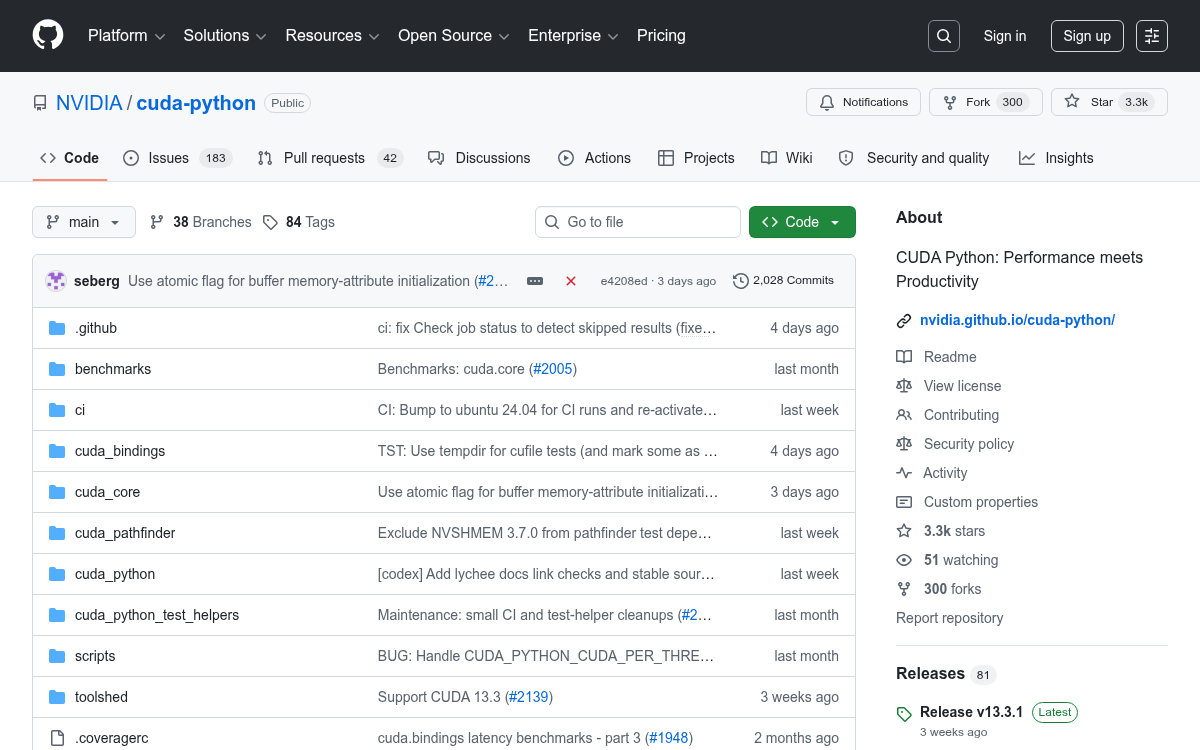
cuda-python is being restructured into a metapackage containing a collection of subpackages, each versioned independently, so you can install only what you need. The 1.0 release ships four stable components:
- cuda.bindings (v13.3.0): Low-level, 1-to-1 Python bindings to every CUDA C API -- Driver, Runtime, NVRTC, nvJitLink, NVVM, nvFatbin, cuFile, and NVML.
- cuda.core (v1.0.0): A Pythonic high-level interface to devices, streams, programs, linkers, memory resources, and CUDA graphs.
- cuda.compute (v1.0.0): Host-callable parallel algorithms (sort, scan, reduce, transform, top-k, histogram) from NVIDIA's CCCL library, now callable directly from Python.
- cuda.pathfinder (v1.6): Utilities for locating CUDA toolkit components in your Python environment.
As of CUDA 13.3, CUDA Python and C++ now stand as equal first-class citizens, with NVIDIA aiming to maintain feature-complete parity going forward. The 1.0 label also comes with a semantic versioning commitment: breaking changes only on major versions, deprecations announced in minor releases with a clear migration path.
What's actually new in cuda.core 1.0
This story is for Pro members
You've reached the end of the free preview. Upgrade to AlphaSignal Pro to read the full article - and everything else behind the paywall.
Comments
