
NVIDIA Drops Container Toolkit v1.19.0, Killing Legacy GPU Hook Model
NVIDIA Container Toolkit v1.19.0 makes CDI the default GPU access method, adding IGX 2.0, Tegra CUDA Forward Compatibility, and read-only rootfs support
 Pro
Takeaways
- v1.19.0 released: Latest feature release adds IGX 2.0 Thor support, CUDA Forward Compatibility on Tegra, and read-only rootfs support.
- CDI is now default: The legacy hook-based GPU injection mode is deprecated; Container Device Interface (CDI) is the new standard across Docker, containerd, CRI-O, and Podman.
- JIT CDI mode: CDI specs are auto-generated at container creation time, removing the need for manual pre-generation steps.
- Kubernetes default: GPU Operator v25.10.0+ uses CDI by default for all GPU workloads, making runtime-specific plugins unnecessary.
- Non-root & read-only support: Containers can now run as unprivileged users without extra group config, and on read-only root filesystems.
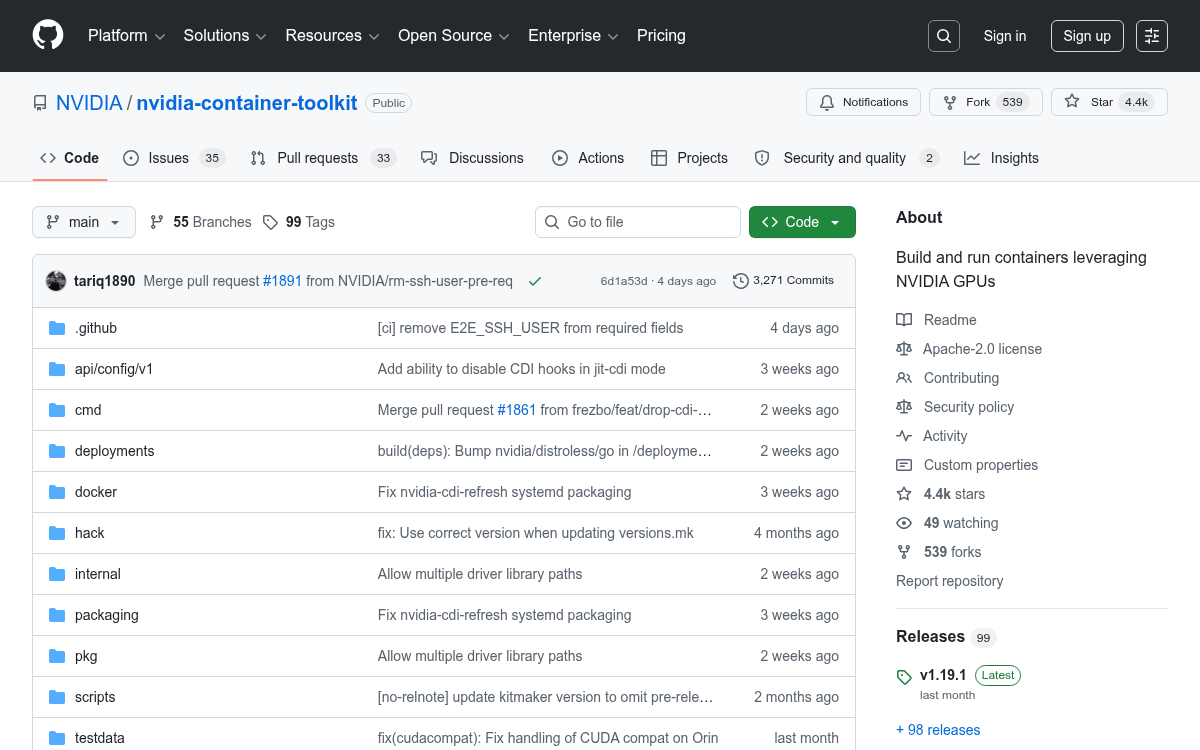
- Free & open source: Apache 2.0 license; available via GitHub and official docs.
NVIDIA Container Toolkit is the foundational layer that makes GPU-accelerated containers possible. Without it, Docker and Kubernetes have no way to see, allocate, or pass through NVIDIA hardware to workloads. The project just pushed v1.19.0 as its latest feature release, and the changes reflect a broader architectural shift that has been building across the last several versions: the old hook-based GPU injection model is being replaced by a cleaner, standards-based approach called CDI.
What the toolkit actually does
The NVIDIA Container Toolkit allows users to build and run GPU-accelerated containers, including a container runtime library and utilities to automatically configure containers to leverage NVIDIA GPUs. In practice, it sits between your container engine (Docker, containerd, CRI-O, Podman) and the host NVIDIA driver, handling the injection of GPU device nodes, driver libraries, and firmware into each container at startup.

The stack has four main components that work together:
- libnvidia-container1 , the low-level C library that does the actual device injection using kernel primitives
- nvidia-container-cli , a CLI wrapper around the library that runtimes call to configure containers
- nvidia-container-runtime , a thin wrapper around
runcthat injects the NVIDIA hook before a container starts - nvidia-ctk , a utility CLI for configuring runtimes and generating CDI specifications
You do not need to install the CUDA Toolkit on the host system, but the NVIDIA driver needs to be installed. The toolkit handles everything else, including mounting the right driver libraries into the container at runtime.
The CDI shift is now complete
CDI, or Container Device Interface, is an open specification that describes GPU access in a declarative YAML/JSON file rather than through runtime hooks. Think of it as moving from "run this script when a container starts" to "here is a spec file that describes exactly what devices and libraries a GPU container needs." CDI is a specification for container runtimes such as CRI-O, containerd, and Podman that standardizes access to complex devices like NVIDIA GPUs by the container runtimes.
The default mode of the NVIDIA Container Runtime has been updated in v1.18.0 to make use of a just-in-time-generated CDI specification instead of defaulting to the legacy mode. The v1.19.0 release builds on this, and the legacy hook-based mode is now formally deprecated. This matters because CDI is runtime-agnostic: the same spec works with Docker, containerd, CRI-O, and Podman without any runtime-specific plugins.
The toolkit supports two CDI workflows:
- Pre-generated specs , run
nvidia-ctk cdi generateonce, specs are stored at/etc/cdi/and read by any CDI-aware runtime - Just-in-time (JIT) mode , CDI specs are generated automatically at container creation time when devices with vendor
runtime.nvidia.comare requested, eliminating the need for pre-generation and automatic updates
A systemd unit was added to generate CDI specifications for available devices automatically, allowing native CDI support in container engines such as Docker and Podman to be used without additional steps.
What's new in v1.19.0
The latest feature release adds several things that matter for production and edge deployments:
- IGX 2.0 Thor support , added support for NVIDIA IGX 2.0 Thor-based systems, including those with discrete GPUs installed alongside the integrated processor
- CUDA Forward Compatibility on Tegra , containers can now use a newer CUDA version than the driver installed on the host, on Orin-based edge systems. This requires specific compat libraries in the container image
- Non-root device access , containers can now run as a user without explicit access to a device node, without requiring additional group memberships to be specified manually
- Read-only root filesystems , support for running containers on systems with read-only root filesystems, such as those booting from an initramfs
- NRI plugin server , an NRI (Node Resource Interface) plugin server for injecting CDI devices into GPU management containers was added to the toolkit container images
- Improved CDI refresh triggering , the systemd service that keeps CDI specs up-to-date now handles more edge cases, including compressed kernels
The Kubernetes angle
Starting with GPU Operator v25.10.0, CDI is used by default for enabling GPU support in containers running on Kubernetes, specifically using CDI support in container runtimes like containerd and CRI-O to inject GPUs into workload containers. This is a significant operational change: cluster administrators no longer need to configure runtime-specific plugins or worry about which low-level runtime is in use.
Use of CDI is transparent to cluster administrators and application developers. The benefits of CDI are largely to reduce development and support for runtime-specific plugins. For teams running mixed Kubernetes environments with multiple container runtimes, this is a meaningful simplification.
The toolkit is deployed as part of the NVIDIA GPU Operator and is used to provision the NVIDIA container runtime and tools on the system. The container has been validated to work with and without FIPS-enabled Linux and Kubernetes distributions.
Getting started
The toolkit is free and open source under the Apache 2.0 license. Installation is straightforward on any supported Linux distribution:
# Ubuntu / Debian
curl -fsSL https://nvidia.github.io/libnvidia-container/gpgkey | sudo gpg --dearmor -o /usr/share/keyrings/nvidia-container-toolkit-keyring.gpg
sudo apt-get install -y nvidia-container-toolkit
sudo nvidia-ctk runtime configure --runtime=docker
sudo systemctl restart docker
# Verify GPU access in a container
docker run --rm --gpus all nvidia/cuda:12.0-base nvidia-smi
The latest container image is available at nvcr.io/nvidia/k8s/container-toolkit:v1.19.0. The latest tag is v1.19.1, updated on the NGC catalog, with multi-arch support and a compressed size of 54.34 MB. For Kubernetes deployments, the recommended path is through the NVIDIA GPU Operator, which manages the toolkit lifecycle automatically across nodes.
The full release notes and installation guide are available in the official documentation. With CDI now the default and legacy mode formally deprecated, teams still relying on the old hook-based approach should plan a migration path before it is removed entirely.