

NVIDIA and Unitree's Isaac GR00T Gives Any Lab a Full Humanoid Research Stack
NVIDIA and Unitree unveil the first open humanoid robot reference design, giving academic labs a full-stack platform from simulation to real-world deployment
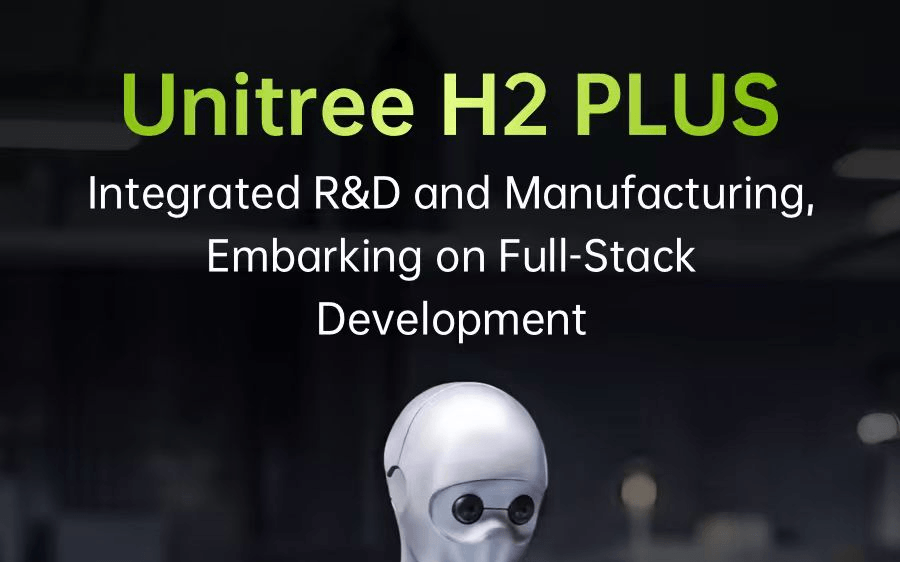
- First open humanoid reference design: NVIDIA and Unitree launched the Isaac GR00T Reference Humanoid Robot at GTC Taipei, bundling hardware and full software stack.
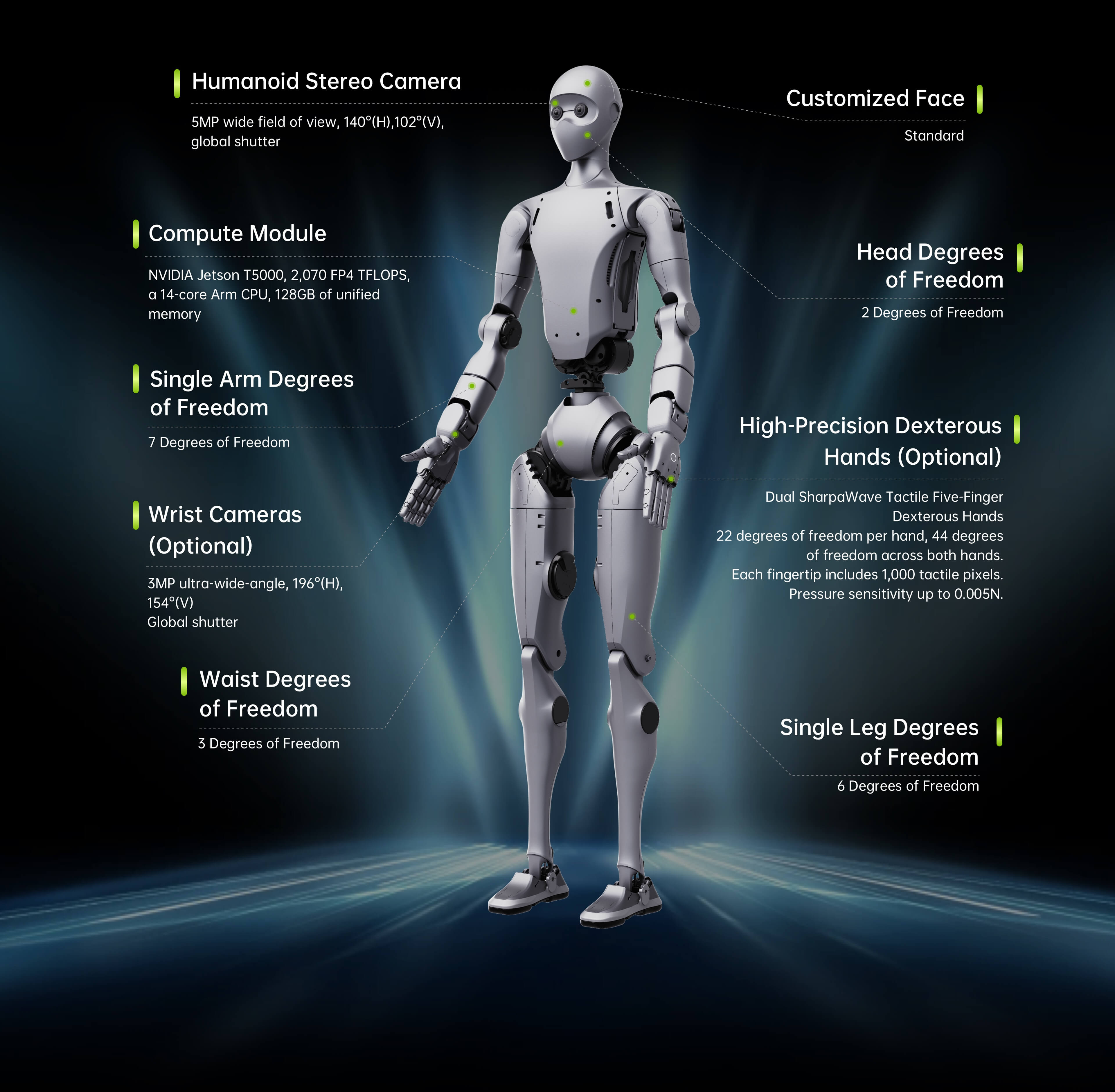
- Three-way hardware stack: Unitree H2 Plus body (6ft, 150lbs, 31 DOF) + Sharpa Wave tactile five-finger hands + NVIDIA Jetson Thor (2,070 FP4 TFLOPS).
- Full-stack software included: Isaac Teleop, Isaac Sim, Isaac Lab, Isaac ROS, and open GR00T foundation models cover the entire data-to-deployment pipeline.
- Top labs already committed: Stanford Robotics Center, ETH Zurich, Ai2, UC San Diego, and NVIDIA Research are confirmed early adopters.
- Availability late 2026: No confirmed ship date or system price announced; base Unitree H2 starts at $29,900 without the NVIDIA compute upgrade.
- Strategic stakes are high: Goldman Sachs projects a $38B humanoid market by 2035; Unitree shipped 5,500+ units in 2025 and is targeting up to 20,000 in 2026.
For years, building a humanoid robot research platform meant months of painful integration work: sourcing hardware, writing drivers, stitching together simulation tools, and assembling data pipelines before a single experiment could run. NVIDIA and Unitree just announced they want to end that. At GTC Taipei, Jensen Huang unveiled the NVIDIA Isaac GR00T Reference Humanoid Robot, the first open humanoid robot reference design built on NVIDIA's Jetson Thor compute and the Isaac GR00T open development platform, with Unitree's H2 Plus as the physical body.
One Box, Full Stack
The reference design unifies development by bringing a Unitree H2 Plus humanoid robot and Sharpa Wave tactile five-finger hands (the "body"), with NVIDIA Jetson Thor-powered onboard compute and Isaac GR00T software and workflows (the "brain") into a single integrated reference design, helping research teams move faster from robot bring-up to skill development and real-world validation. Think of it less as a product launch and more as an infrastructure decision for the research community.
The reference design helps democratize frontier humanoid robotics research by providing access to advanced hardware and an open software stack without requiring proprietary platforms. As demand for general-purpose humanoids accelerates, developers still face a fragmented process spanning hardware integration, data collection, simulation, training, evaluation and deployment. Teams typically spend months cobbling together hardware, software stacks, and data pipelines before getting to actual research. The H2 Plus is designed to skip all of that.
What You Actually Get
The hardware specs are serious. The H2 Plus stands nearly 6 feet tall and weighs 150 pounds, with 31 degrees of freedom across the body. Add the optional Sharpa Wave hands and you get 75 total degrees of freedom. Here is what is packed inside:
- Compute: NVIDIA Jetson AGX Thor T5000 with a Blackwell GPU delivering 2,070 FP4 TFLOPS, a 14-core Arm CPU, and 128GB of unified memory
- Torque: Up to 120 N·m arm torque and 360 N·m leg torque, with a rated arm payload of 7 kg and peak payload of 15 kg
- Hands: Dual Sharpa Wave tactile five-finger hands with 22 active degrees of freedom, over 1,000 tactile pixels per fingertip, and 150N grip force
- Vision: Head-mounted stereo camera (140° horizontal FOV), optional wrist cameras, and an IMU for motion tracking
- Connectivity: Wi-Fi 6, Bluetooth 5.2, Ethernet, USB, array microphones and speakers
- Battery: 15Ah, 0.972 kWh capacity for approximately 3 hours of operation
The software stack is where NVIDIA's fingerprints are most visible. The software stack includes Isaac Teleop for data collection, Isaac Sim and Isaac Lab for simulation and training, Isaac ROS middleware for deployment, and NVIDIA's open foundation models for humanoid reasoning and behavior development. The whole pipeline is modular, so teams can plug in individual components or use the full stack end-to-end.
The Real Problem Being Solved
A Stanford grad student who trains a manipulation policy in Isaac Sim against the H2 Plus URDF can deploy that policy onto physical hardware without rewriting the perception or control layers. That is the core value proposition. The sim-to-real gap, the driver compatibility issues, the hardware bring-up time -- all of that is pre-solved in the reference design.
This announcement is part of a broader physical AI push from NVIDIA, including Cosmos 3 and the Vera robotics layer, that the company has been rolling out through Computex 2026. The GR00T platform is not a standalone product; it is a beachhead in NVIDIA's strategy to own the compute and software layer of the coming robotics wave.
Who Is Already Buying In
Leading research institutions including Ai2, ETH Zurich, Stanford Robotics Center and UC San Diego's Advanced Robotics and Controls Laboratory will use the reference design to advance frontier humanoid robotics research. NVIDIA Research itself is also on the list, using the platform to advance Isaac GR00T open models and frameworks.
The endorsements from academia carry weight. Steve Cousins of the Stanford Robotics Center noted that "robotics moves fastest when researchers can build on open platforms, share code and test ideas on real machines," adding that the reference design gives students and collaborators "an open humanoid reference design with dexterous hands, onboard AI compute and the NVIDIA Isaac GR00T development platform for creating, comparing and sharing robot behaviors on physical hardware."
NVIDIA's Bigger Play
The strategic logic here mirrors NVIDIA's GPU playbook. If the robots that fill warehouses, staff factories, assist in hospitals, and operate in homes all run on Jetson Thor compute and Isaac GR00T software, NVIDIA captures a portion of the economic value of each robot, in perpetuity, through compute sales and platform licensing. Jensen Huang framed the stakes plainly: "Humanoid robots will bring physical AI to the world's largest industries, opening a multitrillion-dollar economic opportunity."
Goldman Sachs projects the humanoid market at $38 billion by 2035. And Unitree is well-positioned to ride that wave. The company's IPO prospectus confirms 2025 revenue of ¥1.708 billion (up 335% year-over-year), net profit growth of 674% on a deductions basis, and 5,500+ humanoid units shipped in 2025, putting Unitree at roughly 32% of the global humanoid market by volume.
The unveiling lands precisely as Unitree heads into its STAR Market IPO hearing in China, reportedly seeking around $580M. Unitree shipped 5,500+ humanoid units in 2025 and is targeting 10,000 to 20,000 units in 2026. An NVIDIA co-branded reference design is a powerful endorsement heading into that process.
Who Wins, Who Watches Nervously
The clearest winners are academic robotics labs. For institutions advancing humanoid robotics, H2 Plus provides a more capable reference design built around NVIDIA compute, software and security requirements, helping democratize frontier robotics research and enable teams to move faster from research ideas to physical robot validation.
The pressure lands on closed-stack competitors. The pitch is simple: take the hardware stack that has been gated behind Figure, 1X, and Tesla's internal teams, and ship a validated version to any robotics lab with a purchase order. If the open reference design gains traction in academia, it seeds a generation of researchers whose intuitions, datasets, and trained policies are all built on the Isaac GR00T stack. That is a durable moat.
Every lab that builds a thesis on this stack ships its trained weights, its dataset format, and its simulation assumptions into NVIDIA's tooling. The network effects compound over time. There is also a notable extension coming: the NVIDIA Isaac GR00T developer platform will also support the Unitree G1 humanoid robot, extending the same development approach to a robot widely used by researchers and humanoid developers across leading institutions.
When Can You Get One
Unitree says the H2 Plus will be available in the second half of 2026, though this is an expected timeline, not a confirmed ship date. The complete system price has not been announced. For context, the base Unitree H2 (without the NVIDIA compute module and Sharpa hands) starts at $29,900, making the H2 Plus configuration likely a significant step up. The NVIDIA Isaac GR00T platform and reference workflow for Unitree G1 are expected to be available soon on GitHub and Hugging Face for robot developers.
One open question worth watching: for university labs with no prior US government funding concerns, NVIDIA's reference design represents the most direct path from lab procurement to deployable policy research that has existed in this field. Whether it proves equally viable for federally funded programs will depend on what the US government determines about Unitree's classification. That is a real risk for US-based labs that need to navigate export controls and procurement rules around Chinese-origin hardware. For everyone else, the H2 Plus is the most complete starting point for humanoid research that has ever been made available off the shelf.
Comments
