

NVIDIA and GRITS Cut Robot Food Spillage by 40% Without Extra Training Data
A new diffusion policy uses a spillage predictor as a differentiable guidance signal to cut robot food-scooping spillage by over 40 percent.
 PRO
- GRITS is a spillage-aware guided diffusion policy for robot food scooping, an ICRA 2026 Best Paper finalist.
- A learned spillage predictor acts as a differentiable guidance signal during the reverse diffusion sampling process.
- Achieves 82% success and 4% spillage on 10 unseen foods, cutting spillage over 40% versus unguided baselines.
- Predictor trained on 4,000 simulated trials in Isaac Lab across four primitive shapes with varied mass, friction, and particle size.
- Uses composite point clouds (depth-reconstructed food plus CAD models of spoon and bowl) with a DP3 encoder to close sim-to-real gap.
- Trade-off: guidance slightly raises scoop failure rate versus vanilla diffusion policy; sticky and densely packed foods remain hard.
Robotic food scooping sounds trivial until you watch a manipulator send mung beans skittering across a countertop. A team from National Yang Ming Chiao Tung University, XYZ Robotics, and NVIDIA has proposed GRITS, a guided diffusion policy that treats spillage as a differentiable cost to minimize during trajectory sampling. The work was named a Best Paper Award finalist on Robot Learning at ICRA 2026.
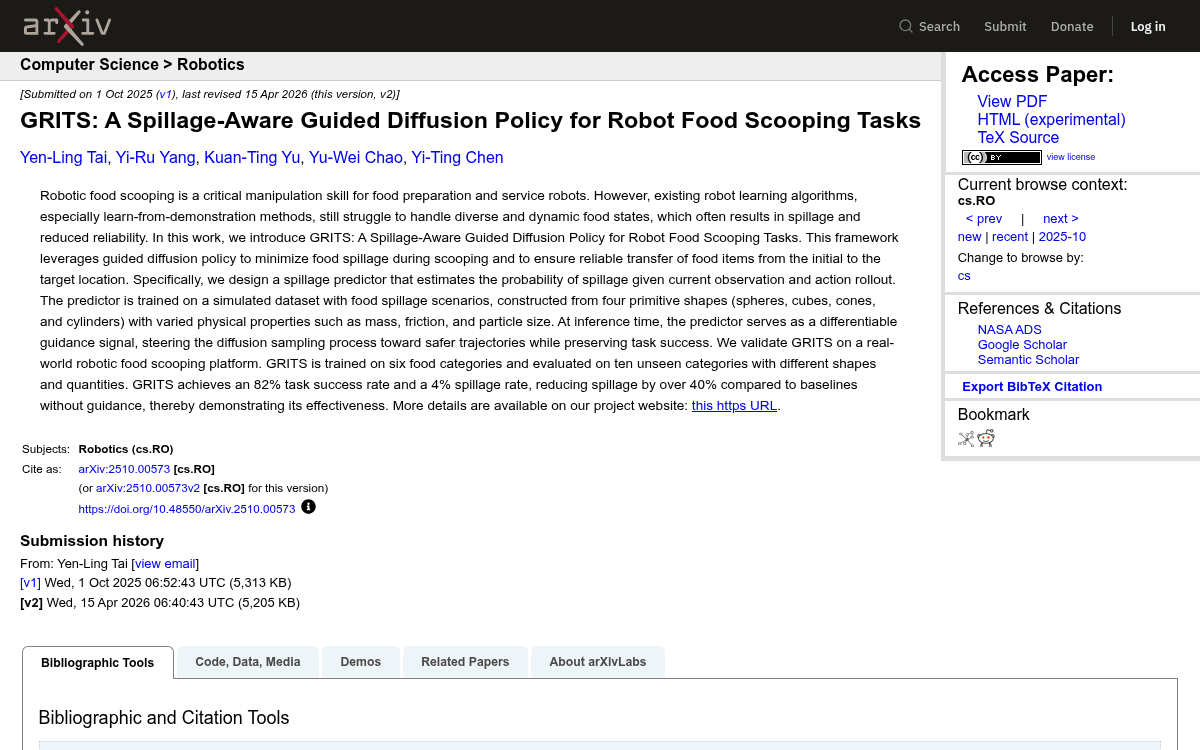
GRITS achieves an 82% task success rate and a 4% spillage rate, cutting spilled food by over 40% compared to baselines without guidance, across ten unseen food categories the policy was never trained on.
Why scooping breaks imitation learning
Learning from demonstration works well when the world sits still, but food does not. Diffusion policies generalize well from relatively few expert demonstrations, yet they fail to account for unseen food states such as an overfilled bowl, which often causes unintended spillage. A policy imitating a demo collected on a half-empty bowl of rice will happily replay the same trajectory on a bowl piled with chocolate balls and knock half of them off the table.
Collecting demonstrations that cover every food type, quantity, and dynamic state is impractical. Beans behave nothing like penne, and prunes stick to each other in ways that sago does not. The team frames this as a test-time controllability problem rather than a data problem.
This story is for Pro members
You've reached the end of the free preview. Upgrade to AlphaSignal Pro to read the full article - and everything else behind the paywall.
Comments
