

NUS Researchers Found a Hidden Birthmark Inside Every AI Model
A new paper argues that the random seed used to initialize an LLM leaves a statistical signature that survives pretraining, fine-tuning, and quantization.
 PRO
- SeedPrints identifies LLMs by the statistical bias their random init seed leaves in output logits
- Bias survives pretraining, SFT, PEFT, quantization, merging, and distillation
- Detection uses a correlation test over identity dimensions with t-test or Mann-Whitney U
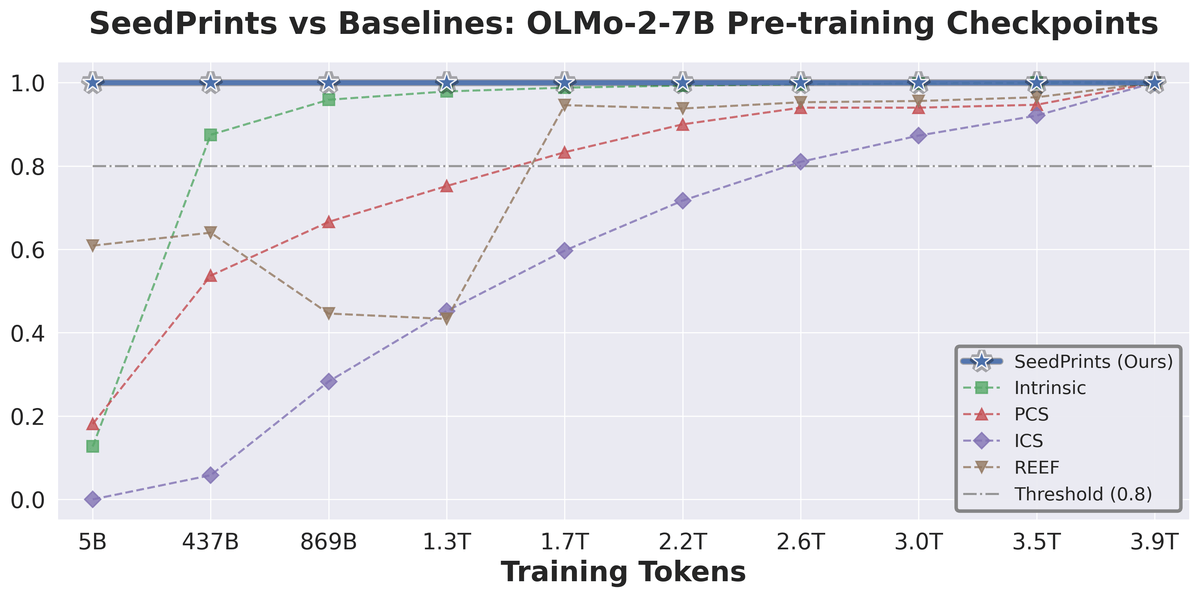
- Achieves 0.992 overall AUC on LeaFBench across 6 model families
- Enables lineage verification from initialization onward, not just after convergence
- Code and reproduction scripts released at github.com/YnezT0311/SeedPrints
A team from the National University of Singapore and CUHK-Shenzhen has published work claiming that every large language model carries a birthmark from the exact random seed used to initialize its weights, and that this birthmark can be detected long after trillions of tokens of training have washed over it. The method, called SeedPrints, reframes model fingerprinting around properties that exist before any gradient step is taken.
Why current fingerprints fall apart during pretraining
Model fingerprinting matters for provenance verification, copyright auditing, and detecting whether someone quietly forked your base model. Existing methods are primarily evaluated after fine-tuning, where models have already acquired stable signatures from training data, optimization dynamics, or hyperparameters. Most of a model's capacity is acquired during pretraining, and current techniques become unreliable in this regime because they rely on post-hoc signatures that only emerge after substantial training.
The authors argue this violates the classical notion of a fingerprint. Prior methods define their signatures post hoc, identifying emergent properties from a completed training process rather than the innate, Galtonian fingerprints present from random initialization. Francis Galton's 19th-century work established fingerprints as intrinsic, permanent, and unique from birth. Existing LLM fingerprints are more like tattoos acquired later in life.
Untrained models already have preferences
The starting point is a surprising empirical claim. Untrained models exhibit seed-dependent preferences in token selection, and the same prompt induces subtle but reproducible biases in next-token probabilities that remain measurable. Feed uniform random inputs into a freshly initialized LLaMA-2 style transformer and certain output dimensions systematically receive the minimum logit far more often than chance would predict. Change the seed and a different set of dimensions gets disfavored.
This story is for Pro members
You've reached the end of the free preview. Upgrade to AlphaSignal Pro to read the full article - and everything else behind the paywall.
Comments
