

NTU's Audio-Interaction Listens Continuously and Responds Without Being Asked
Audio-Interaction unifies streaming ASR, voice chat, and proactive sound alerts into one always-on model that decides when to speak from the audio itself
 PRO
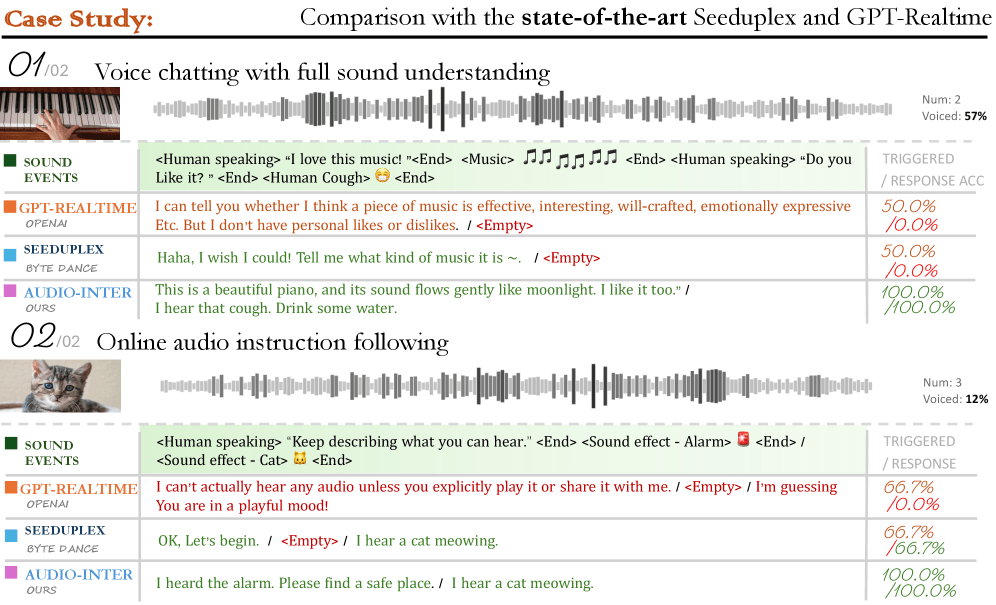
- Audio-Interaction is a 3B-parameter streaming model that listens to continuous audio and autonomously decides when to respond using a perceive-decide-respond loop, replacing the need for multiple specialized models.
- The SoundFlow framework handles end-to-end training: streaming-native data construction, comprehension-aware training to prevent false triggers, and FIFO-scheduled asynchronous inference that cuts first-frame latency by 4.5x.
- StreamAudio-2M, a new 2.6M-item, 302k-hour streaming corpus spanning 7 capabilities and 28 sub-tasks, is publicly released on Hugging Face.
- On MMAU benchmarks, the 3B model scores 58.15 (audio instructions), matching or beating several 7B offline baselines, while retaining 91%+ accuracy across 5 concatenated audio streams.
- A new benchmark, Proactive-Sound-Bench (644 human-designed events), evaluates whether a model can proactively intervene without explicit instructions; Audio-Interaction scores 61.2/62.8 (single/multi-round).
- Key limitation: 59.8% of errors are false positives triggered by benign sounds like paper tearing or appliance noise; model weights are not yet publicly released.
Every audio AI model you can name today has the same fundamental flaw: it waits. It waits for you to finish speaking, waits for a complete audio clip, waits for an explicit prompt. Current Large Audio Language Models (LALMs) follow the conventional offline input-output formulation, which poorly matches the real-time and interactive nature of audio. A new paper from researchers at NTU, NUS, and CUHK proposes a clean break from this paradigm with the Audio Interaction Model, introducing a unified streaming system called Audio-Interaction that listens continuously, decides autonomously, and responds in real time.
The problem with today's audio AI
A common bridge has been to train a dedicated streaming model for each important task, such as dialogue and streaming speech recognition, but this approach has two fundamental problems: every capability requires its own model trained from scratch, and each model handles only a narrow capability. Moshi can hold a conversation but cannot recognize a cough. A streaming ASR model can transcribe but cannot answer a question. Even fully-streaming systems like Moshi, despite strong conversational capability, cannot interpret a hesitant pause or recognize a cough.
Two deeper technical challenges make unification hard. First, comprehension-grounded response triggering: an interactive model must decide whether to respond at every audio chunk based on semantic understanding, not just surface-level acoustic cues, and no existing corpus pairs continuous audio with properly timed intervention cues. Second, real-time context continuity: audio must be consumed in fixed-length chunks to meet low-latency requirements, but chunking breaks the temporal continuity of acoustic signals and the long-range context accumulated across the interaction.

The perceive-decide-respond loop
The core idea is deceptively simple. Audio-Interaction consumes audio one chunk at a time and, at each step, makes a comprehension-grounded decision between responding and remaining silent, forming an always-on perceive-decide-respond loop. At every 400ms chunk, the model predicts a single special token: <silent> or <response>. Only when it emits <response> does it switch from listening to generating text. This formulation casts streaming interaction as a unified sequential process, allowing the model to jointly learn
This story is for Pro members
You've reached the end of the free preview. Upgrade to AlphaSignal Pro to read the full article - and everything else behind the paywall.
Comments
