
NousResearch's Hermes Agent Evolves Its Own Behavior Without Retraining Any Weights
NousResearch's hermes-agent-self-evolution uses GEPA and DSPy to let agents rewrite their own skills, prompts, and tool code — no GPU needed, ~$2–10 per run
 Pro
Takeaways
- What it is: NousResearch released hermes-agent-self-evolution, a pipeline that uses GEPA + DSPy to automatically evolve Hermes Agent's skills, prompts, and code.
- No GPU needed: Everything runs via API calls only — no weight updates, no fine-tuning — at ~$2–10 per optimization run.
- GEPA is peer-reviewed: The core optimizer is an ICLR 2026 Oral paper that outperforms GRPO by up to 20% using up to 35x fewer rollouts.
- 5-phase roadmap: Phase 1 (skill files) is implemented; Phases 2–5 covering tool descriptions, system prompts, code, and continuous loops are planned.
- Hard guardrails: Every evolved variant must pass the full test suite, size limits, semantic checks, and benchmark gates — all changes go through human PR review, never auto-merged.
- Community traction: The repo has 3,300+ stars and 355 forks; users report up to 30% token reduction on repetitive tasks after weeks of use.
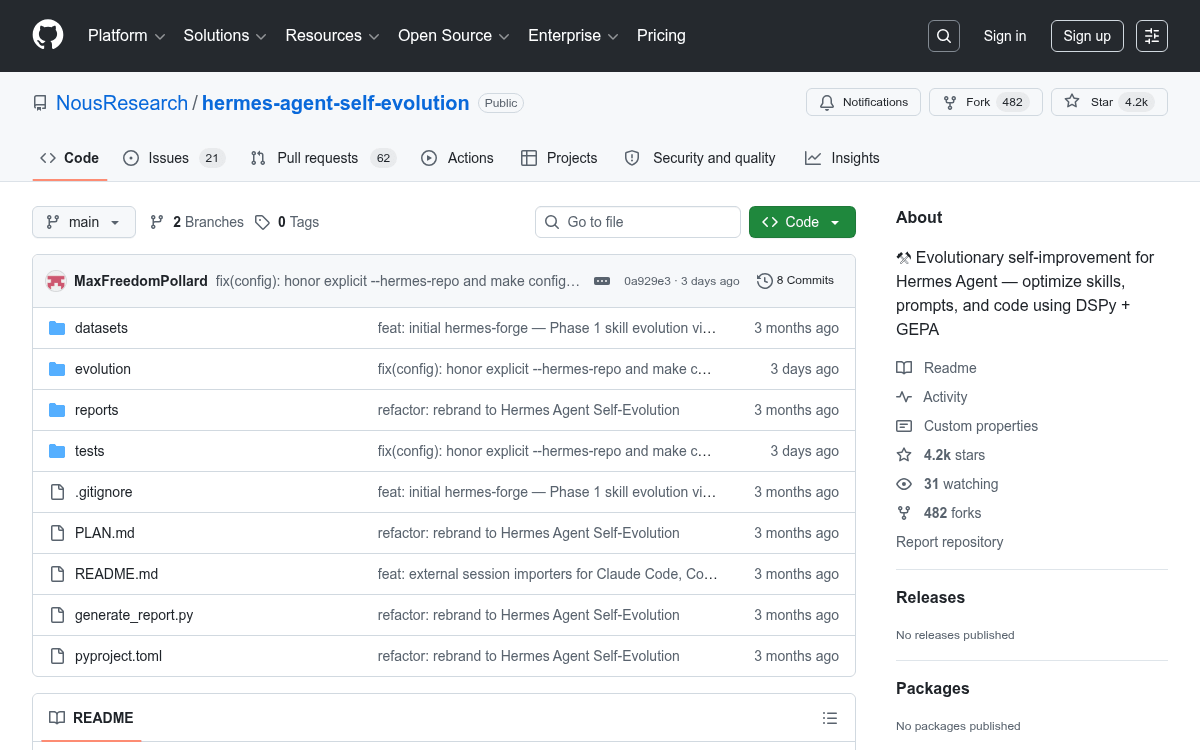
Hermes Agent Self-Evolution is a new open-source pipeline from NousResearch that lets an AI agent improve itself over time , not by retraining weights, but by evolving the text that drives its behavior: skill files, tool descriptions, system prompt sections, and eventually tool implementation code. The engine behind it is GEPA (Genetic-Pareto Prompt Evolution), a prompt optimizer that just received an Oral presentation at ICLR 2026. The repo has already crossed 3,300 stars with 355 forks and is actively receiving community PRs.
The problem it actually solves
Every agent framework eventually hits the same wall: your agent's behavior is only as good as the prompts and skill instructions you wrote on day one. Improving them means manually reading failure logs, guessing what went wrong, editing text, and re-running evals. It's tedious, opaque, and doesn't scale. GEPA reads execution traces to understand why things fail , not just that they fail , and works with as few as 3 examples. That's the shift this project is betting on.
Nous Research built its credibility on the Hermes model series , fine-tuned LLMs with strong instruction-following that became workhorses for the open-source community. Hermes-agent is a different kind of bet: not a model, but an agent framework that claims to get smarter the more you use it.
What GEPA actually does
GEPA is a reflective prompt optimizer for compound AI systems that merges textual reflection with multi-objective evolutionary search. It iteratively mutates prompts using natural language feedback drawn from new rollouts. The key word is reflective , instead of treating a failed run as just a negative scalar reward (like RL does), GEPA reads the full execution trace and writes a natural-language diagnosis of what went wrong before proposing a fix.
Given any AI system containing one or more LLM prompts, GEPA samples system-level trajectories , reasoning, tool calls, and tool outputs , and reflects on them in natural language to diagnose problems, propose and test prompt updates, and combine complementary lessons from the Pareto frontier of its own attempts.
The "Pareto" part matters too. Rather than optimizing a single score, GEPA maintains a frontier of candidates that trade off multiple objectives simultaneously , accuracy, cost, latency, and safety , and selects from that frontier to avoid getting stuck in local optima. As a result of GEPA's design, it can often turn even just a few rollouts into a large quality gain. Across six tasks, GEPA outperforms GRPO by 6% on average and by up to 20%, while using up to 35x fewer rollouts.
What the pipeline actually evolves
Hermes Agent Self-Evolution uses DSPy + GEPA to automatically evolve and optimize Hermes Agent's skills, tool descriptions, system prompts, and code , producing measurably better versions through reflective evolutionary search. The project is structured into five sequential phases:
- Phase 1 (implemented): Skill files , the
SKILL.mdprocedural instruction files the agent follows for specific tasks - Phase 2 (planned): Tool descriptions , the natural language text in tool schemas that tells the agent when to pick which tool
- Phase 3 (planned): System prompt sections , persona, memory guidance, formatting instructions
- Phase 4 (planned): Tool implementation code , actual Python source files, evolved via the Darwinian Evolver
- Phase 5 (planned): A continuous improvement loop that auto-detects underperforming skills and triggers optimization on a schedule
Only Phase 1 is currently implemented. The rest is detailed in a thorough PLAN.md that reads more like a research spec than a roadmap , each phase has explicit validation gates, and if a phase doesn't produce measurable improvements, the plan says to stop rather than push forward.
The optimization loop, step by step
Here's what actually happens when you run an evolution cycle on a skill:
- The current skill file is read and wrapped as a DSPy module
- An evaluation dataset is generated , either synthetically (a strong model reads the skill and writes test cases) or mined from real session history stored in Hermes' SessionDB
- GEPA runs the agent on those test cases, collects execution traces, and writes natural-language diagnoses of failures
- Candidate variants are proposed and evaluated in parallel via a batch runner
- Every candidate must pass the full test suite, size limits, semantic preservation checks, and benchmark gates , variants that fail any constraint are discarded
- The best surviving variant is committed to a git branch and opened as a PR for human review , never merged automatically
The human-in-the-loop PR step is non-negotiable by design. The fitness function is task-specific , did the skill do its job better? Benchmarks ensure the improvement didn't break something else. A variant that improves skill quality by 20% but drops benchmark scores by 5% is rejected.
No GPU, no fine-tuning
No GPU training is required. Everything operates via API calls , mutating text, evaluating results, and selecting the best variants. A full optimization run costs approximately $2–10. This is a meaningful distinction from RL-based self-improvement approaches. DSPy + GEPA and MIPROv2 optimize the text of prompts, instructions, and few-shot examples , they mutate and evaluate strings, not model weights.
The only component that touches code rather than text is the Darwinian Evolver (used in Phase 4), which is an external CLI tool licensed under AGPL v3 , meaning it's invoked as a subprocess rather than imported, to keep the main project MIT-licensed.
Getting started
The repo is available now on GitHub. Phase 1 skill evolution is the only implemented piece, so that's what you'd actually run today:
git clone https://github.com/NousResearch/hermes-agent-self-evolution.git
cd hermes-agent-self-evolution
pip install -e ".[dev]"
# Point at your hermes-agent repo
export HERMES_AGENT_REPO=~/.hermes/hermes-agent
# Evolve a skill using synthetic eval data
python -m evolution.skills.evolve_skill \n    --skill github-code-review \n    --iterations 10 \n    --eval-source synthetic
# Or use real session history
python -m evolution.skills.evolve_skill \n    --skill github-code-review \n    --iterations 10 \n    --eval-source sessiondb
The --eval-source sessiondb flag mines Hermes' own conversation history to build a real-usage eval dataset, which produces higher-quality signal than synthetic data once you have enough sessions accumulated.
Where it fits and where it falls short
The practical use cases are clearest for teams running Hermes Agent on repetitive, well-defined workflows , code review, research summarization, recurring data pipelines. Users who tested Hermes for multiple weeks report measurable efficiency gains on repetitive tasks. One r/LocalLLaMA user shared that after three weeks of continuous use, their agent's token consumption on daily briefing tasks dropped by roughly 30%.
The limitations are worth being honest about. First, only Phase 1 is live , tool description and system prompt evolution are still planned. Second,
self-evolving skills are a black box in one important sense: skill files are human-readable Markdown, but the agent's reasoning about which patterns to preserve or modify has no explainability interface.
Third, the pipeline is tightly coupled to Hermes Agent's specific infrastructure , it reads from batch_runner.py, agent/trajectory.py, and SessionDB, which means adapting it to a different agent framework would require significant rework.
The bigger picture
Unlike RL or gradient-based methods that collapse execution traces into a single scalar reward, GEPA uses LLMs to read full execution traces , error messages, profiling data, reasoning logs , to diagnose why a candidate failed and propose targeted fixes. That's the core idea that makes this different from prior prompt optimization work.
The hermes-agent-self-evolution repo being backed by an ICLR 2026 Oral paper is significant. This isn't a framework built on vibes , the GEPA architecture has gone through peer review. That matters for enterprise evaluators who need more than GitHub stars as evidence. The field has been talking about self-improving agents for years; this is one of the more rigorous attempts to actually build the infrastructure for it, with explicit guardrails, benchmark gates, and a human review step baked in from the start.