

Nous Research Turns Hermes Agent Into a Full Enterprise Platform With Teams
Nous Portal adds shared credit pools, per-member spend caps, and a Spend Intelligence dashboard so teams can run Hermes Agent without juggling logins or billing chaos

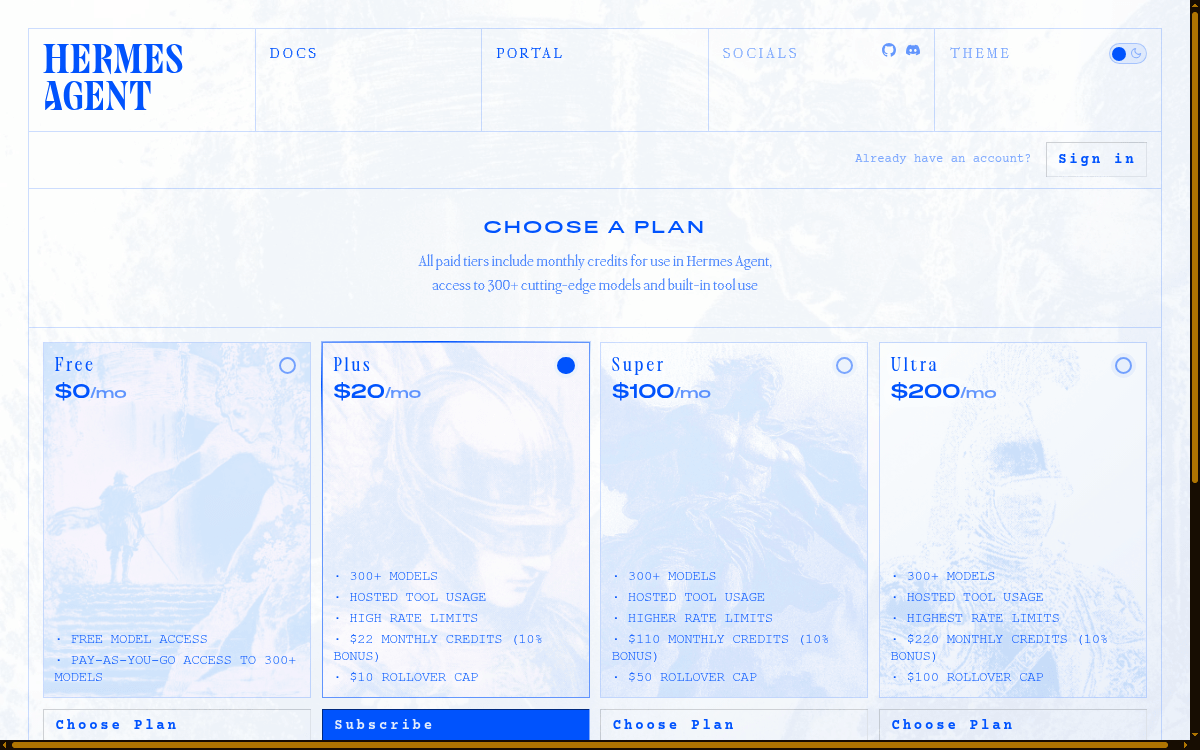
- Teams is live: Nous Portal now supports shared credit pools across an org, with one billing owner and a Spend Intelligence dashboard.
- Credits over seats: Teams scale by topping up a shared balance, not buying per-user licenses -- a friendlier model for variable workloads.
- Admin controls: Per-member spend caps, usage breakdowns by member and team, and the ability to invite or remove members at any time.
- Platform context: Nous Portal bundles 300+ models, web search, image gen, TTS, and browser automation behind a single login, with a free tier ($0.10/mo credits) and paid plans from $20/mo.
- Hermes momentum: The underlying Hermes Agent has crossed 180,000 GitHub stars in under four months, making it the fastest-growing open-source agent framework of 2026.
- Open-source optionality: Hermes Agent remains MIT-licensed and works with any provider; Portal and Teams are convenience layers, not lock-in.
Nous Portal, the subscription platform from Nous Research that bundles 300+ models and a full tool gateway into a single login, just got its first proper team feature. The new Teams layer lets an entire organization share one credit pool under a single billing owner, with granular visibility into who is spending what. It is a small but telling step for a company that has spent 2026 turning an open-source agent project into something that looks increasingly like a platform business.
What the old world looked like
Before Teams, organizations had two bad options:
- Separate Portal accounts per person, meaning separate billing, separate credit top-ups, and no shared visibility.
- One shared login passed around the team, with zero controls over who was spending what.
Running a capable AI agent used to mean signing up for and paying multiple providers: a model provider, a web search provider, an image generation provider, a TTS provider, and optionally a browser automation provider -- each with its own dashboard, billing, and quota. Portal already collapsed that into one account. Teams collapses the per-person fragmentation on top of that.
How Teams actually works
The setup flow is exactly what you would expect from a modern SaaS product. Create a team, invite members by email, they click a link and join. One subscription replaces separate accounts with OpenRouter, Anthropic, OpenAI, ElevenLabs, and other providers. With Teams, that single account now extends across an entire org.
The key design decision is credits over seats. Teams run on a shared credit balance, not per-seat subscriptions, so scaling means topping up one number instead of buying more licenses. Admins get a Spend Intelligence dashboard with:
- Per-member and per-team spend breakdowns
- Per-member spend caps to prevent runaway usage
- The ability to invite or remove members at any time
Users can belong to multiple teams and switch between them, which matters for consultants or anyone working across client environments.
The platform it sits on top of
Nous Portal launched as a subscription product that bundles 300+ models and built-in tools -- web search, image generation, TTS, browser automation -- behind a single login. The Portal proxies a curated catalog of agentic models from across the ecosystem, billed against your Nous subscription instead of one credit balance per lab. Routing happens through OpenRouter under the hood, so model availability and failover behavior matches what you would get with an OpenRouter key.
All paid tiers include monthly credits for use in Hermes Agent, access to 300+ cutting-edge models, and built-in tool use. The free tier is $0/month with $0.10 in monthly credits , enough to evaluate. If you want to keep using it, the $20 plan is the recommended next step.
Why this matters for Hermes Agent's trajectory
Hermes Agent is an open-source autonomous AI agent built by Nous Research, released in February 2026. The open-source project has accumulated over 180,000 GitHub stars in under four months since its February 25 launch, making it the fastest-growing open-source agent framework of 2026 by Dealroom's count. That kind of community momentum is rare, but community momentum alone does not pay for model training or infrastructure.
The Nous Tool Gateway positions Nous Portal as a full-stack inference and tooling platform rather than just a model hosting service. Teams is the next logical layer: once you have individuals hooked on a unified billing experience, you sell the org-wide version. It is the same playbook that made GitHub, Notion, and Slack into enterprise businesses.
Companies are starting to ask harder questions about AI coding assistants and agent tools. Claude Code, Codex, and Copilot have made the category real, but they have also made costs, permissions, and vendor dependence harder to ignore. A credit-pooled, admin-controlled, open-source-backed alternative is a credible answer to those concerns.
What is now possible
The combination of Teams and the existing Portal stack means an engineering org can now:
- Give every engineer access to 300+ models and the full tool gateway without individual signups
- Set per-engineer token budgets before a sprint, not after an invoice surprise
- See exactly which team member is burning credits on browser automation versus inference
- Keep the underlying agent (Hermes Agent) fully open-source and self-hostable, with Portal as an optional convenience layer
Hermes Agent is open source and free; you can run it with any provider you like -- OpenRouter, direct Anthropic, OpenAI, or Google keys, local models via Ollama, or Nous Portal. Portal is one option among many, not a requirement. That optionality is part of the pitch: you are not locked in, but the convenience of Teams may make Portal sticky for orgs that have already standardized on Hermes.
Teams is live now in the Nous Portal dashboard. New users can sign up at portal.nousresearch.com/signup.
Comments
