

Northwestern and Purdue's RecSysSWT Brings Netflix-Style AI Recommendations to a Single GPU
A reproducible pipeline packages Netflix-style sliding window training with a hash-based embedding trick, delivering +6% MRR gains on commodity GPUs.
 PRO
- Open framework RecSysSWT reproduces Netflix-style sliding window training for long-sequence recommenders on academic GPUs.
- Delivers +6.04% MRR and +6.34% Recall@10 on Retailrocket versus a matched no-sliding baseline.
- Novel k-shift embedding layer uses bit-shifted hash lookups into a shared table for million-item vocabularies.
- Runtime-aware ablation shows stride=2 cuts training time 31.8% while losing only 1.6% MRR.
- All-Sliding beats Mixed-1000 on Retailrocket, reversing Netflix's finding and confirming dataset-dependent optima.
- Fails on Taobao's 4.1M-item catalog due to hash collisions and short 9.1-interaction average histories.
Long user histories are gold for recommender systems, but training on them at full length has been treated as a luxury reserved for companies with warehouse-scale GPUs. A new open-source release from researchers at Northwestern and Purdue pushes back on that assumption, showing that industrial-style sliding window training can be reproduced on a single university cluster while still delivering measurable ranking gains.
The reproducibility gap in long-context recommenders
Long interaction histories sit at the core of modern recommenders, yet training on the full sequence gets dismissed as impractical under realistic memory and latency budgets. This work argues otherwise and backs it up at academic scale. The technique in question, sliding window training, was popularized by a Netflix paper at RecSys 2024 but shipped without code, without runtime numbers, and without a strategy for handling the million-item vocabularies that make real catalogs painful to embed.
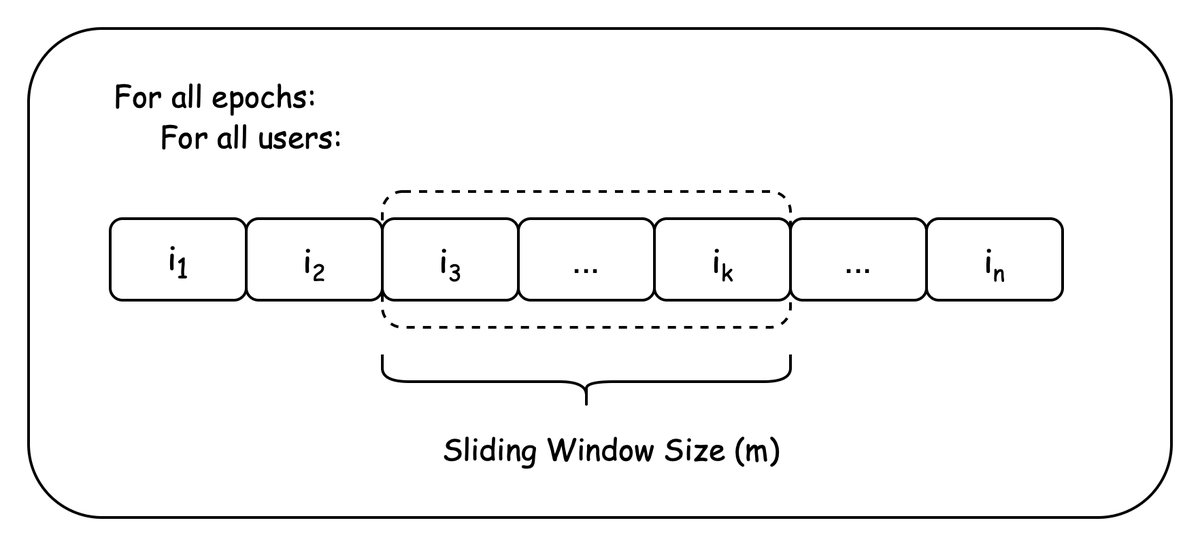
The idea itself is simple. Rather than feeding a model a truncated recent slice of a user's history, you slide a fixed-size context window across the entire sequence over multiple epochs. The model still sees a short context per step, respecting inference latency budgets, but is eventually exposed to the full temporal range of behavior. Nobody outside the original team had a working recipe until now.
This story is for Pro members
You've reached the end of the free preview. Upgrade to AlphaSignal Pro to read the full article - and everything else behind the paywall.
Comments
