

Nodeterm's Open-Source Canvas Lets Developers Run Claude and Codex Side by Side
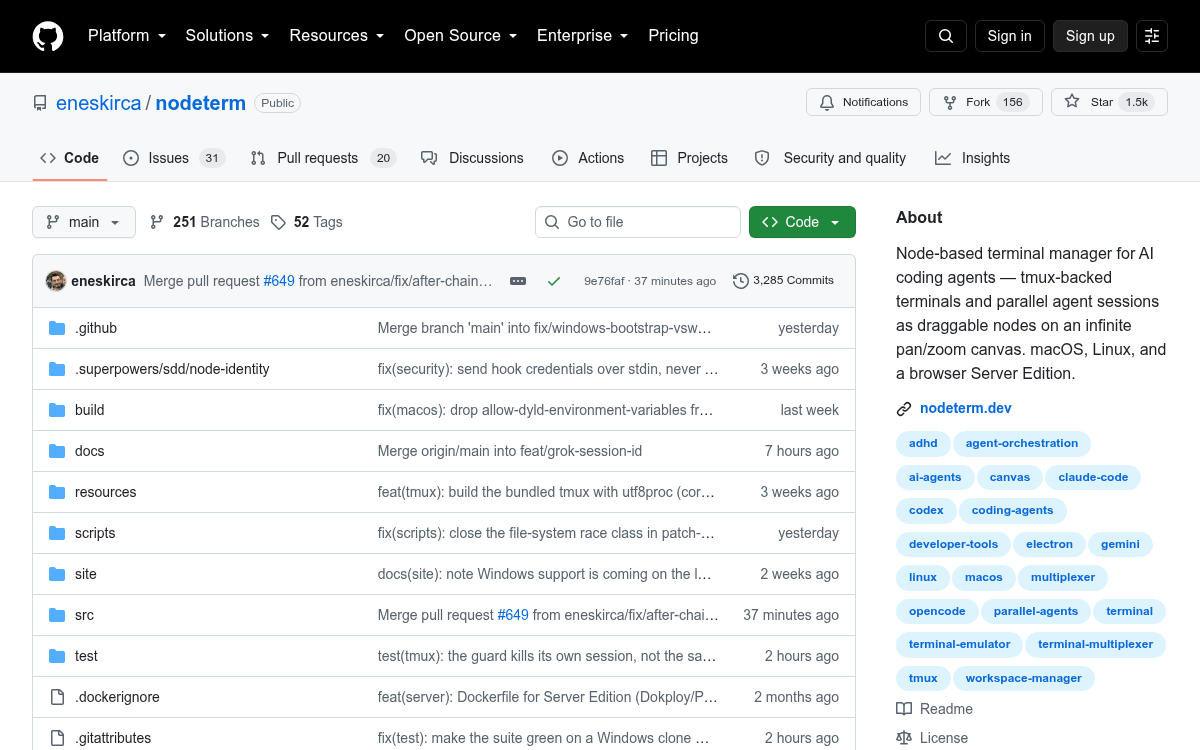
Nodeterm turns terminals and coding agents into draggable nodes on an infinite canvas, with tmux-backed sessions that survive reboots.

 PRO
PRO- Nodeterm is an open-source node-based terminal manager with 1,500+ GitHub stars.
- Real terminals run as draggable nodes on an infinite pan/zoom React Flow canvas.
- Tmux-backed sessions survive app restarts and full machine reboots, including running agents.
- Supports Claude Code, Codex, and Gemini as agent nodes with live RUNNING / NEEDS YOU badges.
- Context-link edges let two agent nodes read each other's transcripts on demand.
- Available on macOS, Linux, and via a browser-based Server Edition under BUSL-1.1.
Anyone juggling three Claude Code sessions, a Codex agent, and a couple of tmux panes knows the pain: stacked terminal tabs hide context, and you lose track of which agent is waiting for approval and which one silently crashed twenty minutes ago. Nodeterm is an open-source terminal manager that replaces the tab stack with a spatial canvas where every shell, agent, editor, and diff lives as a draggable card on an infinite pan/zoom workspace.
The project just crossed 1,500 GitHub stars. It ships as a macOS desktop app, a self-hosted browser build called Server Edition for Linux, and an in-progress mobile companion.
Everything is a node
Each shell gets its own PTY via node-pty, rendered as a card on a React Flow canvas. You can place, group, label, and zoom into any node independently. The detail that lifts it past novelty is tmux-backed session continuity: terminals keep running across node remounts and full app restarts. Reboot the machine, reopen Nodeterm, and your agents are still where you left them, live processes included.
This story is for Pro members
You've reached the end of the free preview. Upgrade to AlphaSignal Pro to read the full article - and everything else behind the paywall.
Comments
