

Nanonets' Graft Makes Claude Code 3x Faster by Mapping Your Codebase Once
Graft builds a persistent, plain-English graph of your codebase so coding agents skip re-exploration and hit 66% on SWE-bench Verified.

 PRO
PRO- Graft is an open-source context layer that maps codebases into linked markdown graphs for any coding agent
- Benchmarks show 46% fewer tool calls, 42% fewer tokens, 60% less latency versus cold Claude Code
- On SWE-bench Verified, Graft-wired Claude Sonnet resolved 33/50 instances against baseline 27/50, a +12 point jump
- Structural graph uses deterministic tree-sitter across 22 languages, no LLM or API key required
- Optional --deep pass adds LLM-written summaries via OpenAI, Anthropic, OpenRouter, or local models under your own key
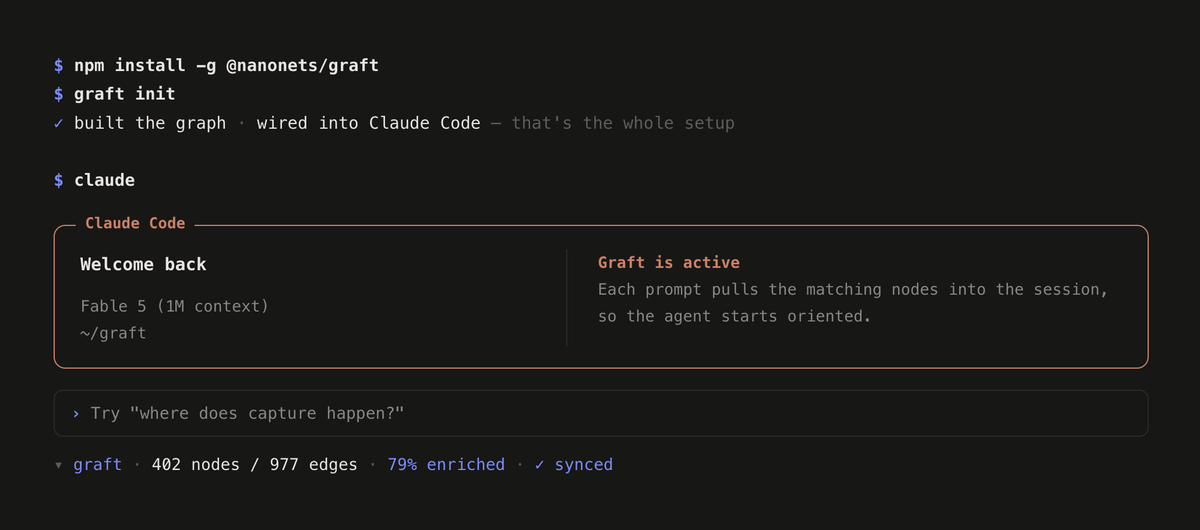
- Setup is two commands:
npm install -g @nanonets/graftthengraft init, MIT licensed
Every time you fire up Claude Code or Cursor on the same repo, your agent starts from zero. It greps the same terms, opens the same files, follows the same imports, then throws all of that mapping away when the session ends. A new open-source project called Graft, from the team at Nanonets, writes the map to disk once and lets every coding agent read it like any other file.
The pitch is concrete: Graft claims up to 4x cheaper and 3x faster runs with equal or better correctness, and it has the benchmarks to back it up. On SWE-bench Verified with Claude Sonnet, Graft-wired Claude Code resolved 33 of 50 instances against a cold baseline's 27, a jump from 54% to 66%.
The rediscovery tax
The core problem Graft targets is that agents rebuild their mental model of a codebase on every task, and that rediscovery burns most of a run's tool calls, tokens, and latency. A no-map agent's exploration trail wanders file to file before it finds what it needs, and none of that work carries over to the next session or the next teammate.
Graft precomputes the understanding once and stores it as a folder of linked markdown files, one node per subsystem, API, or concept. Each node contains:
- Summary: a plain-English explanation written by an LLM and cached
- Crux: the handful of lines that carry the actual logic, lifted from source
- Sources: the exact files the node was built from, tracked by content hash
- Links: typed edges to other nodes like
depends_on,uses,implements,produces - Notes: anything you write yourself, preserved across regenerations
This story is for Pro members
You've reached the end of the free preview. Upgrade to AlphaSignal Pro to read the full article - and everything else behind the paywall.
Comments
