

Multiverse Computing's Quasar 438B Tops Europe's AI Leaderboard While Beating Bigger Models
Multiverse Computing's Quasar 438B tops European AI rankings with a 43 Intelligence Index score and 15.3-second reasoning responses.
- Multiverse Computing launched Quasar 438B, the top-ranked European model on Artificial Analysis Intelligence Index v4.1.1.
- Scores 43 on the composite index, 13 points ahead of Mistral Medium 3.5 and 5 above Nemotron 3 Ultra.
- Returns 500 tokens with reasoning in 15.3 seconds, faster than nearly all higher-scoring models.
- AA-LCR long-context score of 75.0 puts it level with Grok 4.6 and near Claude Opus 5.
- Available now via the OpenAI-compatible CompactifAI API with first month free.
- Supports English and Spanish only, with tool calling and structured outputs enabled by default.
Europe has a new flagship reasoning model. Quasar 438B, from Spanish AI compression specialist Multiverse Computing, has landed at the top of the European leaderboard on Artificial Analysis' latest benchmark suite, and it did so while running faster than most of the frontier models it is chasing.
Multiverse Computing pitches Quasar 438B as its flagship reasoning model for enterprise-scale agents and coding, and it is the first large model the company has released. The headline number is a 43 on the Artificial Analysis Intelligence Index v4.1.1, a composite that the benchmarking group uses to rank general model capability across nine tasks.
What the benchmark measures
The Intelligence Index v4.1.1 is a weighted average of nine evaluations across four categories: Agents (GDPval-AA v2 and τ³-Banking), Coding (Terminal-Bench v2.1 and SciCode), Scientific Reasoning (Humanity's Last Exam, GPQA Diamond and CritPt), and General Knowledge and Long-Context Reasoning (AA-Omniscience and AA-LCR). A score reflects how a model performs across agentic tool use, code execution in real terminals, hard science questions, and needle-in-a-haystack long-document reasoning.
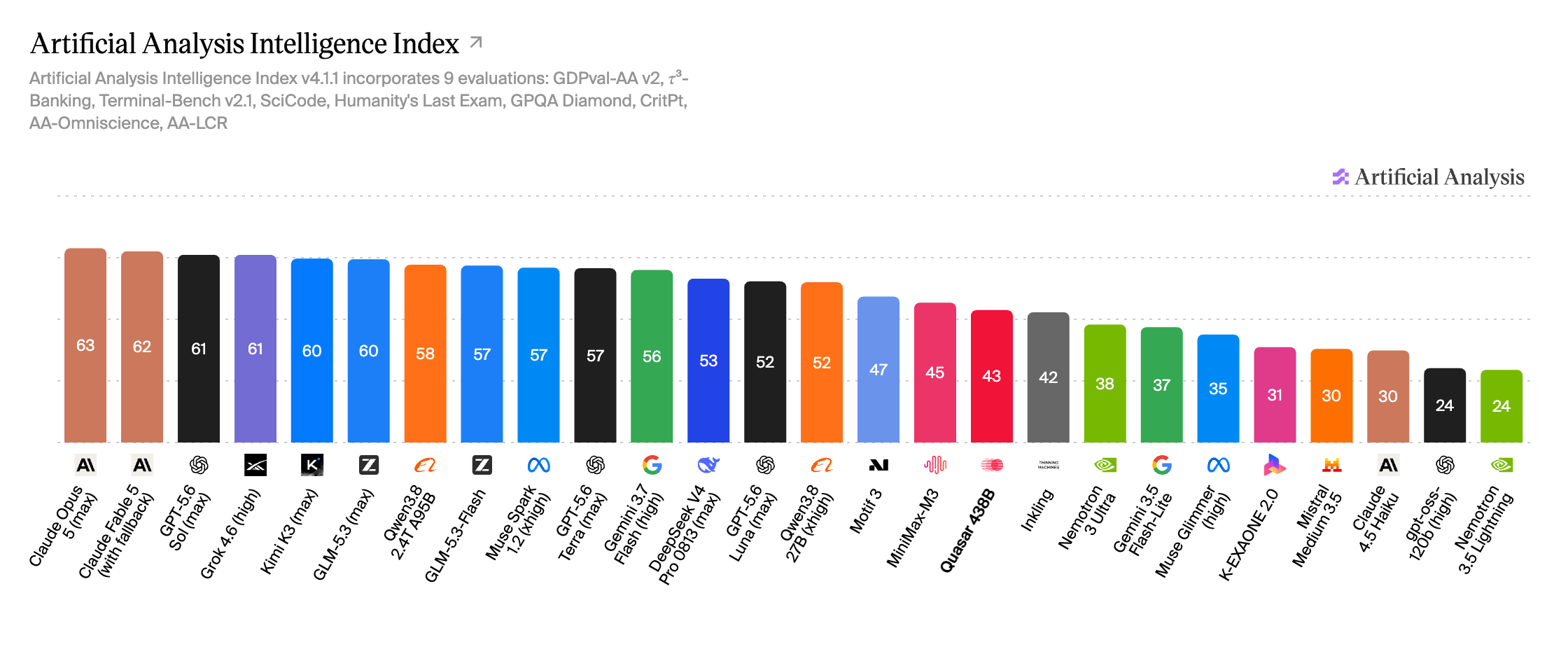
Quasar scores 43 on the composite index, 13 points ahead of Mistral Medium 3.5 and 5 ahead of Nemotron 3 Ultra, which carries 112 billion more parameters. The frontier group led by Claude Opus 5 sits well above at 63, but Quasar narrows a European gap that has widened over the last year of US and Chinese releases.
Speed under load
Reasoning models tend to be slow because they burn tokens on internal chains of thought before answering. Quasar returns a 500-token response, thinking time included, in 15.3 seconds. Only three models in the comparison answer faster: Nemotron 3.5 Lightning at 9.4 seconds (scoring 24 on the index), Gemini 3.5 Flash-Lite at 10.8 seconds (37), and Gemini 3.7 Flash at 11.5 seconds (56). Every model that beats Quasar on capability needs between 25 and 156 seconds to return the same 500 tokens.
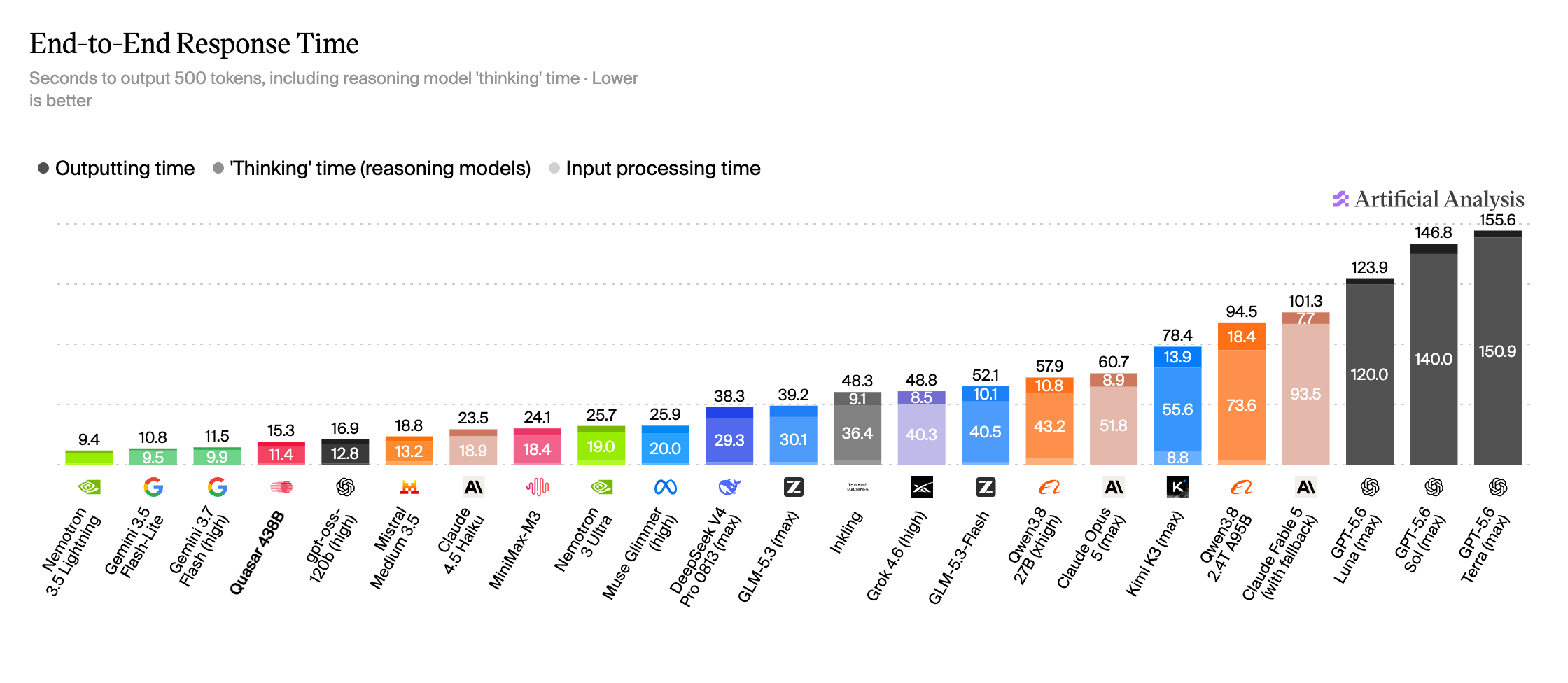
That gap compounds quickly in agent loops, where a single user request may require dozens of model calls to plan a task, invoke tools, check results, and adjust course. Each slow step adds to the total wait.
Long context and terminal work
Quasar's long-context reasoning score is the most competitive part of its profile. On AA-LCR, which tests whether a model can extract, connect, and reason over facts scattered through long documents, it scores 75.0, level with Grok 4.6 and within a point of Claude Opus 5 at 75.7. It leads Nemotron 3 Ultra by 4 points and Mistral Medium 3.5 by nearly 10.
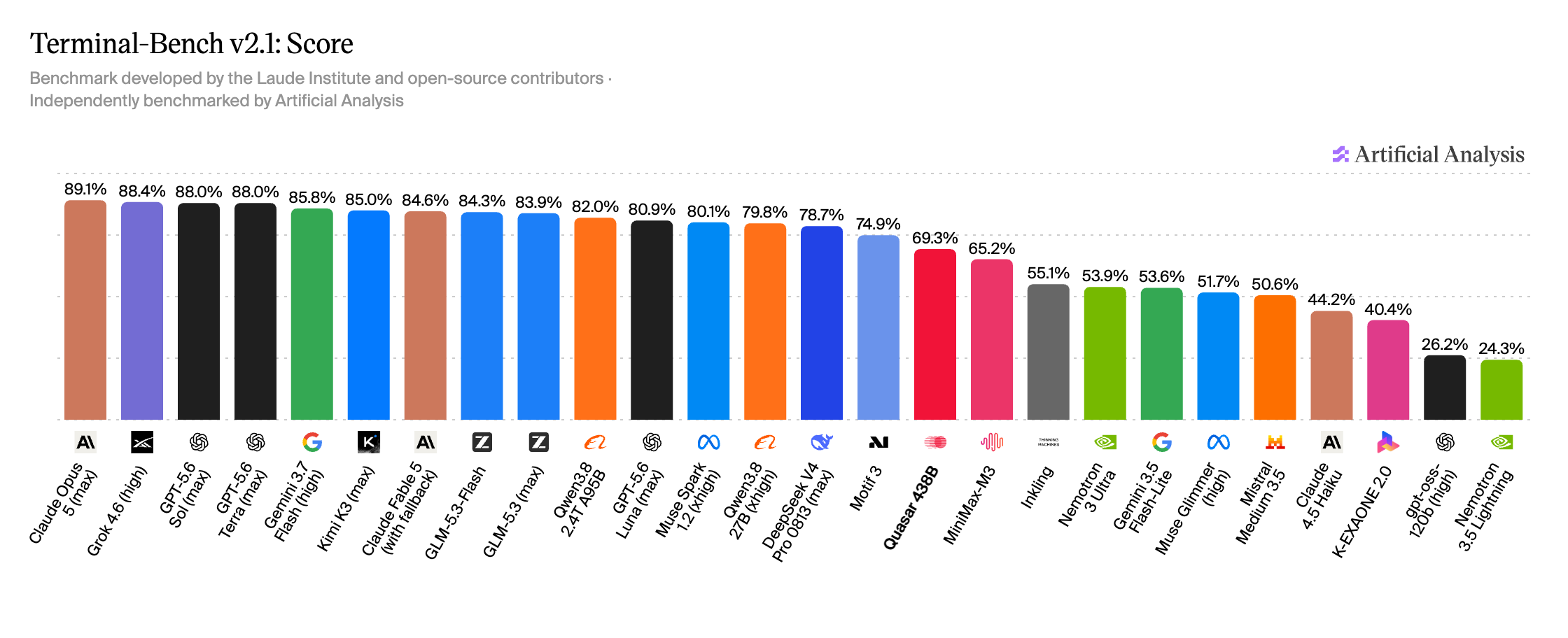
On Terminal-Bench v2.1, which drops an agent into a real shell and asks it to complete tasks, Quasar scores 69.3, an 18.7-point lead over Mistral Medium 3.5 and 15.4 over Nemotron 3 Ultra. Claude Opus 5 still leads at 89.1, and Multiverse openly flags terminal performance as the area with the most room to grow.
Strengths and gaps
Based on the published numbers, Quasar is well suited for:
- Long-document analysis, RAG pipelines, and research assistants that need to hold and cross-reference large contexts.
- Interactive agent loops where response latency affects user experience.
- Coding agents that operate in a terminal, run commands, and iterate.
- Bilingual English and Spanish deployments, which is unusual at this parameter scale.
Its weaker spots:
- Hard scientific reasoning still trails Claude Opus 5, Grok, and the top OpenAI models.
- Terminal-Bench at 69.3 is solid but well short of Opus-class autonomous coding.
- No multimodal or vision capability is advertised.
- Language coverage is limited to English and Spanish, narrower than the Mistral or Qwen families.
The compression story
Multiverse built its reputation on CompactifAI, a compression stack that uses tensor-network methods borrowed from quantum physics to shrink large models with minimal accuracy loss. Quasar brings that approach into the 400B-plus parameter class: a reasoning model for multi-step tasks that need planning, tool use, code execution, and large context, without the latency that class normally carries. The company has not disclosed the base architecture or whether Quasar is a compressed derivative of an existing open model, but a 438B model beating a 550B one on both quality and speed fits the CompactifAI thesis neatly: remove redundant weight, keep the useful capacity, and inference gets cheaper without a benchmark penalty.
Dropping it into your stack
Quasar 438B is live on the CompactifAI API, with the first month free for new sign-ups. The model is exposed through POST /v1/chat/completions using the standard OpenAI-compatible chat payload, supports function and tool calling (tools, tool_choice, assistant tool_calls), and works with structured outputs via response_format where applicable. Dropping it into an existing OpenAI SDK client is roughly a base URL swap.
from openai import OpenAI
client = OpenAI(
    base_url="https://api.compactif.ai/v1",
    api_key="YOUR_KEY",
)
resp = client.chat.completions.create(
    model="quasar-438b",
    messages=[{"role": "user", "content": "Plan a refactor of this repo."}],
)
One integration quirk worth knowing: reasoning is always enabled and cannot be disabled via chat_template_kwargs. Every call pays the thinking-time cost, which suits agentic and coding workloads but makes the model a poor fit as a cheap general chat completion endpoint.
A new option for EU-hosted deployments
Mistral has carried most of the weight in European sovereign AI for the past two years, with everything else trailing US and Chinese frontier models by a wide margin. A 438B reasoning model that ships with tool calling, OpenAI-compatible APIs, and frontier-adjacent long-context scores gives teams a credible alternative to Mistral Medium without reaching outside the EU. The broader signal is that a compression-first company has shipped one of the fastest large reasoning models on any leaderboard, European or not. If the CompactifAI approach continues to scale, the more pressing question becomes whether the industry at large has been leaving inference efficiency on the table all along.
Comments
