

Moonshot AI's Kimi K3 Drops 2.8 Trillion Parameters to Beat OpenAI and Anthropic
Moonshot AI's 2.8T parameter Kimi K3 launches with frontier-level agentic performance, a 1M token context window, and open weights on the way
- Kimi K3 launches: Moonshot AI releases its 2.8T parameter flagship model, the largest open-source model to date, on July 16, 2026.
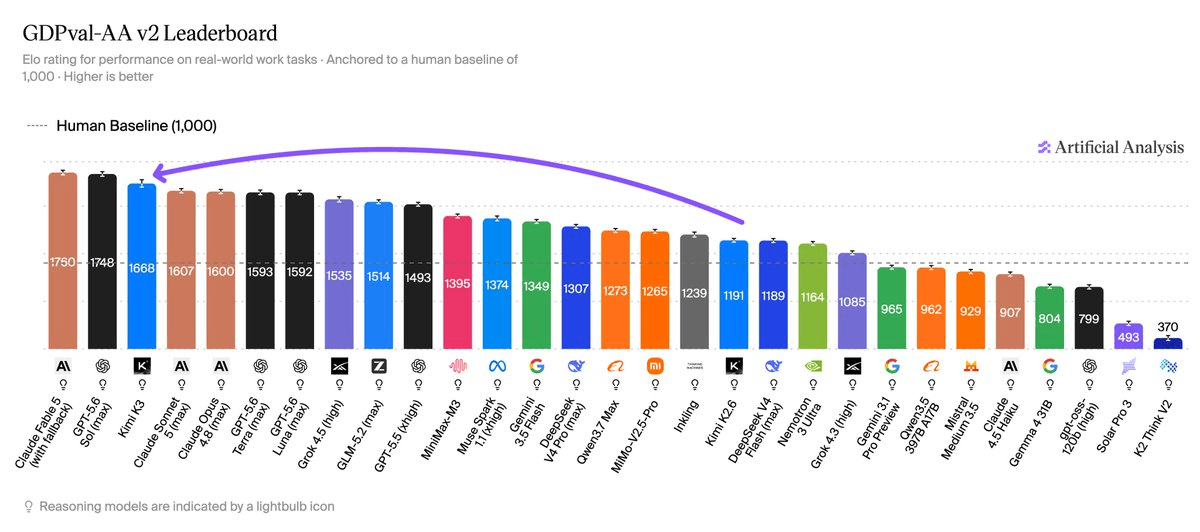
- Frontier-tier agentic performance: Scores 1668 Elo on GDPval-AA v2, surpassing Claude Opus 4.8 (1600) but trailing Claude Fable 5 (1760).
- Open weights incoming: Weights not yet released but confirmed coming; would lead all open-weight models including DeepSeek V4 Pro (1.6T) and GLM-5.2 (753B).
- Pricing: $3/$15 per 1M input/output tokens; ~$0.94 cost per task, roughly half the price of Claude Opus 4.8.
- Token efficiency up, hallucinations up: 21% fewer output tokens than K2.6 while scoring 13 points higher, but hallucination rate rose from 39% to 51%.
- New architecture: Built on Attention Residuals and native multimodal vision; accessible now via Kimi's API with 1M token context window.
Moonshot AI just dropped Kimi K3, and it's making a loud entrance. The model clocks in at 2.8 trillion total parameters, making it the largest open-source model released to date, and it's already posting benchmark numbers that put it in the same breath as Anthropic's Claude Opus 4.8 and OpenAI's GPT-5.5. The weights aren't out yet, but Moonshot has confirmed they're coming, which would make K3 the dominant open-weight model by a wide margin.
A generation jump, not an iteration
Kimi K3 is the third-generation model in Moonshot AI's Kimi series, succeeding the K2 family that shipped between July 2025 and mid-2026. Moonshot AI is a Beijing-based startup best known for the Kimi chatbot and for releasing K2 under a Modified MIT license, which made it one of the strongest open-weight models of 2025. But K3 isn't just another incremental update. At 2.8 trillion total parameters, it sits well ahead of DeepSeek V4-Pro at 1.6 trillion and every other open-weight release from a Chinese lab this year. Moonshot's own chart shows just how sharply the line jumps with K3, after months of the field hovering in the 500 billion to 1 trillion parameter range.
K3 follows the K2 family, which had roughly 1 trillion total parameters with a 256K context window. K3 more than doubles the parameter count and quadruples the context. The architecture also changes. K3 is described as built on a "new architectural innovation" rather than a straight scale-up of the K2-series MoE. Specifically, the model introduces Attention Residuals, a technique Moonshot open-sourced earlier this year as a drop-in replacement for standard residual connections, alongside native visual understanding baked directly into the model rather than added as a separate module.
Where it lands on the leaderboard
Kimi K3 scores 57 on the Artificial Analysis Intelligence Index, placing it well above average among comparable models, which average 30. When evaluating the Intelligence Index, it generated 130M tokens, which is very verbose compared to the average of 63M.
The headline number for agentic work is its GDPval-AA v2 Elo score. GDPval-AA v2 is a benchmark that tests models on real-world tasks spanning 44 occupations across nine industries, run inside an agentic loop with code execution and web browsing tools. Here's how K3 stacks up:
- K3 scored 1668 on GDPval-AA v2, behind Claude Fable 5 and GPT-5.6 Sol, but ahead of Claude Opus 4.8 Max which scored 1600.
- On AA-Briefcase, a private benchmark measuring long-horizon agentic knowledge work, K3 scored 1547, landing second behind Claude Fable 5 and just ahead of GPT-5.6 Sol at 1495.
- K3 also takes the #1 position on AutomationBench-AA, Artificial Analysis's implementation of Zapier's agentic SaaS workflow evaluation, with a score of 53%.
- The 1M token context window shows up in K3's BrowseComp result too. Moonshot says the model hit a state-of-the-art score of 91.2 on the benchmark running as a single agent, with no context compression or workarounds needed.
Smarter and leaner than its predecessor
One of the more surprising results is that K3 got more intelligent while using fewer tokens to think. Kimi K3 generated 130M output tokens to complete the Intelligence Index, compared to approximately 166M for K2.6, a 21% reduction while achieving a 13-point Intelligence Index gain. That's a meaningful signal: the model isn't just bigger, it's more efficient in its reasoning.
There's a notable caveat on the knowledge reliability front though. K2.6 scored well on the AA-Omniscience Index partly due to a comparatively low hallucination rate of 39%, indicating a greater capability to abstain rather than fabricate knowledge when uncertain. K3 regresses here: its hallucination rate climbs to 51%, up from K2.6's 39%, even as its accuracy rate improves from 33% to 46%. The net result is a better AA-Omniscience Index score (+18 vs +6), but the higher hallucination rate is something to watch in production.
The open-weights play
Moonshot's Kimi K2 models have been received well in the open-source AI market, ranking high on benchmarks and demonstrating capabilities not far behind the latest frontier models. Kimi K3 is said to take this further to close the gap with closed-source models from OpenAI and Anthropic. The FT reports K3 will be the largest open-weight AI model from China, with a parameter count between 2 trillion and 3 trillion.
Weights haven't dropped yet, but when they do, the gap over the competition will be stark. The current leading open-weight models are GLM-5.2 at 753B parameters (Intelligence Index score: 51) and DeepSeek V4 Pro at 1.6T parameters (score: 44). K3 at 2.8T and a score of 57 would lead both by a wide margin. Moonshot AI has consistently released open-weight models, which matters for customization: open weights let you fine-tune the model for your specific use case, and you can run it on your own infrastructure, in your own cloud, with your own security policies, with no data leaving your environment.
What it costs and how to use it
Kimi K3 costs $3.00 per 1M input tokens and $15.00 per 1M output tokens, based on Kimi's API. Cached input is discounted 90% to $0.30 per 1M tokens. That's a significant jump from K2.6's $4/1M output token pricing, but the cost-per-task picture is more favorable. At $0.94 per Intelligence Index task, K3 is roughly half the price of Claude Opus 4.8 ($1.80) and similar to GPT-5.6 Sol ($1.04).
On July 16, 2026, Moonshot launched Kimi K3, making K3 Max and K3 Cluster Max available to logged-in users. You can access it through Moonshot's first-party API right now. A few things to know for API usage:
- Model currently reasons at
maxeffort only; lighter reasoning settings are planned for later. - The full 1M token context window (
1048576tokens) is included at the standard rate. - Supports tool calls, JSON mode, structured outputs via JSON Schema, and partial mode.
- Two new capabilities in this generation: tool choice constraints and dynamically loaded tools.
- Web search functionality is being updated; Moonshot advises against relying on it in the near term.
-
Third-party tools may need the model ID set to
k3and context window set to1048576for full 1M support.
The bigger picture
The launch underscores how quickly Chinese AI developers are narrowing the technology gap with U.S. rivals. The Financial Times reported that Kimi K3 could challenge the industry's long-held assumption that Chinese frontier models trail their American counterparts by eight to twelve months. The competitive pressure increasingly extends beyond benchmark performance to economics. Chinese developers, including DeepSeek, have gained enterprise interest by offering AI models at a fraction of the cost charged by leading U.S. providers, forcing businesses to reconsider whether premium frontier models justify their higher prices.
Data from prediction market Polymarket showed the probability of a K3 release in July reached as high as 97-98%, underscoring the industry's recognition of Moonshot AI's technical execution speed. The community was already stress-testing the model before launch under the codename "Kivine" on arena platforms, with developers posting side-by-side comparisons against GPT-5.6 Sol and Fable 5. One widely shared thread showed the model building a fully animated, real-time Star Wars-style trench run from a prompt that was only meant to produce a static scene. The recurring trade-off users flagged was speed, with some generations taking over half an hour to complete, which aligns with Moonshot's own framing of K3 as a model built for deep reasoning over quick turnaround.
The practical use cases K3 is best suited for today are long-horizon agentic tasks where quality matters more than latency: software engineering across large codebases, knowledge work like research and analysis, and multimodal tasks that blend code with visual understanding. Moonshot is reportedly seeking a valuation of about $31.5 billion while rival DeepSeek is pursuing a valuation of roughly $71 billion. The technical report and full model weights are expected to follow shortly, and that's when the real independent evaluation begins.
Comments
