

Moonshot AI's Kimi Code Rewrites Its CLI and Ships Video-to-Code in One Update
Kimi Code CLI gets video context, a plugin marketplace, ACP IDE bridging, and autonomous goal mode — all powered by the open-source K2.6 model

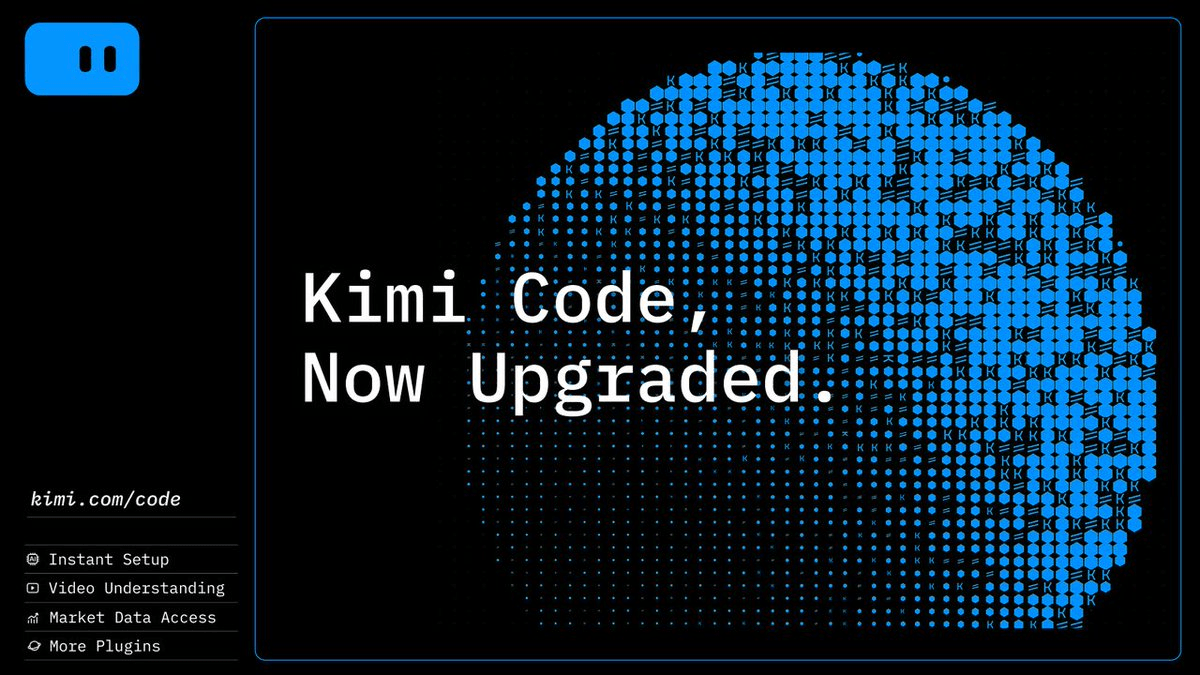
- Major CLI rewrite: Kimi Code CLI rebuilt from Python to TypeScript/Node.js for faster startup and a one-line install with no dependencies.
- Video as coding context: Drag video files into the CLI for screen-recording-to-code, reference-to-LUT, and long-video-to-short workflows.
- ACP IDE integration: Native Agent Client Protocol support lets Zed and JetBrains drive Kimi sessions directly — no browser switching needed.
- Plugin marketplace live: Install community plugins from GitHub URLs; first-party plugins for stocks, financial reports, and academic papers available.
- Autonomous goal mode:
/goaland/goal nextlet Kimi work toward multi-turn objectives and queue tasks without blocking on decisions. - Powered by K2.6: The underlying Kimi K2.6 model is a 1T-param open-source MoE with 96.6% tool invocation success and 300-sub-agent swarm scaling.
Kimi Code, Moonshot AI's open-source coding agent, just shipped a wave of updates that collectively reframe what a terminal-based coding agent can do. The headline features , drag-in video context, a plugin marketplace, ACP-based IDE bridging, and autonomous goal mode , land on top of an already significant foundation: a full rewrite of the CLI from Python to TypeScript, and the upgrade to the Kimi K2.6 model underneath.
From CLI tool to coding platform
The entire codebase was rewritten from Python to TypeScript and Node.js , not an incremental update, but a new foundation with a redesigned architecture, installation flow, and configuration format. The practical payoff is immediate: faster cold starts, a proper full TUI with a status bar and approval panel, and a one-line install that requires no Python environment at all.
curl -fsSL https://code.kimi.com/kimi-code/install.sh | bashThat single command is the entire setup. Install with the official script , no Node.js required. On first launch, /login opens a browser for OAuth; no manual API key wrangling needed.
Video as a first-class coding input
The most novel addition is video context. You can now drag a video file directly into the CLI and use it as reference material for a coding task. The supported workflows include:
- Screen-recording-to-code: paste a screen recording and ask Kimi to reproduce the UI or workflow in code
- Reference-to-LUT: use a color-graded video clip as a reference to generate a color lookup table
- Long-video-to-short: summarize or extract key segments from a long recording
This is possible because Kimi K2.6 is a 1-trillion-parameter, native multimodal MoE (Mixture-of-Experts) model with only 32B parameters activated per token. Multimodality is baked into the base model, not bolted on. Many open coding models still ask you to choose between the model that codes and the model that sees. Kimi K2.6 is a 1T-parameter MoE model with 32B active parameters, a 262K context window, and native image and video input.
A plugin marketplace and hooks for custom workflows
The What's New changelog shows the plugin system launched in v0.4.0, letting users install plugin packages that bundle Skills and MCP servers, with an official marketplace now live. The first published plugin is Kimi Datasource. The announcement also mentions plugins for stocks, financial reports, and academic papers , with more on the way.
You can paste a repo link to install community plugins, with support for pinning specific versions. Hooks let you wire in custom tools and trigger logic around agent actions, making it possible to build specialized pipelines without forking the agent itself.
Kimi Code supports Model Context Protocol (MCP), an open protocol that allows AI models to safely interact with external tools and data sources. This extends capabilities beyond code editing: connect to databases, APIs, documentation sources, and development tools, or build specialized agents for specific tasks like security scanning, performance analysis, or documentation generation.
IDE bridging via ACP
ACP stands for Agent Client Protocol , an emerging standard for letting IDEs drive an agent session over stdio, rather than embedding a model directly. Connect the CLI to your IDE via ACP , Zed, JetBrains AI Chat, and other editors can directly drive Kimi's sessions and tool calls without switching to a browser or terminal.
The configuration is minimal. For Zed or JetBrains, you add a single JSON block pointing at kimi acp:
{
  "agent_servers": {
    "Kimi Code CLI": {
      "type": "custom",
      "command": "kimi",
      "args": ["acp"],
      "env": {}
    }
  }
}
Kimi Code CLI speaks the Agent Client Protocol, so ACP-compatible editors and IDEs can drive a session over stdio. Log in once, then point your editor at the kimi acp subcommand , no extra login needed.
Autonomous goals and background reasoning
Two of the most practically significant additions are the Goal system and background structured questions. Start with /goal <objective> and Kimi will work toward that goal across multiple turns until it's done or hits a decision point that needs you. When the agent needs a decision, it parks that question in the background and keeps working on other steps , no more blocking on a single small choice.
The v0.10.0 release extends this with a goal queue: /goal next <objective> lines up upcoming tasks so that when the current goal completes, Kimi picks up the next one automatically. Combined with the /auto permission mode (less permissive than full YOLO, but hands-free for unattended runs), this starts to look like a genuine background worker rather than an interactive assistant.
What K2.6 actually brings to the table
Kimi K2.6 shows strong improvements in long-horizon coding tasks, with reliable generalization across programming languages like Rust, Go, and Python, and tasks including front-end, devops, and performance optimization. The numbers from partner integrations are notable: code generation accuracy increased by 12%, long-context stability improved by 18%, and tool invocation success rate reached 96.60% over K2.5.
One of K2.6's most architecturally interesting capabilities is its Agent Swarm , an approach to parallelizing complex tasks across many specialized sub-agents, rather than relying on a single, deeper reasoning chain. The architecture scales horizontally to 300 sub-agents executing across 4,000 coordinated steps simultaneously, a substantial expansion from K2.5's 100 sub-agents and 1,500 steps.
In a real-world stress test, over a 13-hour execution, the model iterated through 12 optimization strategies, initiating over 1,000 tool calls to precisely modify more than 4,000 lines of code , extracting a 185% medium throughput leap and a 133% performance throughput gain on a financial matching engine.
Where it shines and where to be cautious
What stands out about K2.6 is its surgical precision in large codebases. When an initial path is blocked, it pivots intelligently: following existing architectural patterns, finding hidden related changes, and keeping fixes scoped to the real problem.
That said, the benchmarks deserve some scrutiny. Some Hacker News users noted K2.6 is "below sonnet and opus 4.0 on capability" and "struggles with domain-specific tasks." K2.6 is best avoided for single-turn high-stakes reasoning where being wrong is expensive. It lags GPT-5.4 on GPQA-Diamond (90.5% vs 92.8%) and AIME 2026 (96.4% vs 99.2%). The sweet spot is multi-step agentic work , long refactors, batch migrations, test generation , where its long-horizon stability and low cost matter more than peak single-query reasoning.
Pricing and access
Kimi K2.6 is free to use. If you'd like to access more features or enhance your workflow with advanced tools, paid plans are also available. Kimi K2.6 is available via the Kimi website, the Kimi App, the Kimi API, and Kimi Code. The API is priced at $0.60 input / $2.50 output per million tokens. The Kimi Code CLI itself is open-source under Apache 2.0, with the source on GitHub; the premium membership unlocks higher quotas, concurrency, and IDE integration perks.
The pace of iteration here is hard to ignore. From the initial CLI release to v0.11.0, the team shipped eleven versions in roughly six weeks , adding the plugin system, scheduled tasks, goal queues, ACP bridging, and video context in rapid succession. Whether you're looking for a Claude Code alternative or just want a capable open-source agent that runs in your terminal and talks to your IDE, Kimi Code has become a serious option worth evaluating.
Comments
