
Moonshot AI Brings Kimi K2.7 Code to AWS, Targeting Enterprise Budgets
Moonshot AI's Kimi K2.7 Code lands on AWS Marketplace with EDP billing support, giving enterprise AWS teams a frontier-grade open-weight coding model without a new vendor contract

- Kimi API Platform is now live on AWS Marketplace, featuring Kimi K2.7 Code — Moonshot AI's latest 1T-parameter open-weight coding model.
- EDP billing integration: eligible enterprise customers can count Kimi API usage toward their AWS Enterprise Discount Program commitments, unlocking pre-allocated cloud budgets.
- K2.7 Code specs: 1T total / 32B active parameters (MoE), 256K context, ~30% fewer reasoning tokens than K2.6, priced at $0.95/$4.00 per million input/output tokens.
- Moonshot AI momentum: the company recently raised $2B at a $20B valuation, with $200M ARR; Kimi K2.6 is the second most-used LLM on OpenRouter.
- Benchmark caveat: all K2.7 Code gains are company-reported on proprietary suites — no independent SWE-bench or Terminal-Bench scores exist yet.
- Kimi K3 on the horizon: a rumored successor with 2.5T+ parameters and 1M context is expected in Q3 2026.
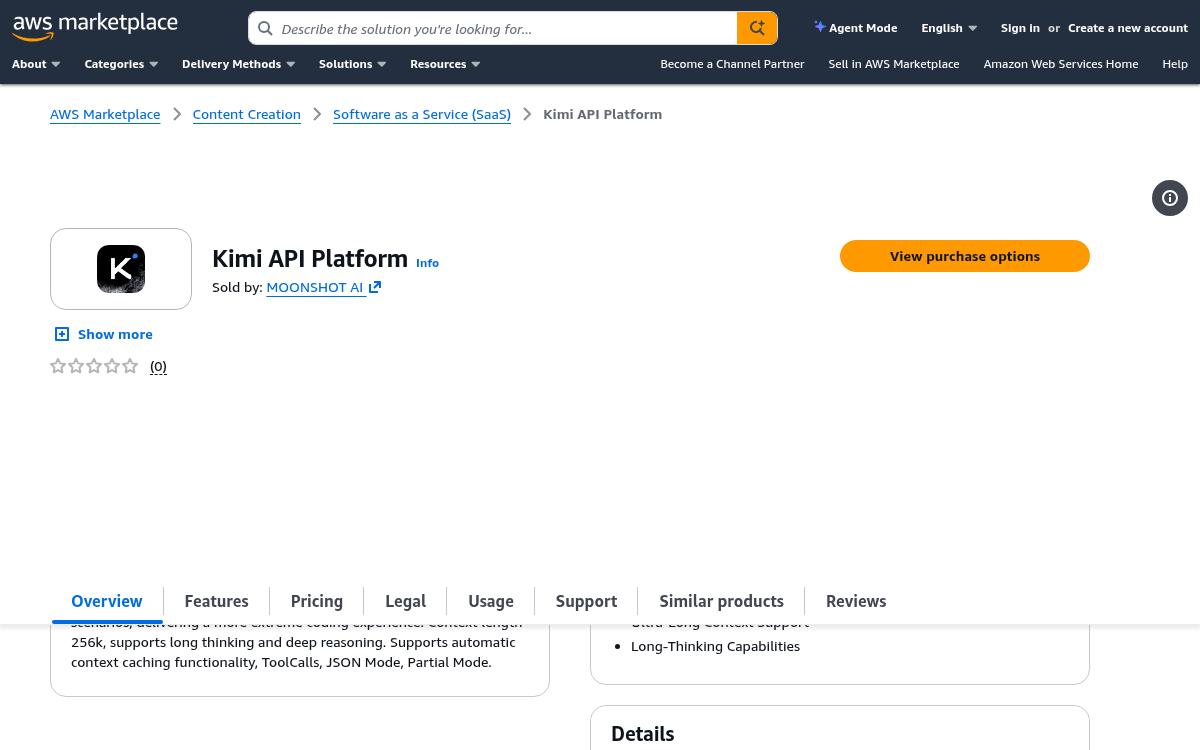
Moonshot AI's Kimi API Platform is now live on AWS Marketplace, making its latest coding model , Kimi K2.7 Code , accessible to enterprise AWS teams through consolidated billing. The listing also lets eligible customers count Kimi API usage toward their AWS Enterprise Discount Program (EDP) commitments, a procurement detail that could meaningfully accelerate adoption inside large organizations already locked into AWS spend agreements.
The model behind the listing
The flagship offering on the marketplace page is Kimi K2.7 Code, Moonshot AI's newest open-weight coding model, which appeared on Hugging Face on June 12, 2026. It is a 1-trillion-parameter Mixture-of-Experts model with 32B active parameters and a 256K-token context window, released under a Modified MIT license. The MoE design , where only a fraction of the total parameters activate per token , is what keeps a 1T-parameter model affordable to serve.
It is specialized for long-horizon, agentic software engineering and uses roughly 30% fewer "thinking" tokens than Kimi K2.6 while scoring higher on Moonshot's coding benchmarks. In practice, that efficiency gain compounds: reasoning models burn a large share of their output budget on thinking tokens , the internal chain-of-thought that precedes every tool call and code edit. In an agentic coding session that runs hundreds or thousands of steps, that overhead compounds: every plan, every retry, every verification pass pays the thinking tax again.
The AWS listing also highlights a K2.7 Code HighSpeed variant, described as outputting approximately 180 tokens/second and up to 260 tokens/second in short-context scenarios , a meaningful difference for interactive coding sessions where latency matters as much as quality.
What the EDP angle actually means
The billing integration is the most strategically interesting part of this launch. The AWS Enterprise Discount Program (EDP) is a pricing agreement between AWS and large enterprise customers who commit to spending a minimum amount on AWS services over a defined period, typically one to five years. In exchange for this committed spend, AWS provides the buyer with a percentage discount on their overall AWS bill.
The AWS EDP operates on a tiered discount system based on an organization's annual AWS spending commitment, usually starting at $1 million per year. Discounts are negotiated based on total committed spend and commitment duration, typically ranging from 1 to 5 years. Greater commitments yield higher discounts. The key mechanic for Kimi: when an enterprise buyer purchases software through AWS Marketplace, that spend counts toward their EDP commitment. This creates a powerful incentive for buyers to consolidate their software procurement through the marketplace rather than purchasing directly from vendors.
If the enterprise falls short of their annual commitment, they still owe the committed amount, creating a strong incentive to find additional AWS and marketplace spending to avoid wasting their commitment. This "use it or lose it" dynamic is what makes EDP buyers some of the most motivated purchasers on AWS Marketplace. For Moonshot, landing on the Marketplace means tapping into pre-allocated enterprise budgets that companies are actively looking to spend.
Pricing on the platform
The AWS Marketplace listing shows a SaaS contract structure. On the direct Kimi API, pricing is $0.95 per million input tokens and $4.00 per million output tokens. Automatic context caching drops cached input costs to $0.10–$0.16 per million tokens , versus cache-miss input rates of $0.60–$0.95 per million. Caching is automatic with no configuration needed. For comparison, K2.7 Code is roughly 5x cheaper than Claude Opus 4.8.
Who is Moonshot AI?
Moonshot AI is a Beijing-based artificial intelligence company founded in March 2023 by Zhilin Yang, a Tsinghua University alumnus who built the business around the Kimi chatbot. The company is backed by Alibaba and was valued at approximately $4.8 billion as of its last round. That valuation has since exploded: Moonshot AI has raised about $2 billion at a valuation of $20 billion. The round was led by Chinese food delivery company Meituan's VC arm, Long-Z Investments.
Moonshot's annual recurring revenue topped $200 million in April, driven by rapid growth in paid subscriptions and API usage. The K2 model family has been the engine behind that growth: Kimi K2.6 currently ranks as the second most-used large language model on distribution platform OpenRouter.
The broader context: Chinese open-weight models going enterprise
This AWS Marketplace listing is part of a deliberate distribution push. Kimi models were already available on Amazon Bedrock , Kimi K2.5 was among six open-weight models added to Bedrock, powered by Project Mantle, a new distributed inference engine for large-scale model serving on Amazon Bedrock. The Marketplace listing goes further, enabling enterprise procurement workflows that Bedrock alone doesn't support.
The release of Kimi K2 follows a trend among Chinese companies to make their AI models open-sourced, likely trying to counter US efforts to limit China's tech growth. The AWS Marketplace listing takes that strategy one step further , not just open-sourcing the weights, but embedding the API into the procurement infrastructure that enterprise engineering teams already use. When using the direct Kimi API, data is processed in China , which has been a compliance concern for some European teams. Running through AWS infrastructure may address some of those data residency questions for US-based enterprises, though teams should verify the specifics with their compliance teams.
The benchmark picture , with caveats
Moonshot's published numbers for K2.7 Code are compelling on paper:
- The largest coding jump is on Kimi Code Bench v2, from 50.9 to 62.0 over K2.6 , a +21.8% improvement.
- K2.7 Code beats Claude Opus 4.8 on MCP Mark Verified, 81.1 versus 76.4. MCP Mark Verified tests correct tool invocation through the Model Context Protocol , CI checks, ticket updates, file edits in a single loop.
- It also posts +11.0% on Program Bench and +31.5% on MLS Bench Lite versus K2.6, while cutting reasoning token usage by ~30%.
The honest caveat: every benchmark published for K2.7 so far is one of Moonshot's own proprietary benchmarks. As of its release, there are no independent third-party numbers for K2.7 on the standard public suites , SWE-bench Verified, SWE-bench Pro, Terminal-Bench, LiveCodeBench, GPQA Diamond, AIME, or MMLU-Pro. Treat the numbers as directional signals, not independently verified scores.
What this means for your team
If your organization runs on AWS and has an active EDP agreement, the Kimi API Platform listing is worth a look for two reasons. First, it removes the friction of a separate vendor contract , you subscribe through the same procurement flow as any other AWS Marketplace product. Second, the spend counts toward your EDP drawdown, which means you're not adding a net-new line item to your AI budget.
For teams evaluating Kimi K2.7 Code as a coding model, the practical checklist is straightforward:
- Run it on your own codebase. Vendor benchmarks are a starting point, not a verdict. The model always runs in thinking mode , you cannot disable it , so factor that into latency and cost estimates.
- Check your EDP terms. AWS Marketplace can contribute up to 25% of EDP spend , so confirm your specific agreement covers third-party SaaS purchases.
- Compare against the direct API. The direct Kimi API at platform.moonshot.ai may offer different rate tiers or throughput limits. The AWS listing is optimized for procurement convenience, not necessarily the lowest per-token cost.
- Consider data residency. Verify where inference runs when accessed through the AWS Marketplace listing versus the direct API.
A successor Kimi K3 is rumored for Q3 2026, with 2.5T+ parameters and a 1M context window , so teams building long-term pipelines around the Kimi family should keep an eye on that roadmap. For now, the AWS Marketplace listing makes the current generation significantly easier to adopt inside enterprises that are already deep in the AWS ecosystem.