

Mixing Hard and Easy Problems Boosts AI Training Efficiency 5x
A new empirical study shows that for RLVR fine-tuning, mixing question difficulties beats piling on easy examples, delivering up to 5x sample efficiency.
 PRO
- New paper studies RLVR fine-tuning of small models under tight data and compute limits.
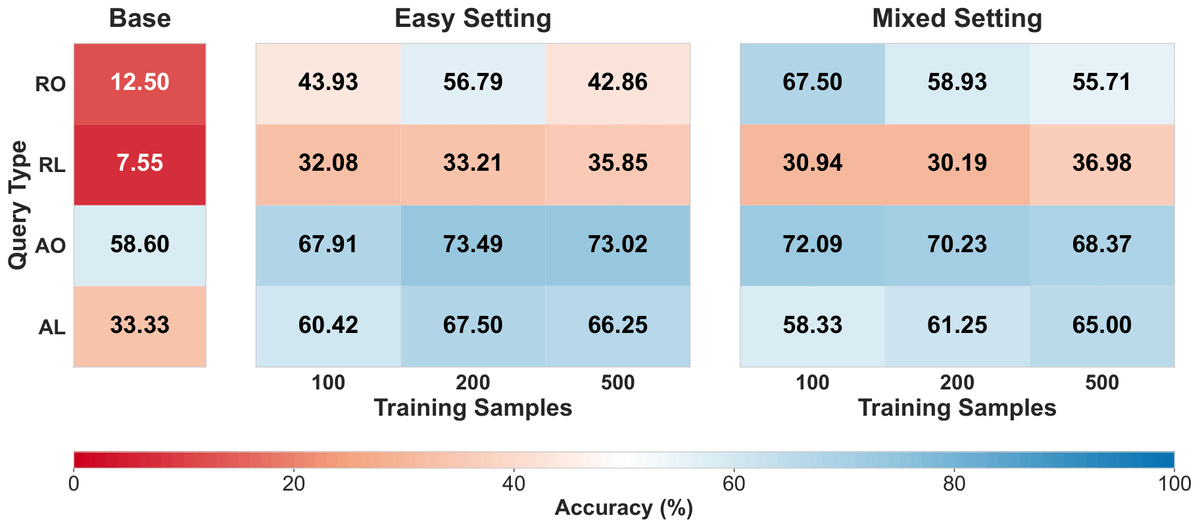
- Mixed easy/medium/hard training gives up to 5x sample efficiency versus easy-only.
- Three new procedural benchmarks cover counting, graph reasoning, and spatial reasoning tasks.
- Base model is Qwen3-4B with LoRA rank 64, trained via GRPO on 4x A100 GPUs.
- Under fixed compute, more data can hurt: accuracy shows inverted-U scaling with dataset size.
- Graph reasoning was capped by token budget, not data, causing extraction failures dominating training.
Reinforcement Learning with Verifiable Rewards (RLVR) has become the go-to recipe for teaching language models to reason. Most published results assume you have tens of thousands of curated problems and a cluster of GPUs sitting idle. A new paper called Learning from Less tackles the opposite regime: what if you only have a few hundred examples and a fixed compute budget?
The short answer from the authors is that training on a mixed-complexity dataset is associated with up to 5x the sample efficiency under the same data budget. That gain comes from how you mix easy, medium, and hard problems, not from adding more data.
Why data scaling laws break at small sizes
Classical scaling work from Kaplan and Chinchilla told us how loss falls off as you increase parameters, tokens, and compute. Those laws assume abundance. In practice, teams fine-tuning a small model for a specific reasoning skill often have a few hundred verifiable questions at best and a handful of GPUs.
The authors point out that recent RLVR research has focused on using high volumes of question-answer pairs to improve LLM reasoning, citing datasets like DeepMath-103K with over 100,000 samples. Nobody has systematically characterized what happens when both data and compute are scarce, which is the situation most practitioners actually live in.
Three synthetic playgrounds with a difficulty dial
To study this in a controlled way, the team built three procedurally generated datasets where they can crank complexity up or down on demand:
- Counting Problems. Natural language prompts that ask the model to filter and count integers using operators like even count, divisible-by-N, bitwise XOR, or median. Complexity is controlled by the number of conditional filters (1 to 4) and transformations (0 to 3) applied before the final operation, creating problems with 1 to 7 total intermediate steps.
This story is for Pro members
You've reached the end of the free preview. Upgrade to AlphaSignal Pro to read the full article - and everything else behind the paywall.
Comments
