

MIT's SwarmWorld Shows 200 AI Agents Building a Society Without Talking
MIT researchers put hundreds of identical LLM agents into a persistent world and watched them evolve specialization, tool inheritance, and technology that survives without them.

 PRO
PRO- MIT's SwarmWorld puts hundreds of identical LLM agents in a persistent world with no assigned roles or recipes. Paper
- Agents spontaneously differentiate into constructors, caretakers, coordinators, and mobile surveyors, discovered by label-blind clustering.
- Roughly 95% of first technology reuse happens through physical observation, not direct messages between agents.
- Executable controllers are inherited and forked across authors, with lineages up to 12 generations deep and content-addressed by SHA-256.
- Shared societies beat best-of-N isolated search on portfolio breadth and resilience; isolated search still wins single-object records.
- Code and data are open at GitHub and Hugging Face.
A team at MIT ran one of the strangest multi-agent experiments to date. They dropped hundreds of identical language-model agents into a shared world, gave them no roles, no recipes, no communication protocol, and no reward function, then watched what happened. The agents built a functioning technological society, split into specialized behavioral phenotypes, inherited and modified each other's code, and left behind machines that kept running after every agent was deleted. The paper, SwarmWorld: Stigmergic technological evolution, quietly upends a common assumption in agentic AI: that coordination requires conversation.
The problem with talkative swarms
Most multi-agent LLM systems lean on direct dialogue, predefined roles, or centralized workflows, and it remains unclear whether decentralized agents can build functional technologies and outperform independent search. That is the gap SwarmWorld targets. Spin up 100 agents in parallel and let each one grind independently, and you get a strong best-of-N baseline. The open question is whether letting them share an environment produces something beyond the sum of parallel attempts, or whether the coordination overhead is just noise dressed up as collaboration.
The authors picked a mechanism from biology to test this: stigmergy, the trick termites use to build mounds without a blueprint or a foreman. One termite deposits a marked clump; another responds by adding to it. Structure emerges through the environment, not through messages between builders. The MIT team wanted to know if frontier LLMs, given the same substrate, would coordinate the same way.
How SwarmWorld actually works
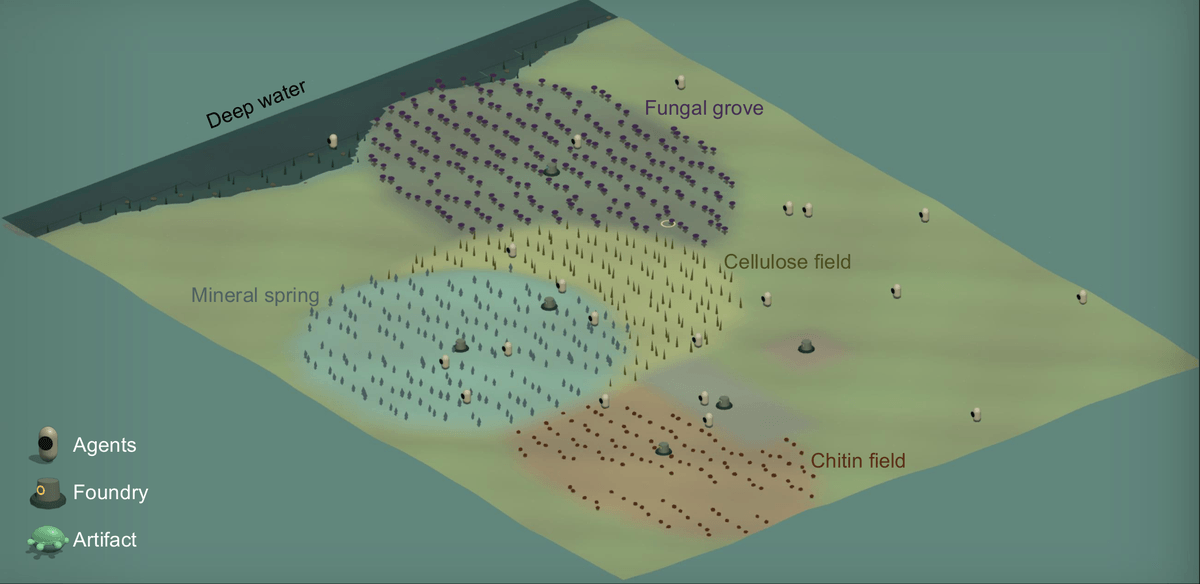
The setup is deliberately hard to game. Agents explore a spatial environment, process resources, test materials, construct persistent artifacts, and write executable controllers evaluated by a deterministic simulator under unseen disturbances after the agents themselves are removed. SwarmWorld splits cognition from consequence: agents propose architectures and controllers within fixed action and material schemas, while the simulated world determines function. In plain terms, agents can propose whatever they want, but physics decides what actually works.
This story is for Pro members
You've reached the end of the free preview. Upgrade to AlphaSignal Pro to read the full article - and everything else behind the paywall.
Comments
