
MIT Rewires How LLMs Fight Hallucinations Before They Ever Appear
MIT researchers fix a core flaw in conformal LLM hallucination control by calibrating the sampling distribution itself, not just filtering outputs after the fact.
 Pro
Takeaways
- MIT paper proposes sampling from a calibrated LLM posterior instead of post-hoc filtering to control hallucinations with formal guarantees.
- Prior conformal methods delete low-confidence claims after generation, producing incoherent outputs; this method reweights the generation distribution itself.
- An off-policy calibration algorithm learns a threshold τ from base-model samples only, requiring no re-calibration when the scorer changes.
- An abstention atom (probability mass β on "I don't know") ensures the posterior is always well-defined, even when the model has no high-confidence completions.
- On the MATH benchmark, the method produces complete, correct proofs at high target factuality levels where the MH baseline degrades to truncated, incomplete outputs.
- No code is publicly available yet; the paper is available at arxiv.org/abs/2606.03731.
Hallucination control in LLMs has largely followed the same playbook: generate text, score the individual claims, then surgically remove the ones that look suspicious. It works well enough on paper, but a new paper from MIT argues this approach is fundamentally broken in a subtle way. By treating generation and filtering as separate steps, post-hoc methods can produce outputs that are grammatically intact but logically incoherent, stripped of the very context that made the remaining claims meaningful. Worse, no amount of post-hoc filtering can actually steer the model toward better responses. It can only make existing responses shorter.
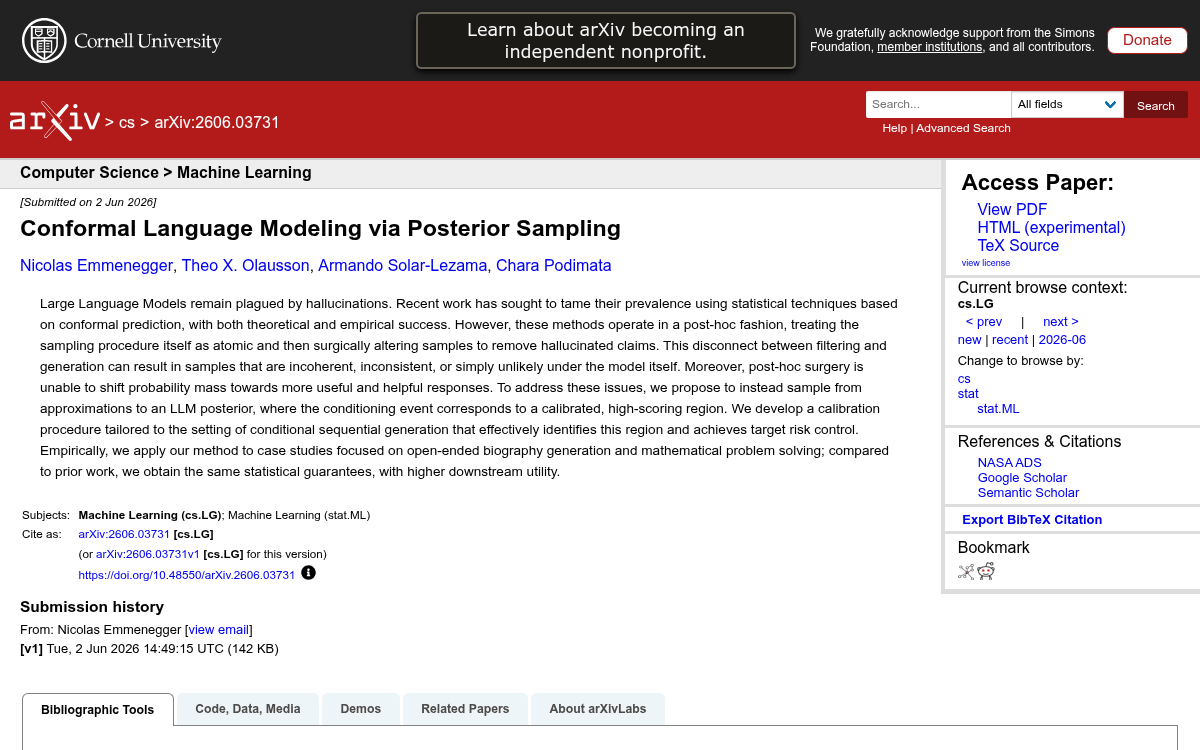
Conformal Language Modeling via Posterior Sampling, from Nicolas Emmenegger, Theo Olausson, Armando Solar-Lezama, and Chara Podimata, proposes a fundamentally different approach: instead of filtering outputs, calibrate the sampling distribution itself so that the model is more likely to generate high-quality responses in the first place.
Why filtering breaks down
To understand the problem, it helps to know what conformal prediction actually does. Conformal prediction (CP) is a statistical framework that provides distribution-free, finite-sample guarantees on error rates. Applied to LLMs, prior work uses it to calibrate a post-hoc filter: generate a response, score each claim for factuality, then delete claims that fall below a learned threshold. The threshold is chosen from a calibration set so that the expected hallucination rate stays below some user-specified level α.
The guarantee is real, but the outputs can be a mess. These methods operate in a post-hoc fashion, treating the sampling procedure itself as atomic and then surgically altering samples to remove hallucinated claims. This disconnect between filtering and generation can result in samples that are incoherent, inconsistent, or simply unlikely under the model itself. Consider a math proof: if you delete step 3 because the scorer was uncertain about it, steps 4 through 10 may no longer follow. The filtered output is technically "safer" but practically useless. Moreover, post-hoc surgery is unable to shift probability mass towards more useful and helpful responses.
Sampling from the posterior instead
The key insight is to reframe the problem probabilistically. Rather than filtering samples from the base LLM distribution p_LLM, the paper proposes sampling from a posterior distribution that conditions on the response falling in a high-confidence region of output space.
Formally, the posterior is defined as:
p_LLM^Φ(y | x) ∝ p_LLM(y | x) · Φ(y | x)where Φ(y | x) is a potential function that is 1 if the response passes a score threshold τ and 0 otherwise. The score S(y | x) is the product of per-claim confidence scores, so a response only survives if all of its claims pass the bar jointly. The goal is to pick τ from a calibration set such that sampling from this posterior provably controls the expected loss at level α.
This is conceptually clean, but two practical problems arise immediately:
- The normalizing constant is intractable. Computing
Z^τ(x), the fraction of the model's probability mass that survives the threshold, requires summing over all possible completions. - The calibration objective is non-monotone. As you raise
τ, you might accidentally drop a correct claim while keeping incorrect ones, temporarily making the average loss go up before it comes down. Standard conformal guarantees require a monotone objective.
How the calibration algorithm works
The paper solves both problems with a three-step procedure (Algorithm 1):
- Sample particles from the base model. For each prompt in the calibration set, draw
Mresponses fromp_LLM. These are used to form an empirical approximation to the posterior. - Add an abstention atom. Mix the empirical distribution with a small probability mass
βon an explicit "I don't know" response. This ensures the normalizing constant is always bounded away from zero, making the posterior well-defined even when the model has essentially no high-confidence completions. The abstention always scores 1.0 (it makes no false claims), so it always survives any threshold. - Monotonize the objective. The per-prompt risk estimate
Ĥ_i(τ)is replaced by its monotone upper envelopeH̄_i(τ) = sup_{τ' ≥ τ} Ĥ_i(τ'). This makes the calibration objective non-increasing inτ, which is what conformal risk control requires. Empirically, the original objective is nearly monotone anyway, so this step adds very little slack.
The final threshold is then:
τ̂ = inf { τ | (1/(n+1)) Σ H̄_i(τ) + 1/(n+1) ≤ α }At test time, you draw M particles from the base model, keep only those with S(y | x) ≥ τ̂, and sample from the resulting empirical posterior (weighted by the abstention atom). The paper proves this controls the expected loss at level α for finite M, and that the guarantee converges to the true population posterior guarantee as M → ∞ via a Glivenko-Cantelli argument.

What the experiments show
The method is evaluated on two tasks using Llama-3.3-70B-Instruct as the base model, GPT-4o for scoring, and GPT-5 for labeling and downstream evaluation:
- Biography generation (FActScore dataset, 682 entities): Open-ended factual generation, where claims are highly interdependent. The baseline is a re-implementation of the Mohri & Hashimoto (MH) post-hoc filtering approach.
- Mathematical reasoning (MATH benchmark, 500 problems): Multi-step proofs where deleting a single step can invalidate all subsequent reasoning.
Both methods attain valid coverage across all target factuality levels, confirming the theoretical guarantees hold empirically. The real difference shows up in downstream utility.
On MATH, the gains are especially clear. Non-abstaining generations from our method degrade less sharply than those from MH as the target factuality increases; the per-axis breakdown reveals that this is predominantly driven by less degradation in completeness and helpfulness, rather than fluency. At high target factuality levels (≥ 0.6), MH begins producing heavily truncated, incomplete proofs at high rates, while the posterior sampling method either returns a complete proof or abstains cleanly.

On FActScore, the picture is more nuanced. When you condition on non-abstaining outputs, the posterior sampling method produces substantially more claims per response, and those claims are judged as more complete and helpful. However, in the unconditional average (which counts abstentions as low-quality responses), MH can look better because it tends to return a partially-edited response rather than a clean refusal. Whether that tradeoff is desirable depends entirely on the deployment context.
The real breakthrough
The core innovation is not just better numbers on two benchmarks. It is the realization that conformal risk control and posterior sampling are the same problem. Prior work treated them separately: conformal methods calibrate a filter, posterior sampling methods (like Sequential Monte Carlo steering) focus on sampling efficiency. This paper shows you can do both simultaneously, and that the resulting framework is strictly more principled than post-hoc filtering.
The off-policy calibration is particularly important. Because the calibration only requires samples from the base model (not from each candidate posterior), you never need to re-run calibration when you change the scorer. This makes the approach practical: swap in a cheaper scorer, and the same calibration set still works.
Limitations to know about
The method has real constraints worth understanding before reaching for it:
- It cannot exceed the model's capacity. If the base model genuinely does not know the answer, the posterior has no high-confidence region to sample from, and the system will abstain. You cannot get factual responses the model is incapable of generating.
- The β parameter requires tuning. The abstention mass β controls a utility-abstention tradeoff. Too small, and the posterior becomes ill-conditioned at high thresholds; too large, and you get more abstentions than necessary. The paper uses β = 0.1 throughout.
- M particles may not be enough. At very high target factuality levels, high-scoring completions may be rare, and 20 particles (used in experiments) may not capture them well. More efficient posterior samplers (e.g., Sequential Monte Carlo) are flagged as future work.
- No code release yet. The paper is a theoretical and empirical contribution; no public implementation is available at time of writing.
For tasks where claim interdependencies are strong, like multi-step reasoning or structured factual generation, this approach offers a principled way to get the same statistical guarantees as conformal filtering while keeping outputs coherent and complete. The abstention mechanism also makes it deployable in high-stakes settings where a clean "I don't know" is preferable to a partially-correct answer.