

Mistral OCR 4 Beats Every Rival With 72% Human Win Rate
Mistral OCR 4 adds bounding boxes, block classification, and confidence scores, topping OlmOCRBench with a 72% average human-preference win rate across 12+ languages
- Mistral OCR 4 launches with bounding boxes, block classification, and per-word confidence scores alongside extracted text.
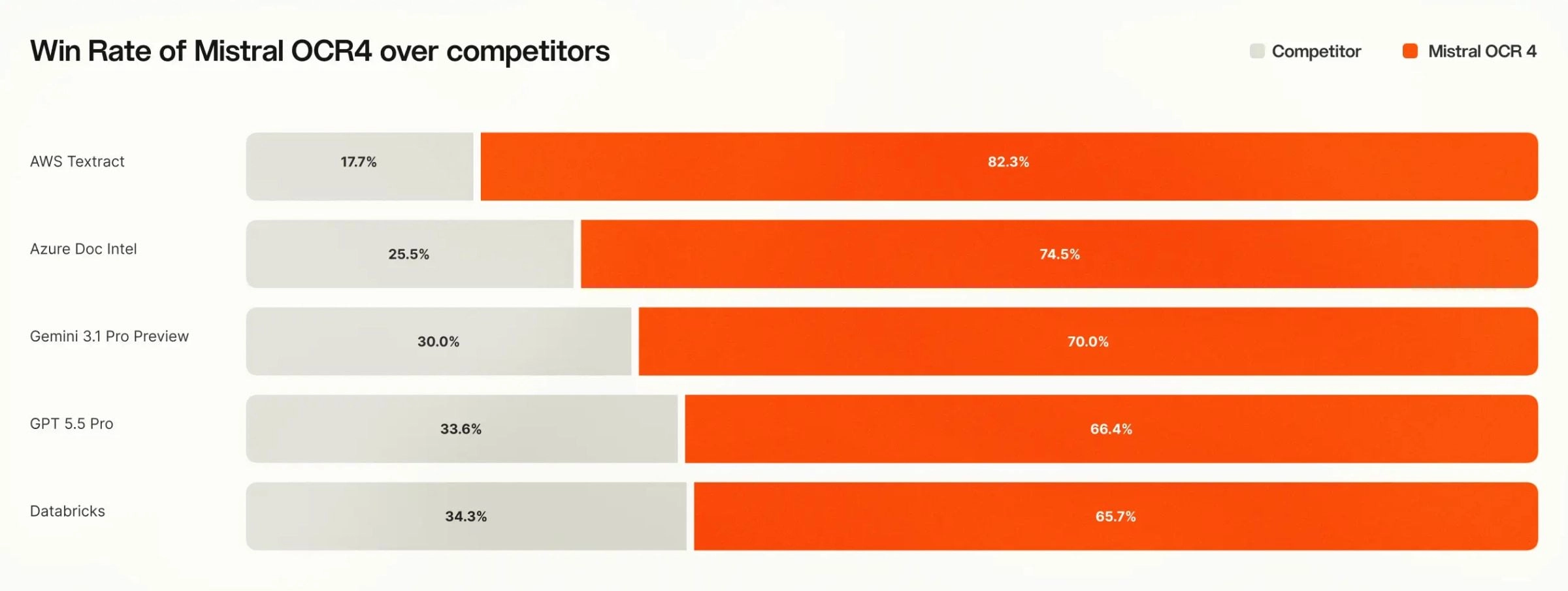
- 72% average win rate over all tested systems (AWS Textract, Azure, Gemini, GPT) in a blind human evaluation of 600+ real-world documents.
- 170 languages supported across 10 language groups, with the largest gains on rare and low-resource languages where competitors degrade.
- Pricing: $4/1,000 pages via API ($2 with Batch API); $5/1,000 pages for Document AI with structured JSON output.
- Available now via Mistral Studio, Amazon SageMaker, and Microsoft Foundry; self-hosted single-container deployment available for enterprise.
- Integrated with Search Toolkit, Mistral's open-source RAG framework, as a structured ingestion component for citation-ready retrieval pipelines.
Most OCR systems hand you a wall of text and call it a day. Mistral OCR 4 takes a different approach: instead of just extracting content, it returns a full structural map of the document. Every block of text comes with a bounding box pinpointing its location on the page, a type label (title, table, equation, signature, and more), and a per-word and per-page confidence score. That trio of metadata is what turns raw extraction into something pipelines can actually act on.
From text extraction to document understanding
The jump from OCR 3 to OCR 4 is not just an accuracy bump. OCR 4 features bounding boxes, block classification, and inline confidence scores alongside extracted text. This matters because downstream systems now know not only what a document says, but where each element lives and how confident the model is about each region. That unlocks a set of workflows that were previously awkward or impossible with text-only output:
- Semantic chunking for RAG: classified blocks become cleaner, more meaningful retrieval units than arbitrary character splits
- Source-grounded citations: bounding boxes let you highlight the exact region of a document that an answer came from
- Human-in-the-loop review: confidence scores tell reviewers exactly which regions to double-check, rather than re-reading everything
- Automated redaction: block types and coordinates make it straightforward to mask specific regions programmatically
- Agentic workflows: agents get structural primitives to complete tasks like form filling, invoice processing, and compliance checks
OCR 4 is also an ingestion component of Search Toolkit, Mistral's open-source, composable search framework. Its structured output supplies citation-ready inputs to the toolkit's ingestion, retrieval, and evaluation workflow for RAG and enterprise search.
Benchmarks: humans preferred it in 72% of cases
Automated benchmarks for OCR are notoriously noisy. Mistral is transparent about this: their blog post details how string-matching against fixed references penalizes correct outputs for things like equivalent LaTeX notation, multi-column reading order, and ground-truth annotation errors. So they ran a parallel human evaluation.
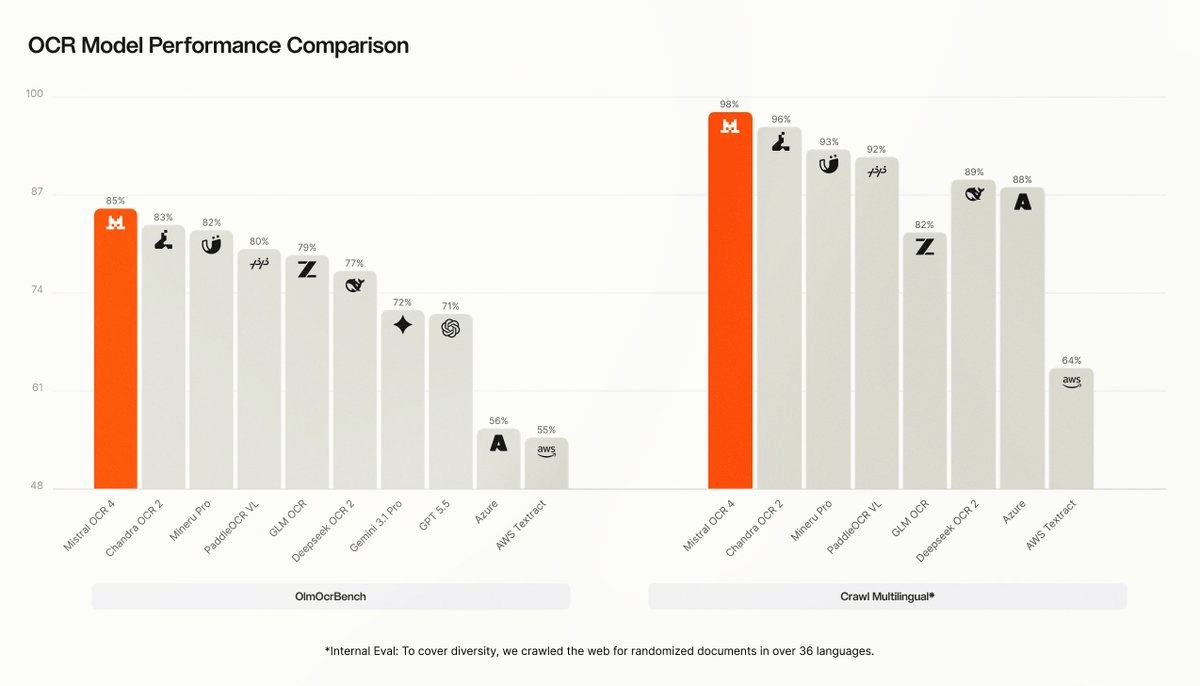
They complemented automated benchmarks with a head-to-head human evaluation on documents chosen to reflect real usage. Independent annotators preferred OCR 4 over every leading OCR and document-AI system tested, with win rates averaging 72%, alongside the top overall score on OlmOCRBench (85.20). The evaluation covered 600+ documents across 12+ languages, sourced from third-party vendors to represent real industry use cases.
On the automated side, OCR 4 scores 85.20 on OlmOCRBench and 93.07 on OmniDocBench. Mistral explicitly flags that these numbers should be treated as directional rather than definitive, and recommends evaluating on your own documents before committing.
Multilingual coverage is the quiet headline
The model supports 170 languages across 10 language groups, runs in a single container for fully self-hosted deployments. The language groups span English, Western Europe, Eastern Europe, Middle Eastern, Chinese, East Asian, Southeast Asian, and what Mistral calls "rare languages" -- a bucket that includes Hindi, Japanese, Georgian, Bengali, Armenian, Hebrew, Greek, and several South Indian scripts.
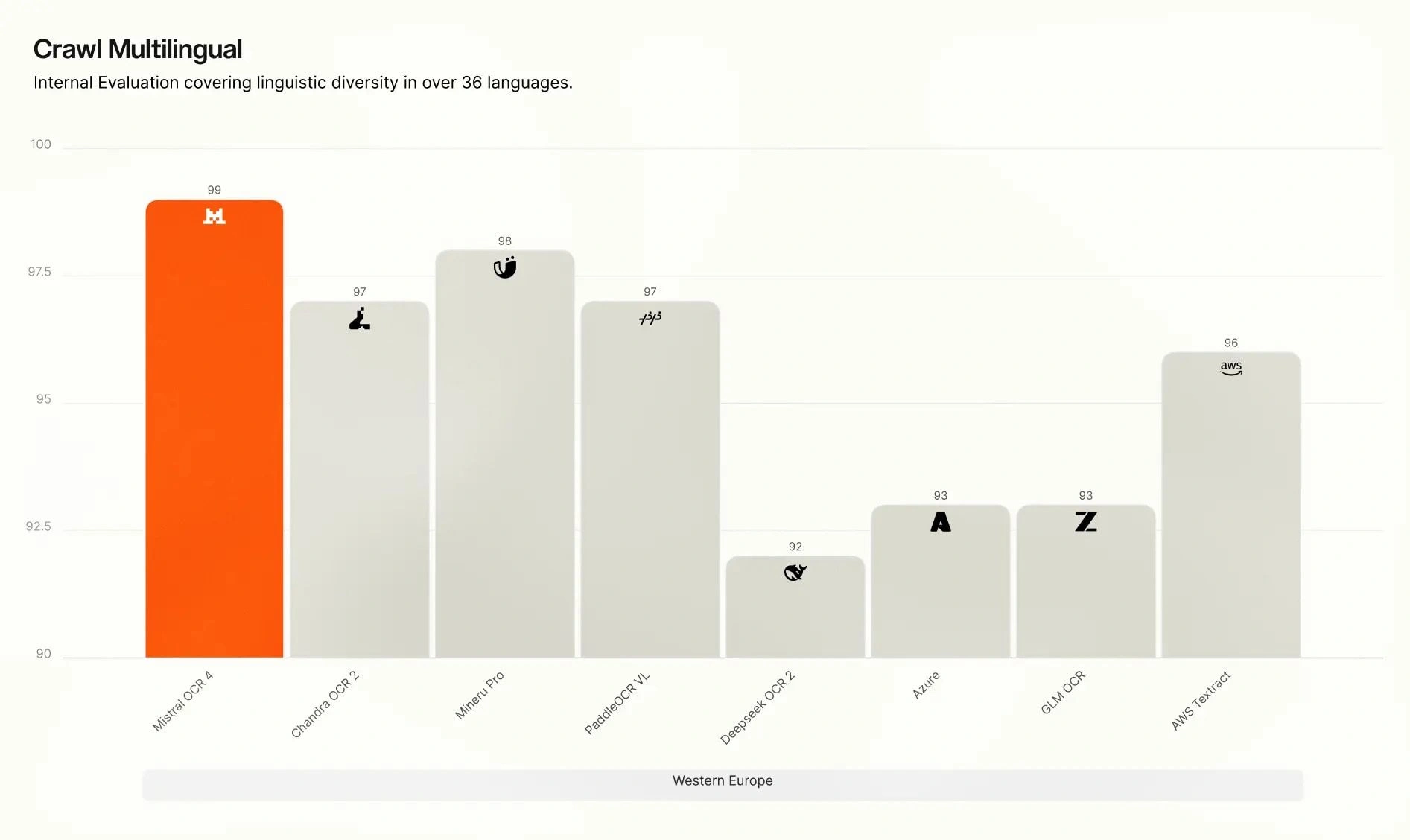
The gains are widest exactly where most systems fall apart. Competing models tend to degrade sharply on low-resource languages, while OCR 4 maintains high accuracy across the board. For any organization processing documents from non-Western markets, this is the most practically significant improvement in the release.
Known limitations
Mistral is upfront about where OCR 4 struggles on benchmarks, and by extension, in the real world:
- Mathematical documents: equivalent LaTeX that renders identically gets flagged as a mismatch in automated evals, and equation segmentation is inconsistent
- Multi-column layouts: words split across column boundaries and column-ordering assumptions cause correct extractions to be scored as failures
- Real-time processing: OCR 4 is explicitly not intended for latency-sensitive applications
- Non-document inputs: raw audio, video, and camera photos are out of scope
- Handwriting benchmarks: the public benchmarks used focus on printed and typeset text; handwriting performance is harder to assess independently
Some HN commenters also flagged the price jump: OCR 3 was priced at $2 per 1,000 pages, with a 50% Batch-API discount reducing the cost to $1 per 1,000 pages. OCR 4 doubles that base price.
Two modes, one endpoint
Mistral OCR 4 through the API is priced at $4 per 1,000 pages, with a 50% Batch-API discount, reducing the cost to $2 per 1,000 pages. Document AI is priced at $5 per 1,000 pages. The distinction between the two modes matters for how you integrate it:
- OCR 4 API (pure extraction): returns extracted text, bounding boxes, block types, confidence scores, and markdown. Best for embedding into your own pipeline, running batch jobs, or self-hosting. Use the model identifier
mistral-ocr-latest. - Document AI (structured output): same endpoint, additional parameters. Pass a JSON schema and the OCR output gets fed to
mistral-small-2603to reshape it into your spec. Useful for extracting structured fields from invoices, forms, or compliance documents without writing custom parsing logic.
Early enterprise users are already seeing concrete gains. One AI engineer at Rogo benchmarked OCR 4 against leading agentic document parsers on a chart and figure-dense financial QA dataset and reached equivalent accuracy at roughly 8x lower cost and 17x lower latency. A separate user at Anaqua reported OCR 4 running roughly 4x faster per page than their previous provider for high-volume IP docketing workflows.
Where to run it
Document AI is available in Mistral Studio for an application-level, no-code path to the same engine. Beyond that, OCR 4 is available via API through Mistral Studio, Amazon SageMaker, and Microsoft Foundry, with Snowflake Parse Document support coming soon. For organizations with data sovereignty requirements, the model is compact enough to run in a single container for fully self-hosted deployments -- keeping documents entirely within your own infrastructure. Self-managed deployment is available to enterprise customers through Mistral's sales team.
The Getting Started with OCR 4 Cookbook walks through a first extraction, working with bounding boxes, and block classification. The practical decision rule Mistral offers is simple: if you need raw extracted content, use OCR 4 as-is. If you need the output reshaped into a structured format or processed with a custom instruction, add the Document AI parameters on top.
Comments
