

Mininglamp's Mano-P Tops OSWorld and Runs Privately on Your MacBook
Mininglamp open-sourced a GUI agent that runs on an M4 Mac mini, hits 58.2 percent on OSWorld, and never phones home.
 PRO
- Mano-P is an open-source GUI-VLA agent from Mininglamp, running locally on M4 Macs.
- Hits 58.2% on OSWorld, first among specialized GUI agents, beating opencua-72b by 13.2 points.
- 4B edge model reaches ~80 tokens/s decode on Apple M5 Pro with 4.3GB memory footprint.
- Companion Cider SDK adds W8A8 and W4A8 activation quantization missing from MLX.
- Trained via bidirectional Mano-Action recipe: SFT, offline RL, then online RL stages.
- Apache 2.0 licensed, installable via
brew install mano-cua, integrates with Claude Code and OpenClaw.
A new open-source GUI agent is claiming the top spot on OSWorld while doing something most rivals can't: running entirely on your laptop. Mano-P, released by Mininglamp Technology, is a vision-language-action model that watches your screen, decides where to click, and executes the action, all without hitting a cloud API or parsing HTML.
Mininglamp describes it as a GUI-aware agent that executes complex cross-platform tasks through pure vision, controlling desktop software, web interfaces, and graphical workflows to break the "see but not do" limitation of AI. In practical terms: your machine sees the pixels, a local 4B model figures out the next mouse click, and the OS carries it out.
Benchmark headline
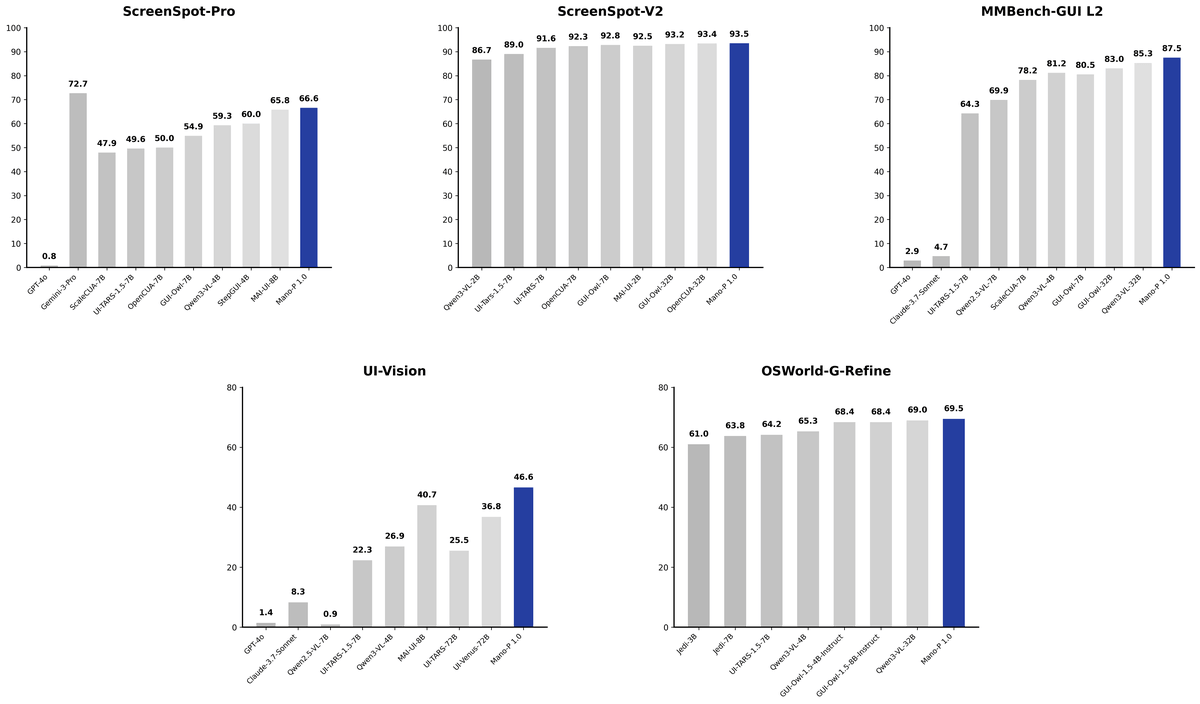
The numbers are the reason people are paying attention. Mano-CUA 1.1 hits a 58.2% success rate on OSWorld, ranking first among specialized GUI agent models and outperforming the second-place opencua-72b (45.0%) by 13.2 percentage points. On web navigation, it scores 41.7 NavEval on WebRetriever Protocol I, ahead of Gemini 2.5 Pro Computer Use (40.9) and Claude 4.5 Computer Use (31.3).

One caveat matters. On OSWorld's leaderboard including generalist frontier models, Claude Sonnet 4.6 reaches 72.1% versus Mano-CUA 1.1 at 58.2%. Mano-P wins the specialized GUI agent category and beats larger cloud APIs on web-specific tasks, but a top-tier general model with a proper tool-use scaffold still leads on raw success rate.
A 4B model that fits on a MacBook
What makes this release different is where the model runs. Mininglamp ships two tiers: a 72B cloud model for peak accuracy, and a 4B edge model designed to fit on Apple Silicon. The quantized 4B supports local execution on Apple M4 Pro devices, reaching up to 476 tokens/s prefill speeds with a 4.3GB memory footprint.
This story is for Pro members
You've reached the end of the free preview. Upgrade to AlphaSignal Pro to read the full article - and everything else behind the paywall.
Comments
