

MiniMax's Music3 Generates Full 5-Minute Songs on a Gaming GPU
MiniMax dropped an 11B open-weight music model that generates full five-minute songs with vocals from lyrics and a caption, in one shot.
 PRO
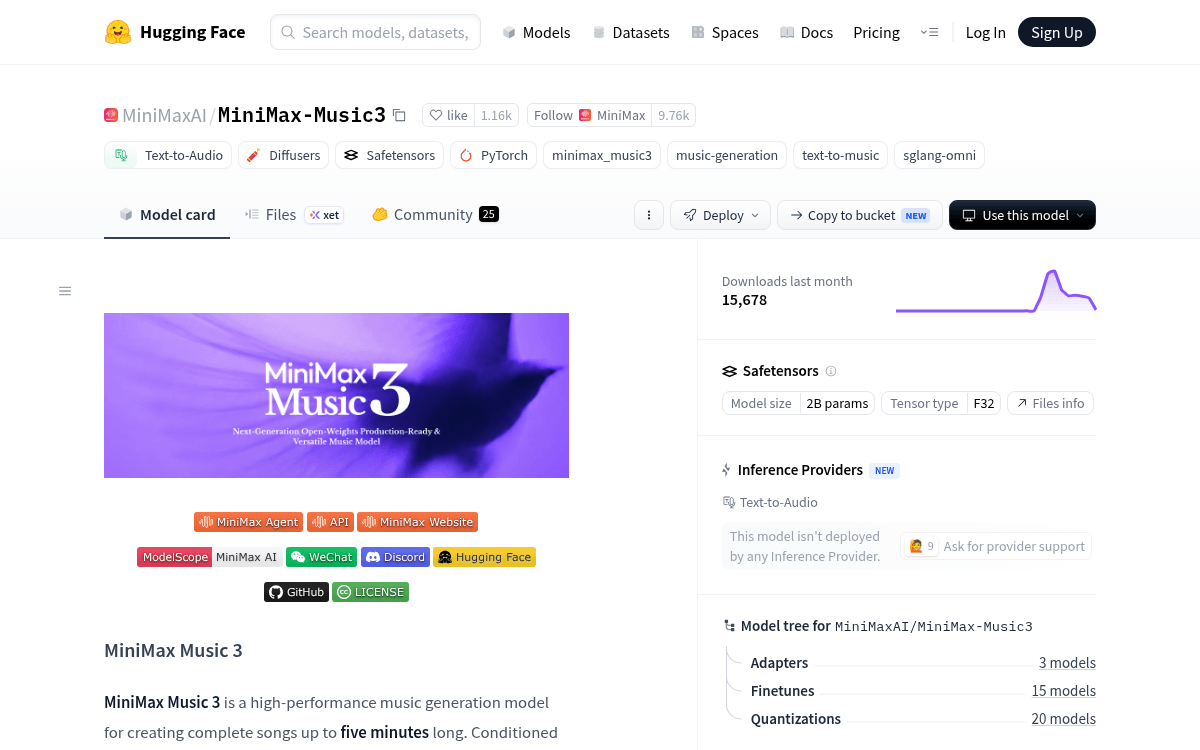
- MiniMax released MiniMax-Music3, open-weights text-to-music model generating five-minute 32 kHz stereo songs.
- Hybrid architecture: 8B Global LLM (Qwen3-8B init), 0.6B Local LLM, 2.4B Flow Matching, 123M Flow-VAE.
- Inference skips discrete RVQ decoder, fuses continuous LLM hidden states for richer vocal and instrumental detail.
- Runs on 24GB VRAM full precision, down to 8GB with layer streaming via diffusers or SGLang-Omni.
- Quality roughly matches Suno V3.5, best-in-class open model for lyric intelligibility and long-form coherence.
- Community License allows commercial use with attribution; separate agreement required above $20M annual revenue.
Open-weight music generation just took a big step forward. MiniMax released MiniMax-Music3, a text-to-music model that produces complete songs, vocals included, from a lyric sheet and a structured caption. Music3 generates full five-minute tracks in a single pass and outputs 32 kHz, 16-bit stereo WAV audio. Weights are on Hugging Face, and the whole stack, inference code and serving paths, shipped the same day.
Instead of stitching together 30-second clips or looping fragments, you give it lyrics with section tags and a description of the sound, and it renders a structurally coherent track end-to-end. Themes, rhythm, vocal identity, and arrangement progression hold together across the full song. It's also the first open model at this quality tier that runs on a single consumer GPU.
A two-brain architecture for songs
Under the hood, Music3 is a hybrid autoregressive system with a diffusion-style back end. An 8B Global LLM, initialized from Qwen3-8B, handles long-range structure; a 0.6B Local LLM restores frame-level acoustic detail; the fused hidden states pass through a 2.4B Flow Matching module and a 123M Flow-VAE decoder to render audio. The split is deliberate: one model plans where verses land and how the chorus builds, the other paints in the acoustic texture frame by frame.

The audio is tokenized with residual vector quantization (RVQ), a scheme where each frame is represented by a stack of codebook entries, each layer refining the last. The training synthesizer uses an eight-layer RVQ setup with a 16,384-entry semantic codebook and seven 1,024-entry acoustic codebooks. The Global LLM predicts only the first, semantic codebook (the one that carries melody and structure), while the Local LLM fills the remaining seven acoustic layers per frame.
This story is for Pro members
You've reached the end of the free preview. Upgrade to AlphaSignal Pro to read the full article - and everything else behind the paywall.
Comments
