

MiniMax's H3 Beats Closed Labs in Video Editing With Open Weights
MiniMax released H3, a 33B open-weight video model that generates video with native stereo audio from mixed text, image, video, and audio inputs.
 PRO
- MiniMax released H3, a 33.1B open-weight omni-modal video model with native stereo audio.
- Single transformer handles text, images, video, and audio in one unified context.
- Ranked #1 in Video Editing, #2 in Text-to-Video on Artificial Analysis leaderboards.
- Open checkpoints are 768p; 2K requires the hosted H3-Regenerate-2K API pass.
- Runs on modest hardware including RTX 3060 12GB with ComfyUI day-0 support.
- License excludes local deployment in the US, EU, UK, and South Korea.
Video generation was the last major modality where closed labs still held a comfortable moat. Weights stayed private, quality stayed behind API keys, and frontier-quality clips came rented by the second. MiniMax H3 closes that gap. MiniMax announced the model on July 31 as an API-only product, then published the weights to Hugging Face on August 3 under the MiniMax H3 Community License. The community had it running on $280 gaming GPUs within a day.
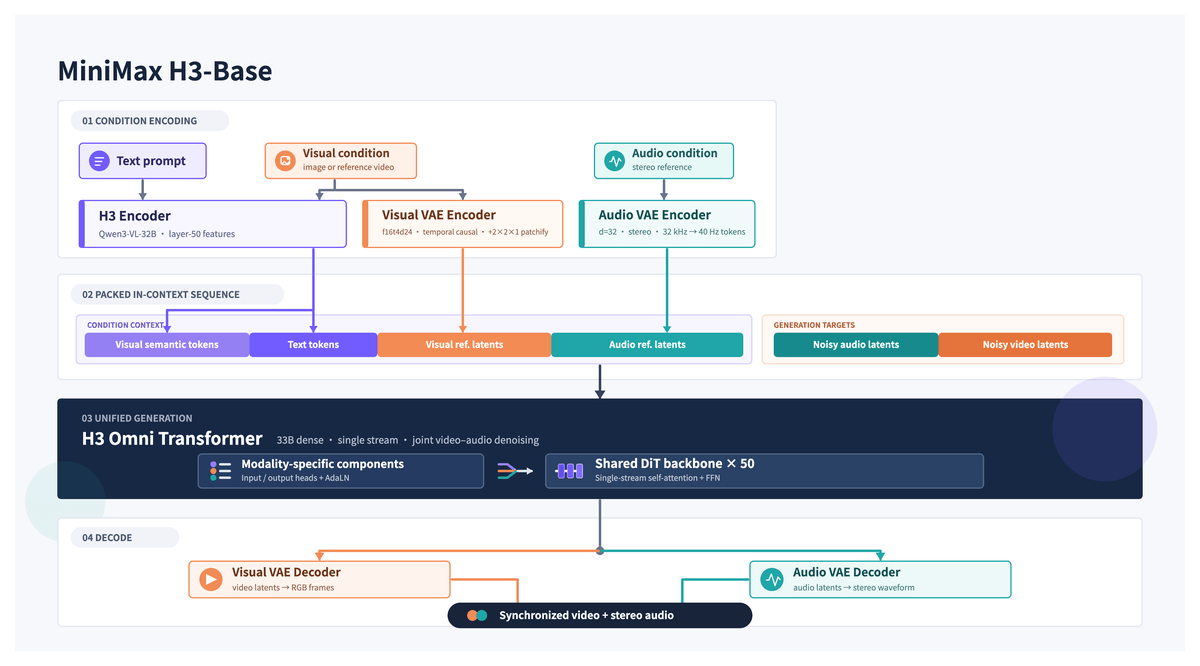
The pitch is unusual for a video model. One unified context reads text, images, video, and audio together and generates coherent audiovisual results from any mix of them, covering text-to-video, first-and-last-frame, reference-to-video, and precise video editing in one checkpoint. The audio is generated jointly, not bolted on in a second stage.
One model, four modalities, one pass
The core spec sheet is where H3 stops looking incremental. It is a 33.1B dense, single-stream Omni Transformer, of which roughly 13B sits in AdaLN branches that can be precomputed and cached for inference-only deployment. The text encoder is Qwen3-VL-32B, position encoding is 3D multimodal RoPE across (t, h, w), and the model produces 4 to 15 second clips at 24 fps with 32 kHz native stereo audio generated in the same pass as the picture.
The reference budget per generation is generous by open-model standards: up to 9 reference images, 3 reference video clips, and 3 reference audio clips per generation. One shot can inherit a face from an image, a camera move from a video, and a voice from an audio clip, all steered by a single sentence prompt.

The four load-bearing tricks
MiniMax attributes the jump to four engineered pieces. Two of them matter for anyone thinking about inference cost:
This story is for Pro members
You've reached the end of the free preview. Upgrade to AlphaSignal Pro to read the full article - and everything else behind the paywall.
Comments
