

Microsoft's Orchard Beats Proprietary AI Agents at 10x Lower Cost
Microsoft Research open-sources Orchard, a Kubernetes-native framework that trains competitive coding, browser, and productivity agents using small models and reusable infrastructure
- Microsoft Research releases Orchard, a free open-source Kubernetes-native framework for training and evaluating AI agents across task types.
- Core component Orchard Env decouples sandbox management from training pipelines, running 10× cheaper than managed alternatives like E2B or Daytona on spot instances.
- Orchard-SWE reaches 69.7% on SWE-bench Verified (73% with reranking) using only ~3B active parameters, matching models 10× larger.
- Orchard-GUI (4B) achieves 68.4% average across WebVoyager, Online-Mind2Web, and DeepShop — the strongest open-source browser agent, competitive with OpenAI and Gemini computer-use systems.
- Agents trained on a single harness collapse on unseen ones; Orchard's multi-harness training keeps performance stable across deployment environments.
- Full release includes environment service, training recipes, and 107K SWE trajectories (including failed attempts used for credit-assignment training).
Building a state-of-the-art AI agent today usually means assembling proprietary scaffolding: custom sandboxes, closed training pipelines, and datasets that nobody outside the lab can reproduce. Microsoft Research's answer is Orchard, a fully open-source framework that puts a reusable, Kubernetes-native environment layer at the center of agent training.
One environment, every harness
At the center of Orchard is Orchard Env, a lightweight Kubernetes environment that provides reusable isolated components for running and building agents at scale, from collecting training data to reinforcement learning rollouts and evaluation. Unlike existing systems that tightly couple environment execution with specific agent scaffolds or managed services, Orchard Env exposes a harness-agnostic interface for command execution, file I/O, and network policy enforcement, making it composable across research settings.
In practice, one team can collect training trajectories using OpenHands, run RL rollouts with a different harness, and evaluate with a third, all against the same environment backend. Because the environment layer is a stable service rather than a piece of a training stack, datasets, training recipes, and evaluation protocols stay portable across harnesses, domains, and projects instead of being rebuilt for each new study.
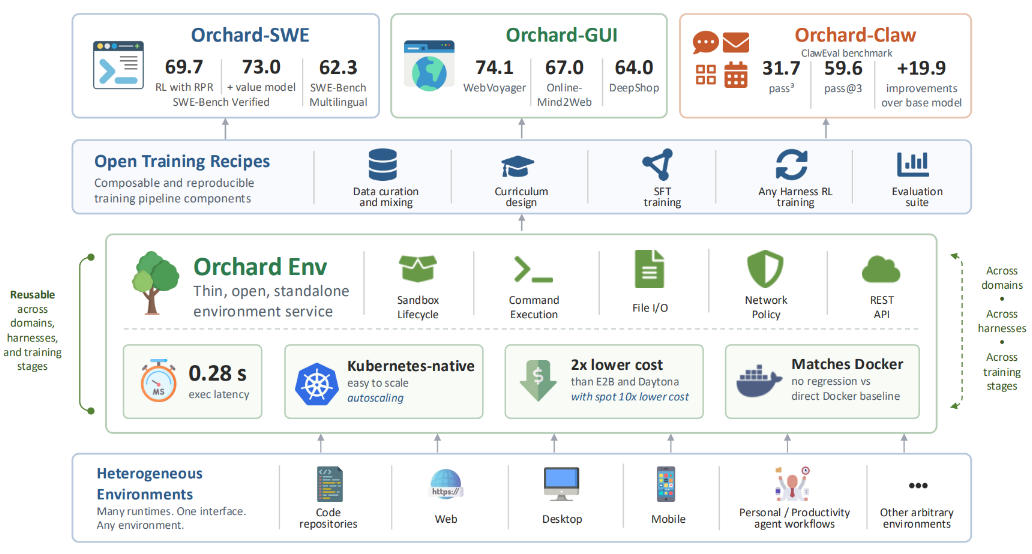
The infrastructure numbers are worth noting. Orchard Env achieves 0.28s average command-execution latency, matching SkyPilot Code Sandbox and running 2.7× faster than E2B and 7.3× faster than Modal. Running 128 parallel sandboxes for 240 hours costs $673 on spot instances, versus $7,078 on Daytona or E2B, roughly a 10× reduction.
Three agents, one shared backbone
Built on top of Orchard Env, the team ships three complete training recipes, each targeting a different agent domain:
- Orchard-SWE — a software engineering agent that fixes real GitHub issues
- Orchard-GUI — a browser agent that navigates live websites
- Orchard-Claw — a personal assistant agent for productivity workflows like email and calendar
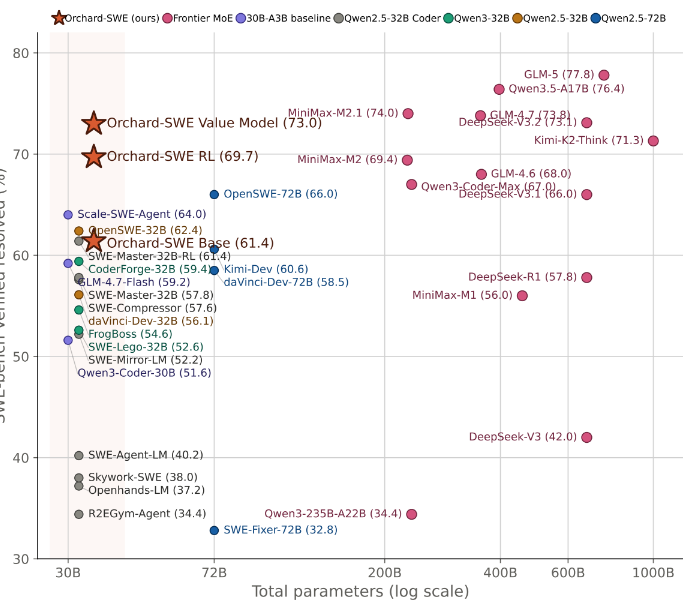
All three show that relatively small open-weight models can achieve strong results on complex real-world tasks. Orchard-SWE reaches 69.7% on SWE-bench Verified (73.0% with value-model reranking) using only about 3 billion active parameters, approaching frontier systems built on models more than ten times larger.
How Orchard-SWE was trained
The coding agent recipe is the most technically detailed of the three. The team distilled 107,000 agent interactions from two advanced open-weight models (MiniMax-M2.5 and Qwen3.5-397B) covering a broad range of GitHub issues. What separates this from prior work is how failed attempts are handled.
The training process uses credit-assignment supervised fine-tuning: rather than discarding attempts where the agent failed to fully resolve an issue, the system learns from the productive portions of those partial trajectories. A teacher model scores each step of a failed trajectory for its estimated probability of eventual success, and only the segments where the agent was making measurable progress are kept as training signal.
After supervised fine-tuning, reinforcement learning is applied using a technique called Balanced Adaptive Rollout (BAR). Standard RL for agents wastes compute because if a task is too easy, all rollouts succeed and the gradient is zero; if too hard, all fail and the gradient is also zero. BAR adaptively generates rollouts in small batches until it assembles a training group with a balanced mix of successes and failures, then stops early, keeping every gradient step informative.
Finally, past RL trajectories are recycled into a 4B-parameter value model that re-ranks candidate solutions at inference time, pushing the final SWE-bench Verified score from 69.7% to 73.0%.
The harness lock-in problem
One of the most striking findings is what happens when you evaluate agents on harnesses they were never trained with. On SWE-bench Verified, Scale-SWE (64.0%) and OpenSWE-32B (62.4%) report similar resolve rates to Orchard-SWE at first glance. Evaluate them across multiple harnesses and the picture changes sharply.
Scale-SWE produces invalid outputs under any harness other than its native one. OpenSWE-32B drops from 62.4% on its home harness to just 3.6% on Kimi-CLI, a harness it was never trained with. Orchard-SWE, trained across two harnesses, stays between 45% and 64.3% across all three evaluated harnesses. Single-harness training teaches an agent to use one specific tool interface, not to code in general.
GUI and personal assistant results
Orchard-GUI trains a 4B vision-language computer-use agent with only 0.4K distilled trajectories and 2.2K open-ended training tasks. It achieves success rates of 74.1%, 67.0%, and 64.0% on WebVoyager, Online-Mind2Web, and DeepShop respectively (68.4% average), making it the strongest open-source model in this category while remaining competitive with leading proprietary computer-use systems. The 4B student model outperforms its own 235B teacher on harder long-horizon benchmarks, a sign that environment-grounded RL is extracting capabilities the teacher itself doesn't exhibit.
Orchard-Claw, the personal assistant agent, was trained with only 0.2K synthetic tasks and achieves 59.6% pass@3 on Claw-Eval and 73.9% when paired with a stronger ZeroClaw harness at inference time. That jump from 59.6% to 73.9% is itself a result: because Orchard-Claw was trained across multiple harnesses, it can exploit the features of a stronger one rather than being locked to the interface it saw during training.
What this changes for researchers
The broader argument Orchard makes is that the environment layer determines whether your training artifacts are reusable at all. A thin, open, harness-agnostic environment layer lets researchers share agentic data, training recipes, and evaluation protocols across domains without rebuilding infrastructure from scratch each time.
The team also points toward cumulative agent learning as a future direction: treating trajectories as persistent assets rather than discarding them after a training run, distilling them into reusable value models so each new generation of agents inherits knowledge from previous ones.
Everything is available now. The Orchard GitHub repo contains the environment service and training recipes, the Hugging Face dataset ships the full 107K SWE trajectories including unresolved ones, and the technical paper covers full implementation details. The framework is free to use.
Comments
