

Microsoft's MAI-Voice-2 Fools Listeners Into Preferring It Over Real Humans
Microsoft's new text-to-speech model jumps from English-only to 15 languages, beats its predecessor 72% of the time, and fools listeners on speaker identity.
- Microsoft AI launched MAI-Voice-2, expanding TTS from English-only to 15 languages with native expressiveness
- Listeners preferred it over MAI-Voice-1 in 72% of side-by-side tests across 2,500 trials
- In speaker similarity evals, 45.5% chose MAI-Voice-2 output versus 44.0% for real human recordings
- Zero-shot voice cloning from 5-60 seconds of audio, plus emotion tags and role styles
- Available now on Microsoft Foundry and OpenRouter at $22 per 1M characters
- Code-switching support for Hindi-English and Spanish-English mid-sentence, with Voice-2-Flash variant coming
Microsoft AI's Superintelligence team has unveiled MAI-Voice-2, a text-to-speech model that goes far beyond a routine upgrade. It is positioned as a significant leap from its predecessor across every dimension that matters to production voice experiences: fidelity, language coverage, speaker consistency, and emotional range. The headline trick? In blind listening tests, people often can't tell its output apart from a real human recording.
The model launched at Build 2026 alongside six other MAI releases, and it's already wired into Microsoft Foundry, VS Code, and the Dynamics 365 Contact Center. For developers building voice agents, audiobooks, or accessibility tools, this is one of the more substantial TTS shipments of the year.
From English-only to fifteen languages, without losing the magic
The original MAI-Voice-1, released in April, spoke only English. MAI-Voice-2 expands from English-only to 15 languages while maintaining the same naturalness and expressiveness as English. The supported set covers English (US and Australia), Italian, French, German, Hindi, Spanish (Spain and Mexico), Portuguese (Brazil and Portugal), Korean, Simplified Chinese, Turkish, Russian, Thai, Dutch, Romanian, and Hungarian.
Microsoft says it deliberately chose depth over breadth, supporting a spectrum of expressive capabilities spanning tonal, pitch-accent, stress-timed, and syllable-timed language systems. Translation: it's not just covering more locales, but adapting prosody to the linguistic structure of each one.
The more interesting capability for global products is code-switching. The model has code-switching capabilities for select language pairs such as Hindi-English and Spanish-English, matching the way users naturally mix languages in everyday speech. In Microsoft's demo clips, the model flips between Hindi and English mid-sentence, or weaves Spanish food terms into English narration, all while holding the same speaker identity and rhythm.
The numbers that actually matter
Two evaluation results stand out. First, in head-to-head preference testing across 2,500 listening trials, MAI-Voice-2 was preferred over its predecessors 72% of the time. Second, and more striking, the speaker-similarity test asks listeners to distinguish real human recordings from MAI-Voice-2 output. The results across 11 languages are essentially a coin flip.
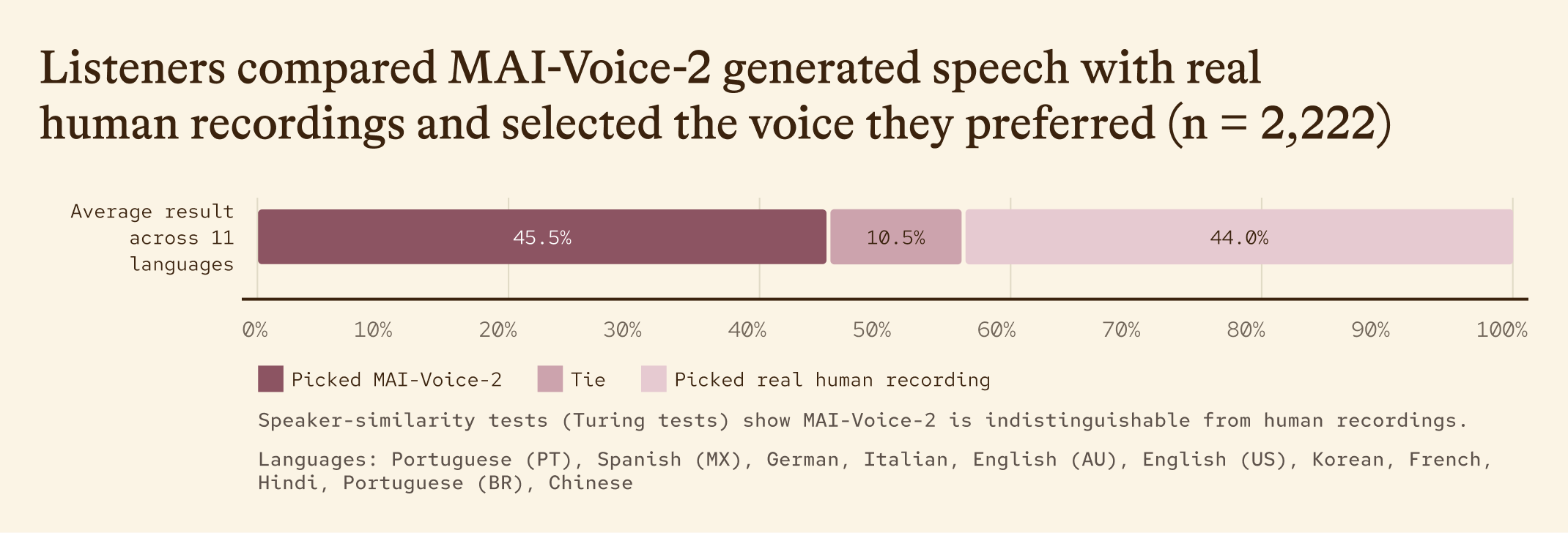
Out of 2,222 responses, 45.5% of listeners preferred MAI-Voice-2 generated speech, 44.0% preferred the real human recording, and 10.5% called it a tie. When your synthesized voice is preferred more often than the human original, the Turing-style barrier for voice has effectively been crossed for this use case.
Emotion tags, role prompts, and zero-shot cloning
MAI-Voice-2 gives developers control through a few different levers:
- Emotion tags like
sad,whispered,excited,embarrassed, orconfusedshape delivery at a granular level - Role styles such as Motivational Trainer or Sports Commentator change pacing, intensity, and cadence holistically
- Zero-shot voice prompting uses a 5 to 60 second reference clip to clone a speaker's identity in any supported language, with no fine-tuning required
- Stable speaker identity across long-form content, so a single voice holds up across an entire audiobook, podcast, or lecture without drift
Identity preservation recreates the unique vocal identity of a specific person, so the model can speak as that individual across markets. Voice prompting takes a short audio sample as a reference for tone, emotion, accent, pacing, and speaking style and lets developers control delivery without managing a separate voice library. Both capabilities now operate across all supported languages, so a single cloned voice or reference style carries naturally across markets without separate systems per language. That last point is the unlock for global brand voices, no separate model per locale.
What it costs and where to get it
MAI-Voice-2 is available right now through Azure Speech and Microsoft Foundry, with distribution also coming through OpenRouter. MAI-Voice-2 is available through Azure Speech with pricing starting at $22 USD per 1M characters. That matches the per-character pricing of the predecessor model, so the quality and language expansion come at no premium.
A faster variant is on the way. Voice-2-Flash is also announced, providing the best value and speed for ultra latency-sensitive voice agents. Microsoft hasn't published streaming latency numbers, but the existence of a Flash SKU signals where they think the market is heading.
To experiment without writing code, Microsoft built DuoAI, a three-way conversational demo that stitches MAI-Voice-2 together with MAI-Transcribe-1.5 (speech-to-text) and MAI-Image-2.5 (image generation) inside the MAI Playground. It's a working preview of the full multimodal stack.
Consent guardrails are not optional
Voice cloning at this fidelity raises obvious abuse risk, and Microsoft is enforcing consent at the system level. Only authorized, licensed voices can be synthesized in production, and unlicensed voice cloning is blocked at the platform. Voice models include protections against unauthorized cloning, and all outputs are watermarked. Developers who want access to the cloning feature have to apply through a customer voice request form.
What this is good for, and what it isn't
The strongest use cases line up with Microsoft's own integration roadmap:
- Customer support and IVR agents, where the same branded voice can handle calls in 15 languages
- Long-form narration like audiobooks, podcasts, and course content, where speaker drift is usually the breaking point
- Accessibility applications where voice is the only interface, including narration for visually impaired users and synthesized voice for people with speech impairments
- Games, AR/VR, and interactive characters that need emotional range and role consistency
- Code-switched markets like India and parts of Latin America, where mixed-language speech is the norm and most TTS systems sound robotic
The limitations worth flagging: Microsoft has not published streaming first-byte latency numbers for the base model, so real-time conversational use cases may need to wait for Voice-2-Flash. The 15-language list also omits Arabic and Japanese, which is a notable gap for global deployments.
The bigger pattern
MAI-Voice-2 is one piece of a deliberate Microsoft push to reduce its dependence on external model providers. Microsoft announced 7 new AI models during Microsoft Build 2026 - MAI Image 2.5, MAI Image 2.5 Flash, MAI Voice 2, MAI Voice 2 Flash, MAI Transcribe 1.5, MAI Code 1 Flash, and MAI Thinking 1. Together they form a stack that covers reasoning, code, image, transcription, and speech, all under one Azure billing surface.
For developers, the practical takeaway is simple. The frontier of TTS has moved to the point where the synthesized voice is statistically indistinguishable from a real one, in 15 languages, with mid-sentence code-switching and emotion control, at $22 per million characters. If you've been waiting to retire stilted TTS from a production voice product, the wait just got shorter.
Comments
