

Microsoft's MAI-Transcribe-2 Beats ElevenLabs on Accuracy at 54% Lower Price
Microsoft AI's new speech recognition model hits 2.0% word error rate at 411x real time speed for $1.67 per 1,000 minutes.
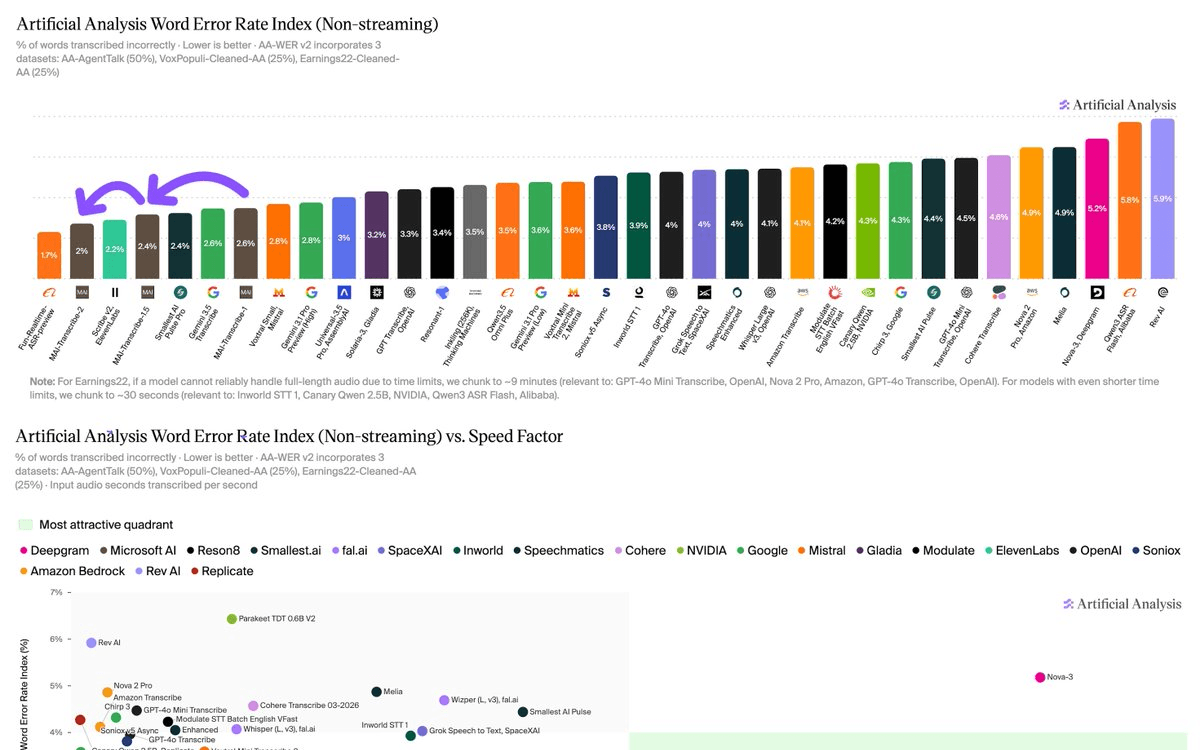
- Microsoft AI released MAI-Transcribe-2, ranking #2 on Artificial Analysis with 2.0% AA-WER.
- Priced at $0.10/hour ($1.67 per 1,000 min), roughly half the cost of Scribe v2.
- Processes audio at 410.7x real time, second only to Deepgram Nova-3 in speed.
- Language support expanded to 60, up from 43 in the prior version.
- Adds speaker diarization, word-level timestamps, and clean vs verbatim transcription modes.
- Available in Azure Speech Fast Transcription API public preview, no SLA yet.
Microsoft AI just dropped a speech-to-text model that undercuts almost everyone on price while landing near the top of the accuracy charts. MAI-Transcribe-2 is now in public preview on Microsoft Foundry, and the numbers on the Artificial Analysis leaderboard tell an aggressive story.
The headline numbers
On the AA-WER benchmark, MAI-Transcribe-2 ranks second overall with a 2.0% word error rate, behind Alibaba's Fun-Realtime-ASR-preview (1.7%) and ahead of ElevenLabs Scribe v2 (2.2%). The per-dataset breakdown: 1.8% WER on AA-AgentTalk, 1.5% on VoxPopuli-Cleaned-AA, and 3.0% on Earnings22-Cleaned-AA.
Speed is the other standout. The model processes audio at 410.7x real time, meaning a one-hour recording finishes in under nine seconds. That's roughly 1.5x faster than Smallest AI Pulse Pro and more than 7x faster than Scribe v2, second only to Deepgram Nova-3 (572.8x) on raw throughput.
The pricing shock
Microsoft is offering MAI-Transcribe-2 at a promotional price of $0.10 per hour of audio through the end of 2026, working out to $1.67 per 1,000 minutes. That's a 72% cut from the $0.36 per hour Microsoft charged five months ago for the first model in this line. For an enterprise processing 100,000 hours of call-center audio annually, the annual bill falls from $36,000 to $10,000. Here's how the top of the accuracy chart compares:
| Model | AA-WER | Speed Factor | Price / 1K min |
|---|---|---|---|
| Fun-Realtime-ASR-preview | 1.7% | - | - |
| MAI-Transcribe-2 | 2.0% | 410.7x | $1.67 |
| ElevenLabs Scribe v2 | 2.2% | 54.7x | $3.67 |
| Smallest AI Pulse Pro | 2.4% | 273.5x | $4.00 |
| Gemini 3.5 Transcribe | 2.6% | 89.7x | $5.00 |
| GPT Transcribe (OpenAI) | 3.3% | 40.0x | $4.50 |
What's actually new
MAI-Transcribe-2 ships with the full production feature set: speaker diarization, word-level timestamps, automatic language identification, keyword biasing, code switching, noise robustness, and two configurable transcription styles. Clean mode strips filler words and false starts for readable meeting notes and captions. Verbatim mode preserves them for legal or clinical records where the exact utterance matters.
Language coverage expanded significantly. The model handles 60 languages, up from 43 in June's MAI-Transcribe-1.5 and 25 in the April original. Microsoft claims first place on the multilingual FLEURS benchmark with a 5.2% average WER across those 60 languages, beating Whisper-Large-V3, GPT-Transcribe, Scribe v2, and Gemini 3.5 Transcribe.
How to plug it in
Access runs through Azure Speech's Fast Transcription API in enhanced mode, with the model selected by setting the enhanced mode model property to MAI-Transcribe-2. You can also test it interactively in the MAI Playground. One caveat before wiring it into anything critical: Microsoft's documentation lists MAI-Transcribe-2 as a public preview without a service-level agreement and explicitly not recommended for production workloads.
Where it fits
The workloads Microsoft is targeting are predictable given the price and speed profile:
- Call-center and contact-center documentation, especially at scale
- Meeting notes and video captioning with word-level timestamps
- Clinical documentation and voice-agent listening layers
- Localization pipelines needing broad language coverage
- Searchable archives of long-form audio
Sitting on both the accuracy and latency frontier makes MAI-Transcribe-2 a natural fit as the listening layer for conversational AI, pairing with MAI-Voice-2 Flash to close the loop from speech in to speech out. For voice agents specifically, the 410x batch speed factor matters less than tail latency on short utterances, so benchmark against your actual audio before committing.
The third model in five months
Each release in Microsoft AI's transcription line has cut price while pushing accuracy up, fitting a broader pattern under Mustafa Suleyman of building first-party frontier models across modalities to reduce dependence on OpenAI. For anyone paying five or six figures a year for transcription today, the math has shifted enough to justify a fresh evaluation, preview-tier caveats included.
Comments
