
Microsoft's MAI-Transcribe-1.5 Transcribes an Hour of Audio in 15 Seconds
Microsoft's MAI-Transcribe-1.5 hits #3 on accuracy benchmarks while processing audio more than twice as fast as any comparable model
Takeaways
- Speed record in the accuracy tier: MAI-Transcribe-1.5 runs at ~276x real-time, more than double the next fastest model in the top-10 accuracy bracket.
- Top-3 accuracy: 2.4% AA-WER on the Artificial Analysis leaderboard; #1 on the FLEURS multilingual benchmark across 43 languages.
- Keyword biasing cuts errors 30%: Supply up to 200 domain-specific terms (names, medical jargon, acronyms) and the model applies them contextually.
- Pricing: $6 per 1,000 minutes ($0.36/hr) via Microsoft Azure Foundry; same price as GPT-4o Transcribe but far faster.
- Already in production: Powers Copilot, Teams, GitHub, Dynamics 365 Contact Centre, Bing, and PowerPoint.
- Key gaps: No diarization (speaker labeling) yet; no native streaming API -- batch-only for now.
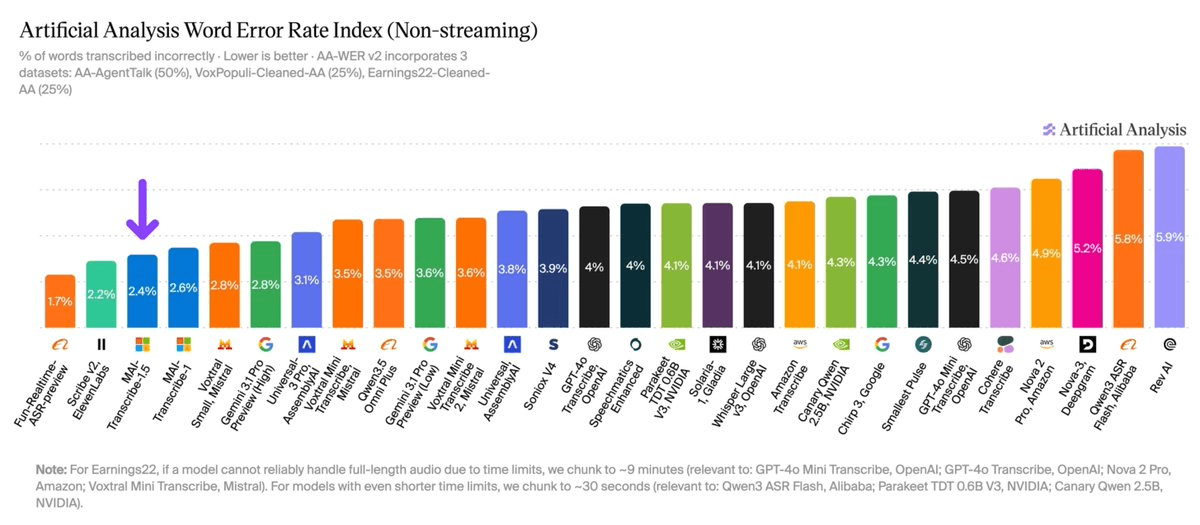
Microsoft's in-house AI lab just dropped MAI-Transcribe-1.5, a speech-to-text model that makes a compelling case for a claim the industry rarely gets to make: you don't have to choose between fast and accurate. The model lands at #3 on the Artificial Analysis Word Error Rate (AA-WER) leaderboard with a 2.4% error rate, while simultaneously being the fastest model in that top-10 accuracy tier by a wide margin.
Lapping the competition on speed
MAI-Transcribe-1.5 stands out as the fastest STT model in the top 10 for accuracy, processing audio at ~276x real-time -- more than double the speed of the second fastest model in that accuracy tier. To put that in concrete terms: it can transcribe one hour of audio in under 15 seconds, down from 53 seconds with its predecessor.
MAI-Transcribe-1.5 is now up to 5x more efficient than Gemini 3.1 Flash, Scribe V2, and GPT-4o-Transcribe on the Artificial Analysis leaderboard. The speed gains come specifically from improvements in how the model handles long-form audio, which is where most production workloads actually live.
Where it sits on the leaderboard
MAI-Transcribe-1.5 comes in at 3rd overall on the Artificial Analysis AA-WER leaderboard, behind Alibaba's Fun-Realtime-ASR-preview (1.7% WER) and ElevenLabs Scribe v2 (2.2% WER). But the accuracy story is stronger on the multilingual front. On the FLEURS benchmark across 43 languages, MAI-Transcribe-1.5 achieves an average WER of 4.86%, beating ElevenLabs Scribe v2 (5.53%), OpenAI's transcription model (5.73%), and Google Gemini Flash Lite (5.63%).
Here's how the top models compare on the key dimensions that matter for production use:
| Model | AA-WER | Speed Factor | Price (per 1k min) |
|---|---|---|---|
| Fun-Realtime-ASR-preview (Alibaba) | 1.7% | -- | $0.00 |
| Scribe v2 (ElevenLabs) | 2.2% | 33.7x | $3.67 |
| MAI-Transcribe-1.5 (Microsoft) | 2.4% | 242x | $6.00 |
| Universal-3 Pro (AssemblyAI) | 3.1% | 83.3x | $3.50 |
| GPT-4o Transcribe (OpenAI) | 4.0% | 32.2x | $6.00 |
The keyword biasing feature is the sleeper upgrade
Speed and accuracy are the headline numbers, but the most practically useful addition in 1.5 is keyword biasing. This is a feature where you supply the model a list of domain-specific terms -- up to 200 of them -- and the model uses that context to decide when to apply them rather than blindly forcing matches.
A major challenge for transcription models is failure on domain-specific words that often matter most to users -- including people and product names, medical terms, internal acronyms, and customer-specific vocabulary that are critical for enterprises. The model uses shared context to decide when keyword biasing should apply, which dramatically improves recognition of specialized vocabulary while maintaining accuracy on general speech -- yielding a 30% reduction in WER on the FLEURS multilingual benchmark.
The effect is striking in practice. Without biasing, a name like "Aoife" gets transcribed as "Oif". With a keyword list supplied, it comes through correctly. The same applies to medical terminology, brand names, and internal jargon that general models consistently mangle.
What it's built for
MAI-Transcribe-1.5 delivers consistently strong transcription accuracy across 43 languages, accents, speaking styles, and noisy environments, with faster inference. The model card lists the primary use cases as:
- Meeting transcription and call center analytics
- Video subtitling and media archiving at scale
- Accessibility tooling for deaf and hard-of-hearing users
- E-learning content with lecture transcripts
- Voice agents that need fast, accurate speech understanding
One important caveat: diarization is not supported yet. Diarization -- the ability to label who said what in a multi-speaker recording -- is listed as a planned upcoming feature. If you need speaker attribution today, this model isn't the right fit.
Baked into the Microsoft stack
MAI-Transcribe-1.5 is being integrated into Copilot, Teams, GitHub, and Dynamics 365 Contact Centre, and is also available in Foundry. These are the same models already powering experiences across Copilot, Bing, PowerPoint, and Azure Speech, and are now available in Foundry for developers to build with. That means most Microsoft enterprise customers are already getting it without a separate integration step.
How to use it
You can access MAI-Transcribe-1.5 via the Azure Speech SDK, or use the REST API directly to access the Speech service. The model accepts WAV, MP3, and FLAC files up to 300 MB or 2 hours in length. A basic REST call looks like this:
curl --location 'https://YourResourceName.cognitiveservices.azure.com/speechtotext/transcriptions:transcribe?api-version=2025-10-15' \
  --header 'Ocp-Apim-Subscription-Key: <YourSpeechResourceKey>' \
  --form 'audio=@"YourAudioFile.wav"' \
  --form 'definition={
    "enhancedMode": {
      "enabled": true,
      "model": "mai-transcribe-1.5"
    }
  }'
To add keyword biasing, include a phraseList in the definition object with your domain-specific terms. By default, the model returns a readability-optimized transcript. You can set the value to verbatim to preserve the original spoken content, including filler words and disfluencies.
Pricing and what's missing
MAI-Transcribe-1.5 is available at $6 per 1,000 minutes of audio via Microsoft Foundry -- which works out to $0.36 per hour. That puts it at the same price point as OpenAI's GPT-4o Transcribe, but with roughly 7.5x the throughput speed. The model is served globally from three regions: Central US, Sweden Central, and Southeast Asia.
The roadmap Microsoft has shared is worth noting. Entity biasing was a heavily requested feature from customers, and a long-standing failure mode for general speech models in sports, business, medical, and technical workflows. Coming next are diarization, a native streaming API for real-time transcription, and expanded language depth. The streaming gap is the most significant current limitation for anyone building live voice applications -- for now, this remains a batch-first model.
For teams already in the Azure ecosystem, MAI-Transcribe-1.5 is a straightforward upgrade. For everyone else, it's a serious contender that redraws the accuracy-speed tradeoff curve in a way the field hasn't seen before.