

Microsoft's MAI-Transcribe-1.5 Transcribes an Hour of Audio in 15 Seconds
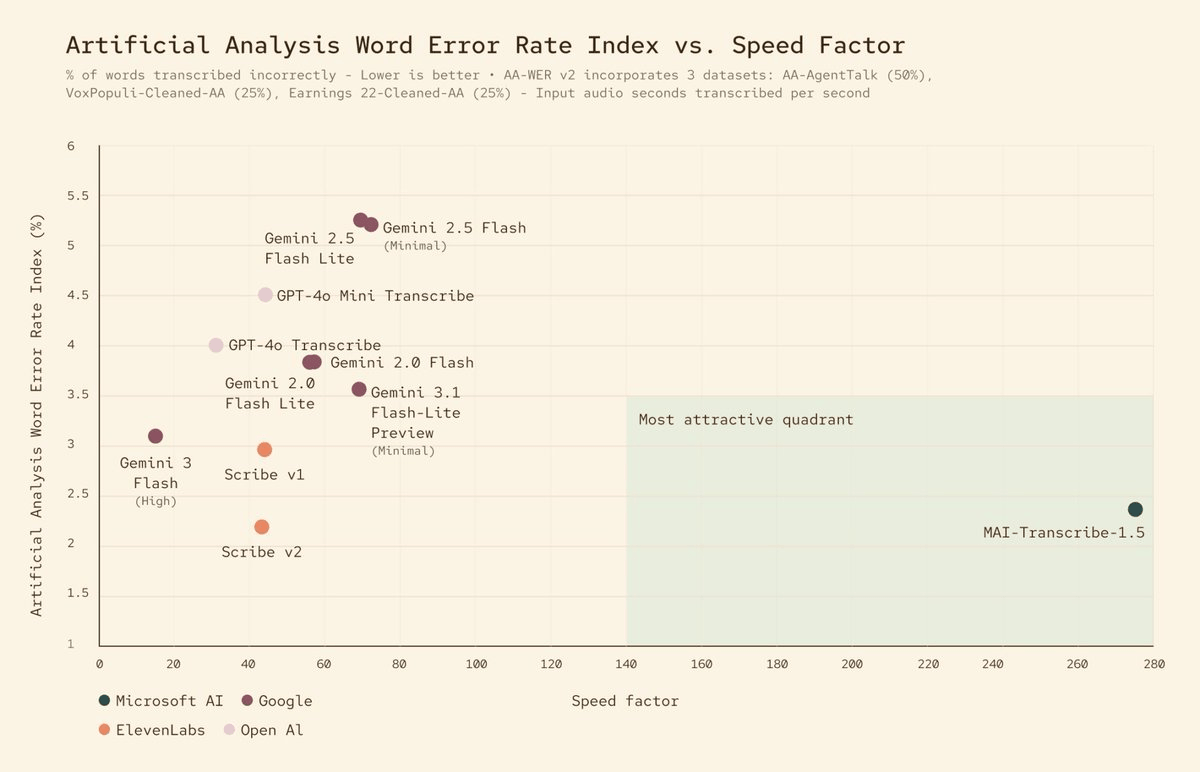
Microsoft's new speech-to-text model hits 2.4% word error rate on Artificial Analysis, transcribes an hour of audio in under 15 seconds, and supports 43 languages.

- Microsoft launched MAI-Transcribe-1.5, a multilingual speech-to-text model with 2.4% WER on Artificial Analysis.
- Transcribes one hour of audio in under 15 seconds, up to 5x faster than competing models.
- Supports 43 languages, up from 25 in the previous version, with best-in-class FLEURS WER.
- Keyword biasing cuts WER by 30% on domain-specific vocabulary like names and acronyms.
- Available on Microsoft Foundry and OpenRouter at $0.36 per hour of audio.
- Roadmap adds diarization, a native streaming API, and broader language coverage next.
Microsoft's Superintelligence team has shipped MAI-Transcribe-1.5, a speech-to-text model that pushes the accuracy-speed Pareto frontier hard enough to make most production transcription stacks worth re-evaluating. It hits a Word Error Rate of 2.4% on the Artificial Analysis leaderboard, taking the #3 position in that benchmark, while running fast enough to turn an hour of audio into text in roughly the time it takes to refill a coffee.
The accuracy-speed tradeoff, quietly broken
Transcription models have historically forced an awkward choice: high accuracy meant slow batch jobs, while fast streaming models gave up word-level precision. MAI-Transcribe-1.5 now leads on Accuracy x Speed on the Artificial Analysis leaderboard, running up to 5x faster than models of comparable accuracy. The impact shows up most on long audio, where the model can transcribe an hour of audio in under 15 seconds.
On FLEURS, the standard multilingual benchmark, the model achieves best-in-class Word Error Rate across 43 languages. Coverage expanded by 18 new languages without compromising accuracy, jumping from the 25 supported in the prior version.
Keyword biasing for domain vocabulary
The most interesting feature for enterprise builders is keyword biasing. A major challenge for transcription models is failing on domain specific words, which often matter the most to users. These include people and product names, medical terms, internal acronyms, and customer-specific vocabulary.
Instead of brute-forcing every match, the model biases its predictions toward a list of domain specific keywords provided by the user. It does not blindly force matches; it uses shared context to decide when keyword biasing should apply. The example in Microsoft's writeup shows a meeting transcript where uncommon names like "Aoife," "Xochitl," and "Søren" go from garbled approximations to clean recognition once the keyword list is provided.
With keyword biasing enabled, Microsoft reports a 30% reduction in Word Error Rate on the FLEURS multilingual benchmark. For domains like medical dictation, legal transcription, or call centers with branded product catalogs, that delta is the difference between something you can ship and something you have to manually correct.
Production-grade conditions
Microsoft is pitching this as built for audio in the wild, meaning noisy backgrounds, overlapping speakers, accents, and rapid speech. The model includes optimizations for real-world use cases such as handling transcription with noisy backgrounds. That positioning matters because benchmark numbers on clean read-speech corpora rarely survive contact with actual call-center audio or field recordings.
Access and pricing
The model is live on Microsoft Foundry and OpenRouter at $0.36 per hour of audio. It's being integrated into Copilot, Teams, GitHub, and Dynamics 365 Contact Centre, and is also available in Foundry as the fastest, most efficient, and most cost-effective transcription model among the hyperscalers. You can try it directly in the MAI Playground.
What's still missing
The current release is batch-first, which limits its use for live voice agents and real-time captioning. Microsoft has flagged three things on the near-term roadmap:
- Diarization, the ability to identify who said what in multi-speaker audio, essential for meetings, interviews, and call center analytics.
- A native streaming API enabling real-time transcription for live applications and voice agents, moving beyond the current batch-first approach.
- Expanded language support, giving each new language the same depth of accuracy and robustness as the existing 43.
If you're running production transcription on Whisper, GPT-4o-Transcribe, Gemini 3.1 Flash Lite, or ElevenLabs Scribe v2, the speed delta alone is worth a head-to-head test, especially for long-form batch workloads. The keyword biasing API also closes a gap that previously required custom fine-tuning or post-hoc text correction pipelines, which makes it a credible drop-in for vertical-specific transcription use cases without the usual MLOps overhead.