

Microsoft's MAI-Thinking-1 Beats Claude Without Copying a Single Reasoning Trace
Microsoft's first homegrown reasoning model lands at 35B active params, hitting 97% on AIME 2025 and matching Claude Opus 4.6 on SWE-Bench Pro.
- Microsoft launched MAI-Thinking-1, its first in-house reasoning model, a 35B-active / 1T-total MoE.
- Scores 52.8% on SWE-Bench Pro, matching Claude Opus 4.6 on agentic coding.
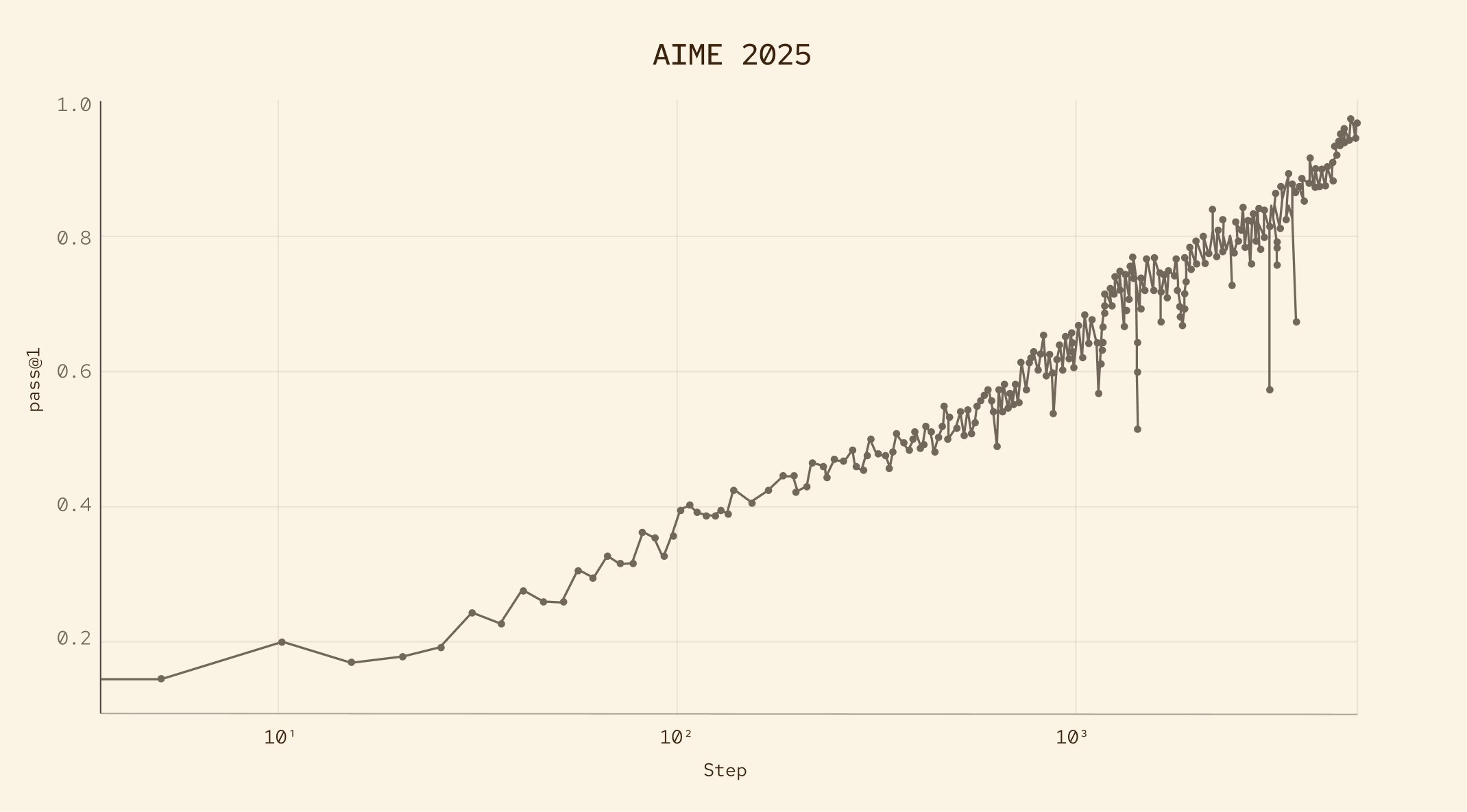
- Hits 97.0% on AIME 2025 and 94.5% on AIME 2026 for math reasoning.
- Preferred over Claude Sonnet 4.6 in a 1,276-task blind human evaluation with Surge.
- Trained without distillation from third-party models, on clean licensed data with no AI-generated pre-training content.
- Available in private preview on Microsoft Foundry, with 256k context and Chat Completions API compatibility.
Microsoft has shipped its first reasoning model built entirely from scratch inside the company. MAI-Thinking-1 is a sparse Mixture-of-Experts model that the MAI team trained without copying chain-of-thought traces from OpenAI, Anthropic, or anyone else, and the numbers suggest the gamble paid off. It matches Claude Opus 4.6 on a hard software engineering benchmark, scores 97% on AIME 2025, and beats Claude Sonnet 4.6 in blind human comparisons.
This is a notable departure from the standard playbook of distilling a stronger teacher into a smaller student. MAI-Thinking-1 was trained without distillation from third party models, forcing the model to truly learn the tasks at hand. For a company that has spent years routing its consumer and enterprise AI through OpenAI, that is a statement of independence.
A medium model punching at the top weight class
The architecture is a 35B-active, ~1T-total parameters, sparse Mixture of Experts model. In an MoE, only a fraction of the network's experts fire on any given token, so inference cost tracks the active parameter count rather than the total. That means MAI-Thinking-1 runs closer to a 35B-class model in latency and memory while drawing on a trillion-parameter knowledge base.
The headline benchmark is SWE-Bench Pro, which tests whether a model can resolve real GitHub issues end to end. MAI-Thinking-1 lands at 52.8%, which the team says is competitive with Claude Opus 4.6, a much larger frontier model. That matters for developers and enterprises because model size determines where advanced coding assistance can be deployed, how often it can be used, and whether it can move from exceptional tasks into daily workflows.
On the math side, MAI-Thinking-1 hits 97.0% on AIME 2025, and 94.5% on AIME 2026, putting it in the same tier as the dedicated math-reasoning models from the major labs. The training curve below shows the pass rate climbing from a near-random baseline to ceiling over the course of reinforcement learning.
The hill-climbing machine
Microsoft calls its training stack a Hill-Climbing Machine. More than a single model, the team is introducing a co-designed pipeline built to make every component of model development climbable, so capabilities improve continually and reliably over time. The pitch is that data, rewards, environments, and compute can each be swapped out and improved independently without breaking the loop.
Three principles drive it:
- Capabilities are learned, not inherited. No distillation from third-party models, on the theory that an imitator is fundamentally tied to the design choices of its teacher and struggles to adapt to new situations.
- Clean data lineage. MAI-Thinking-1 was trained on clean and appropriately licensed data, with AI-generated content excluded from pre-training. That cuts off a known source of model collapse and clarifies provenance for enterprise buyers worried about copyright.
- End-to-end self-sufficiency. From co-design with Microsoft's own accelerators through to the reinforcement learning framework, the team has focused efforts on in-house training infrastructure.
RL without a reasoning warm-start
The most interesting technical claim is in how the reasoning behavior emerged. According to Microsoft's thread, the long reinforcement learning run started from a checkpoint that had never seen a chain-of-thought trace during pre-training. The RL phase is what teaches the model to think step by step, to call tools, to interact with environments, and to respect preference and safety signals all at once.
For coding specifically, the team built executable training environments rather than relying on static problem sets. Each verified environment is deterministic, executable, and graded by real test suites. This gives the model practice on the kind of multi-step work developers actually do: reading code, editing files, running tests, observing failures, and recovering from intermediate mistakes. That is the recipe behind the SWE-Bench Pro number.
Beating Sonnet 4.6 in blind taste tests
Benchmarks are one thing, but Microsoft also ran a human preference study with annotation vendor Surge. The evaluation spanned 1,276 tasks across a wide variety of use cases in both single-turn and multi-turn conversations, with a focus on measuring how helpful each response is and whether it actually advances the user's goals. Raters preferred MAI-Thinking-1 over Claude Sonnet 4.6 overall.
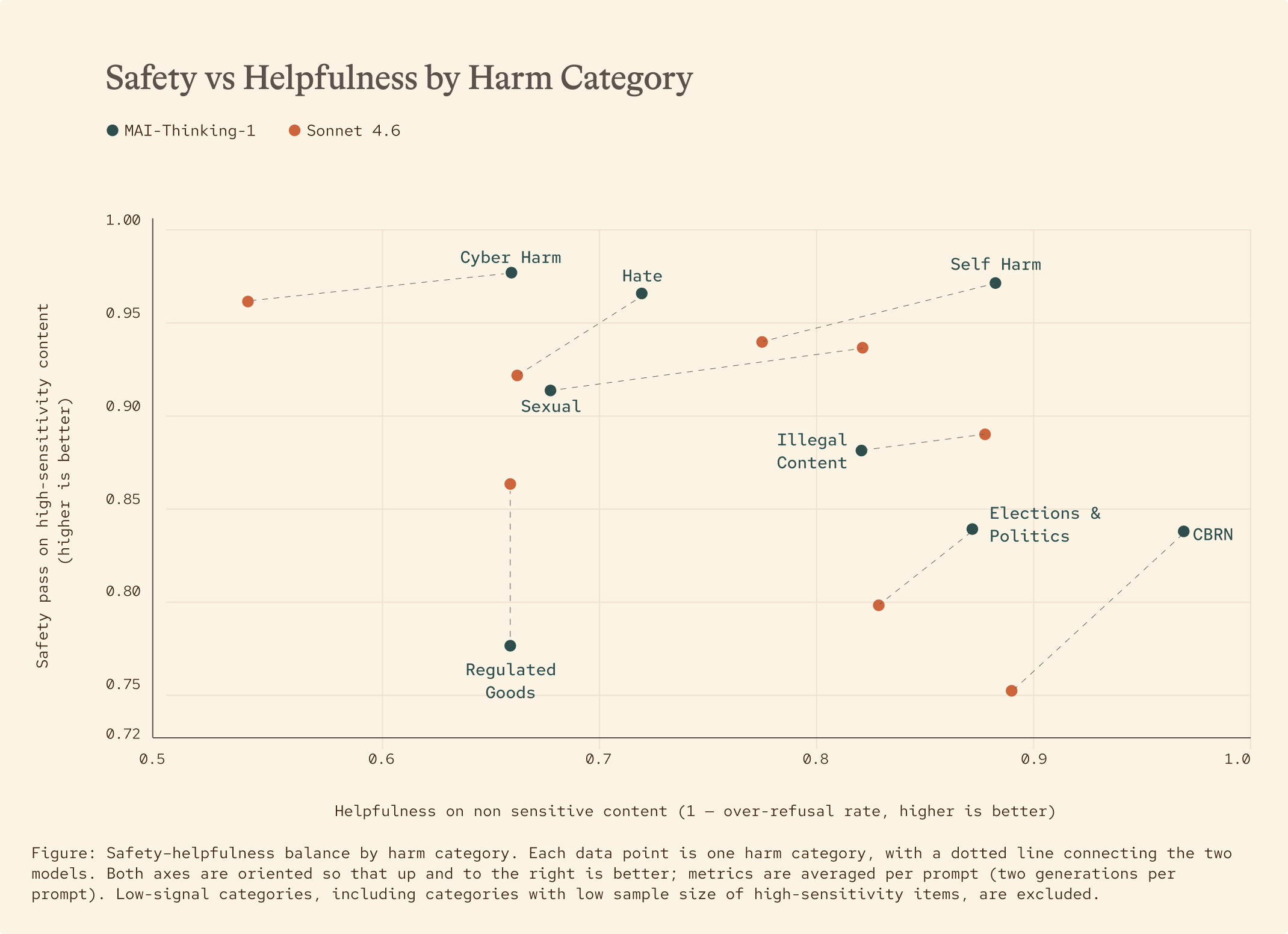
Microsoft is also pitching a more permissive safety posture. The team frames over-refusal as a defect on equal footing with unsafe compliance. Safety is trained with the same reinforcement learning infrastructure used for capability, so safety rewards are part of the same hill-climbing loop ensuring safety is always aligned to the capabilities and not incidental.
What you can actually do with it
Practical specs developers will care about:
- Context window: 256k tokens, enough to fit a 600 page document.
- Tool use: Native function calling and developer instruction layers.
- API surface: Compatible with the Chat Completions API, so existing OpenAI-style client code should drop in.
- Deployment: Enterprise security and compliance through Microsoft Foundry.
The natural fit is agentic coding work and STEM-heavy reasoning tasks where a smaller, cheaper model than Opus or GPT-5 class systems is appealing. Multi-turn refactors, test generation, document analysis over long contexts, and math or scientific problem solving all sit in the sweet spot. It will be less interesting if you need image input, audio, or the long tail of general-knowledge trivia where the bigger frontier models still have an edge.
Availability
MAI-Thinking-1 is in private preview on Microsoft Foundry now, with public preview on MAI Playground promised soon. Microsoft's announcement thread also flagged hosting partners Fireworks AI and Baseten as upcoming endpoints, which is the first time MAI has shipped a flagship outside its own infrastructure. Pricing has not been disclosed for any of those surfaces yet.
The industry signal
Strategically, this matters more than another point on the SWE-Bench leaderboard. Microsoft has been the largest distribution channel for OpenAI's models, and shipping a competitive in-house reasoner with clean data lineage gives it an alternative to fall back on for Copilot, Azure, and enterprise customers nervous about training data lawsuits. The clean-data and no-distillation story is also a direct pitch to regulated industries, where being able to account for every token that shaped a model is increasingly a procurement requirement.
The other shift worth noting is the framing of reinforcement learning as the central training loop rather than a polish step on top of pre-training. If MAI-Thinking-1's results hold up under independent testing, it adds to a growing pile of evidence that RL on verifiable environments, started from a non-reasoning base, can match what the field assumed required massive supervised chain-of-thought corpora distilled from existing frontier models.
Comments
